

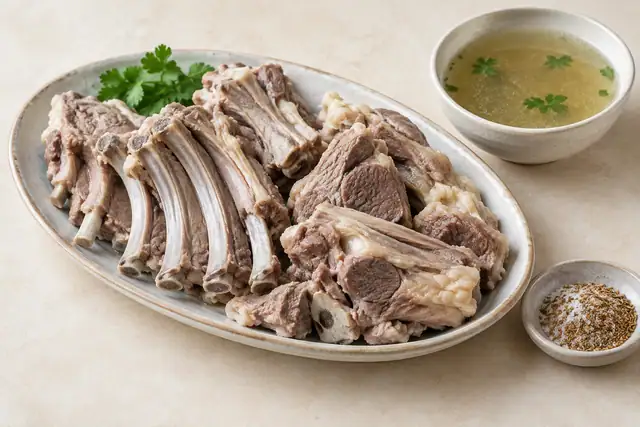
Hand-Grabbed Mutton 手抓羊肉
Hand-Grabbed Mutton is featured among the local specialties of Gansu.


Photo adjustments
EXIF orientation applied where present; resized proportionally to at most 640 px on the long edge and encoded as WebP. No crop, retouching, recoloring or subject changes.
Hand-Grabbed Mutton (手抓羊肉) is mutton boiled in large pieces and served with dips, which the Lanzhou (兰州) local chronicles office lists among the city's noted specialities and records as originally a dish of the Tibetan and Hui peoples. Around Lanzhou it is especially associated with Yongdeng County (永登县), and above all with the town of Wushengyi (武胜驿).
How it is made
The Yongdeng county government describes the Wushengyi version as grass-fattened sheep (草膘羊) from the upland pastures, cooked by Hui chefs in the traditional way with ginger, Sichuan pepper, fennel, sand ginger (三奈, sannai) and tsaoko (草果, caoguo), plus chopped spring onion and more Sichuan pepper. The boiled mutton comes to the table in large pieces together with dishes of mashed garlic, chilli oil and coriander, and the meal comes with its own condiments, side dishes and eight-treasure tea (八宝茶).
Flavour and texture
The Lanzhou chronicles office notes that alkali brush (碱柴, jianchai) grows in parts of Yongdeng, and that mutton from sheep feeding mainly on it has no gamey smell, is not greasy and keeps its aroma for a long time, which is why it is particularly sought after. Lanzhou Daily describes the Wushengyi sheep as free-grazing on the grassland and the meat as fresh and full of flavour.
Where it comes from
Yongdeng has been home to several ethnic groups since ancient times, which the chronicles office gives as the reason Hand-Grabbed Mutton is so widely accepted and valued there. Wushengyi was an important post station on the ancient Silk Road and is the northern gateway of Lanzhou. Hui families settled there at the end of the Ming and the beginning of the Qing, and the town's restaurant trade grew out of Muslim-style hand-grabbed mutton; after some forty years of business a street of mutton restaurants has formed, which Lanzhou Daily puts at close to a hundred.
The Lanzhou city government listed Wushengyi hand-grabbed mutton (武胜驿手抓) as a municipal intangible cultural heritage item in 2015, and in April 2016 the CCTV Chinese international channel programme on the Great Wall region featured the post station and its mutton.
More dishes to compare
Explore related local specialties and compare their names, preparation notes and ordering guidance.
Sunan Hand-Grabbed Mutton 肃南手抓羊肉 →
Sunan Hand-Grabbed Mutton comes from the Yugur herding county of Sunan in Zhangye, while the Lanzhou dish is documented around the Hui mutton restaurants of Wushengyi in Yongdeng, with its own spice set and a 2015 municipal heritage listing.
Sources & reading
Written from the linked sources and checked sentence by sentence against quoted extracts by a separate reviewer on 2026-09-23. Recipes and servings vary between kitchens.