

Baijiao Sea Bass 白蕉海鲈
Baijiao Sea Bass is the regional sea bass of Zhuhai’s Doumen District, named for Baijiao Town at the Pearl River estuary. It is best understood as a working aquaculture-and-food tradition: fine-fleshed fish is commonly served whole, while post-harvest diaoshui holding and Tanka salting show different local ways of handling it.
Where the name comes from
Baijiao Sea Bass is named for Baijiao Town (白蕉镇) in Doumen District (斗门区), Zhuhai (珠海). Baijiao sits between the Modaomen and Jitimen waterways at the Pearl River estuary, where river and sea waters meet. The area’s fish ponds, channels and warm, low-lying farming landscape are part of the story behind the name, not just a label added after the fish reaches a restaurant.
The product received national geographical-indication protection in 2009, and Baijiao was named China’s “Home of Sea Bass” in 2011. The current local management definition is broader than the town that supplied the name: it covers qualifying sea bass produced and processed within present-day Doumen District, including Jing’an, Baijiao, Doumen, Qianwu and Lianzhou towns and Baiteng Subdistrict. A fish sold under the name is therefore not automatically a product of one particular pond or one particular restaurant.
What to taste
The local descriptions emphasise pale, fine-textured flesh with a tender, lightly sweet character. Whole-fish cooking lets you notice that texture most directly. Steaming is a useful first order, but it is a cooking style rather than a fixed Baijiao standard: a 2013 report quoting chefs from the Baijiao Town Fisheries Association gives a reference version with spring onion, ginger, shiitake and bamboo shoots, followed by a light soy, vinegar and oyster-sauce mixture. The report is a recipe example, not a promise that every kitchen uses the same ingredients or timing.
Baijiao’s food culture also includes ways of handling the fish after it leaves the pond. “Diaoshui” (吊水) is a short holding or conditioning stage in circulating-water tanks; one Doumen account describes newly harvested fish being held for about ten days to reduce muddy notes. A separate Tanka (疍家) salted-fish technique, listed as a Doumen district-level intangible cultural-heritage item in 2022, shows how preservation and seasoning belong to the local story as well. These are different preparations, so ask whether a menu is offering freshly cooked fish, diaoshui-conditioned fish, or a salted or processed product.
No preparation should be treated as automatically boneless, vegetarian, halal, or free of allergens. Ask about the fish, sauce, stock and any preserved ingredients if you have an allergy or dietary restriction.
Practical tips
Keep the Chinese name 白蕉海鲈 handy when asking a restaurant or seafood seller what it is serving.
Where to eat it
You can find Baijiao Sea Bass all over Guangdong, so there is no need to seek out one particular restaurant. To find one near you, search for “白蕉海鲈” in Meituan (美团) or Amap (高德地图) and check recent reviews, distance and opening hours.
Sources & reading
Image credits & notes (1)
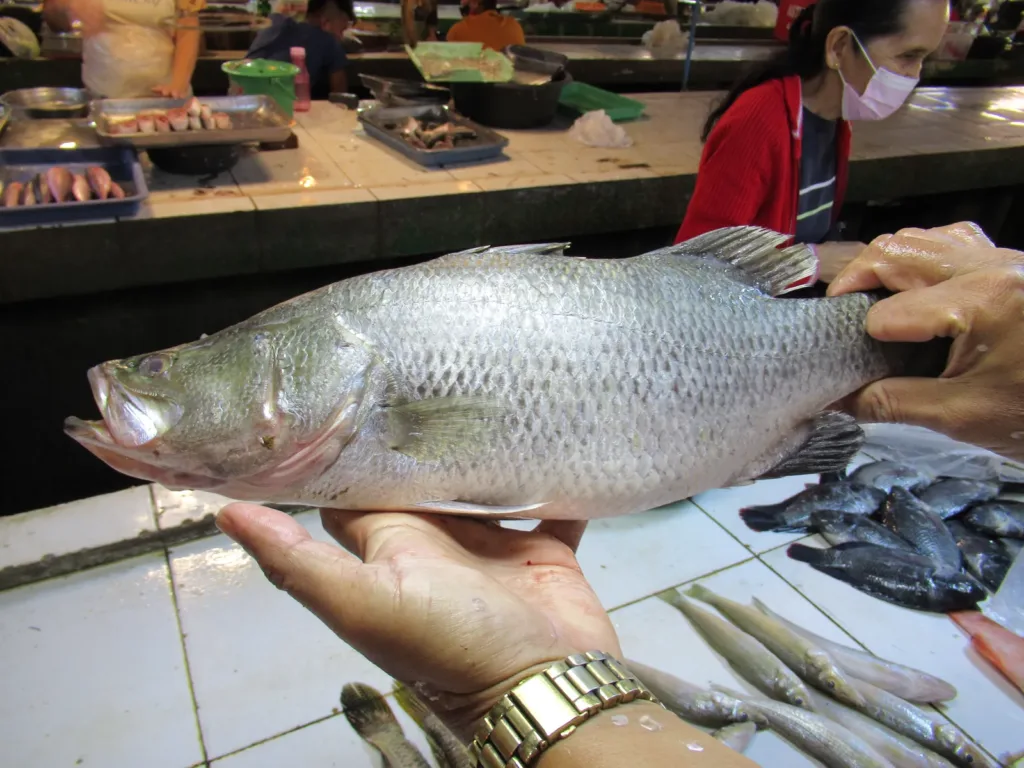
- Illustrative Asian sea bass (Lates calcarifer) at a Philippine fish market; this is a species/food reference image, not a photograph identified as Baijiao Sea Bass or sourced in Zhuhai. Photo: FBenjr123Photo: CC BY-SA 4.0