

Sticky rice 糯米饭
Qiandongnan Sticky rice (糯米饭) is a regional glutinous-rice food tied to Miao and Dong farming and festival life: it may be steamed or coloured with plant-based juices, while the stuffed, lard-fried version is a distinct Guiyang street style.
Tap any red Chinese text to hear it in Mandarin.
What the name covers
The Chinese name to show or type is 糯米饭 Nuò Mǐ Fàn. In Qiandongnan, glutinous rice is not just a snack. The region has a long history of growing glutinous rice, and an official account describes rice, rice wine, festival food and gifts to relatives as part of local life. It also describes Qiandongnan as a centre of “糯禾” culture rather than assigning every sticky-rice dish to one fixed recipe.
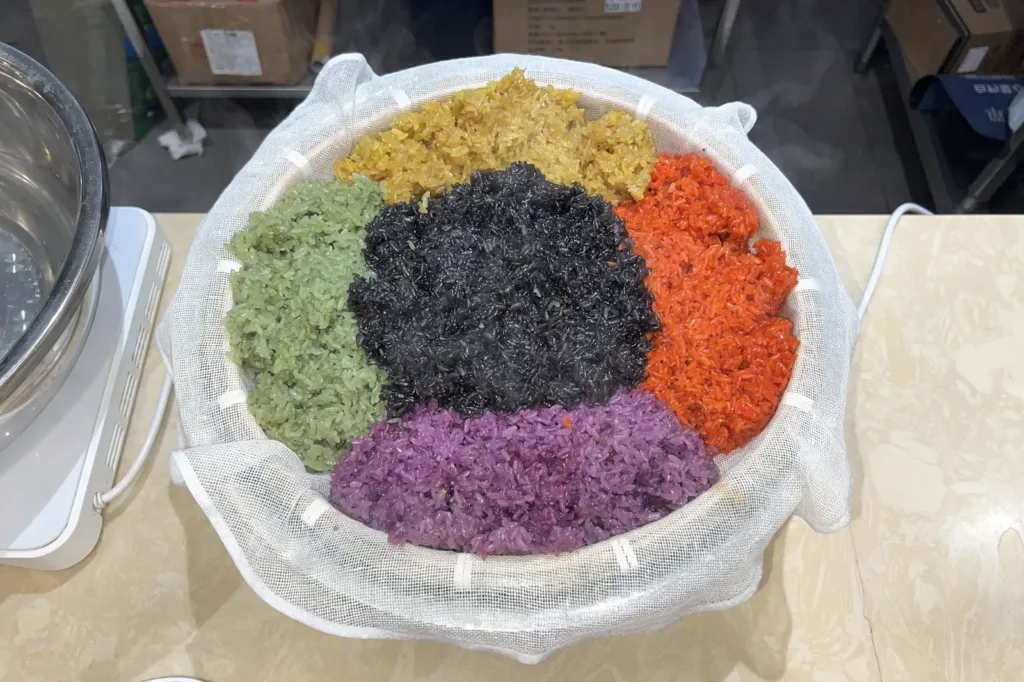
One visible local preparation is 苗家彩色糯米饭 Miáo Jiā Cǎi Sè Nuò Mǐ Fàn or 五色糯米饭 Wǔ Sè Nuò Mǐ Fàn. A Qiandongnan government food guide describes glutinous rice coloured with plant materials such as maple leaves, gardenia and indigo, then steamed. The result is soft and lightly sweet, with a plant-like aroma. The plants, shades and serving context can vary, so colour alone is not an ingredient list.
A useful distinction within Guizhou
Do not assume that every dish labelled 糯米饭 in the province is the same preparation. Guiyang has a street-breakfast version in which glutinous rice is stir-fried with lard and soy sauce, then wrapped around fillings such as crisp pork pieces (脆哨), shredded potato, pickled radish, chilli oil, kelp, peanuts, white sugar, bean flour or 甜引子. That combination gives a sticky, fragrant mouthful with sour, sweet, salty and hot notes. It is a documented Guiyang style, not a universal definition of Qiandongnan sticky rice.
In Qiandongnan, the more useful way to read the dish is through the rice itself and its setting. Steamed or coloured rice may be part of a meal, a seasonal food tradition or a festival table. The official regional account links glutinous rice with major festivals, hospitality and gift-giving, but that cultural history does not mean that every ordinary takeaway portion carries a ceremonial meaning.
How to look for it
This is a regional dish, not a single venue, so there is no one restaurant, address, opening time or “most authentic” shop to recommend. To find a current serving without treating a platform ranking as an endorsement:
- In Meituan (美团) or Amap/Gaode Maps (高德地图), search the exact Chinese name 糯米饭 Nuò Mǐ Fàn. If you want the coloured preparation, also try 五色糯米饭 Wǔ Sè Nuò Mǐ Fàn or 苗家彩色糯米饭 Miáo Jiā Cǎi Sè Nuò Mǐ Fàn, and set the map area to your current town or destination.
- Open the current menu or listing and confirm that the Chinese name appears as a dish. Do not rely on a colourful photograph alone. Read recent reviews for evidence that the dish was served recently, check the current opening status, and verify same-day supply in the listing’s phone or message channel before travelling.
- Ask a practical question before ordering: “今天有糯米饭吗?是蒸的五色糯米饭,还是贵阳式猪油酱油炒糯米饭?用了哪些配料?” This separates the Qiandongnan-style steamed or coloured preparation from the Guiyang stuffed street style.
- If you avoid pork or lard, peanuts, chilli, animal stock or preserved ingredients, ask what is in that day’s serving. For vegetarian, vegan or halal requirements, do not infer suitability from the word 糯米饭 or from the rice’s colour. Recipes and accompaniments vary between kitchens.
- After choosing a live food listing, use Amap’s route button from your actual starting point. Amap supports driving, public transport, walking and cycling, but its own guidance notes that public-transport results can differ because of real-time conditions, timetable changes, construction or temporary diversions. Recheck the route and the food listing on the day.
Practical limits
There is no dish-wide ticket, entrance, reservation system, fixed address or return route. The location and transport fields for this entry are therefore intentionally left unassigned. If you are planning around a festival or a seasonal village event, confirm the latest local announcement and the food arrangement separately; historical descriptions do not establish future dates or guaranteed supply. For an everyday meal, the most reliable plan is to search 糯米饭 Nuò Mǐ Fàn in Chinese, inspect the current menu and recent reviews, and confirm that the portion you want is available that day.
Sources & reading
Image credits & notes (1)
- Five-colour glutinous rice at a Guangxi-style restaurant in Beijing, photographed on 31 March 2025; a regional example, not a photograph of Qiandongnan. Photo: N509FZPhoto: CC BY-SA 4.0