

Pingba Air-Dried Beef 平坝牛干巴
Pingba Air-Dried Beef (平坝牛干巴, Pingba niu ganba) is a salted, cured and air-dried beef specialty associated with Pingba District in Anshun. Its character is concentrated beef flavour and a firm, chewy bite, with versions served as a banquet dish or a snack rather than a single fixed recipe.
Tap any red Chinese text to hear it in Mandarin.
What it is
平坝牛干巴 is the local name to copy when looking for this food. It is associated with Pingba District (平坝区), the current administrative name used by the district government, and an Anshun district that appears in the Ministry of Culture and Tourism’s Anshun rural-tourism route; the same official page lists 平坝牛干巴 among the area’s local products. Older local food references also identify it as a Pingba dish connected with Hui Muslim culinary traditions.
The available descriptions point to beef that is salted, rubbed, cured and air-dried. Salt is central, and some descriptions mention pepper; the cut, seasoning level and drying time can vary. Generic 牛干巴 references often use leg meat, but that does not establish one mandatory cut or formula for every Pingba preparation. The result is usually sliced before serving: expect a dense beef aroma, noticeable saltiness and a firm, chewy texture, with tenderness depending on the maker and how it is cooked.
How it is eaten
A common way to serve cured beef is to fry sliced pieces until fragrant. General 牛干巴 references also describe oil-poured versions and stir-fried versions, but these are useful comparison points rather than a claim that every Pingba kitchen uses the same recipe. At a table, it can work as a small snack or as a savoury dish with rice and other shared dishes; the local Pingba description records both banquet and casual-snack roles.
One older local account places traditional preparation in autumn and winter. A separate meat-processing patent describes a controlled process designed to reduce that seasonal constraint, but it is not evidence of any particular Pingba producer’s current practice. Do not plan around a supposed fixed season. Check the current menu and availability on the day you want to eat it.
How to look for it without assuming a particular restaurant
Copy 平坝牛干巴 Píng Bà Niú Gānba exactly into Meituan (美团) or Amap/Gaode Maps (高德地图) while you are in Anshun or Pingba. Open nearby results one by one rather than treating platform order as a recommendation. Check that the current menu actually names the dish, read recent reviews for evidence that people received it recently, verify the listed opening hours for your day, and call or message to ask whether it is available today. Ask whether the result is the named Pingba dish, a generic 牛干巴, or a packaged product; the names are not interchangeable proof of origin.
If you have halal requirements, ask the venue about its current certification and kitchen practice. A historical local description links the dish with Hui Muslim cuisine, but the name alone cannot guarantee the status of a present-day kitchen. If you avoid strong seasoning or salt, ask about the preparation before ordering: beef, salt and spices such as pepper or chilli may be used, and recipes vary.
This is a dish rather than a fixed venue. It has no single address, ticket, reservation, metro stop or restaurant route to publish. Once you choose a venue, use that venue’s live address and map directions; this guide does not endorse a particular shop, brand, ranking or “most authentic” claim.
Sources & reading
Image credits & notes (1)
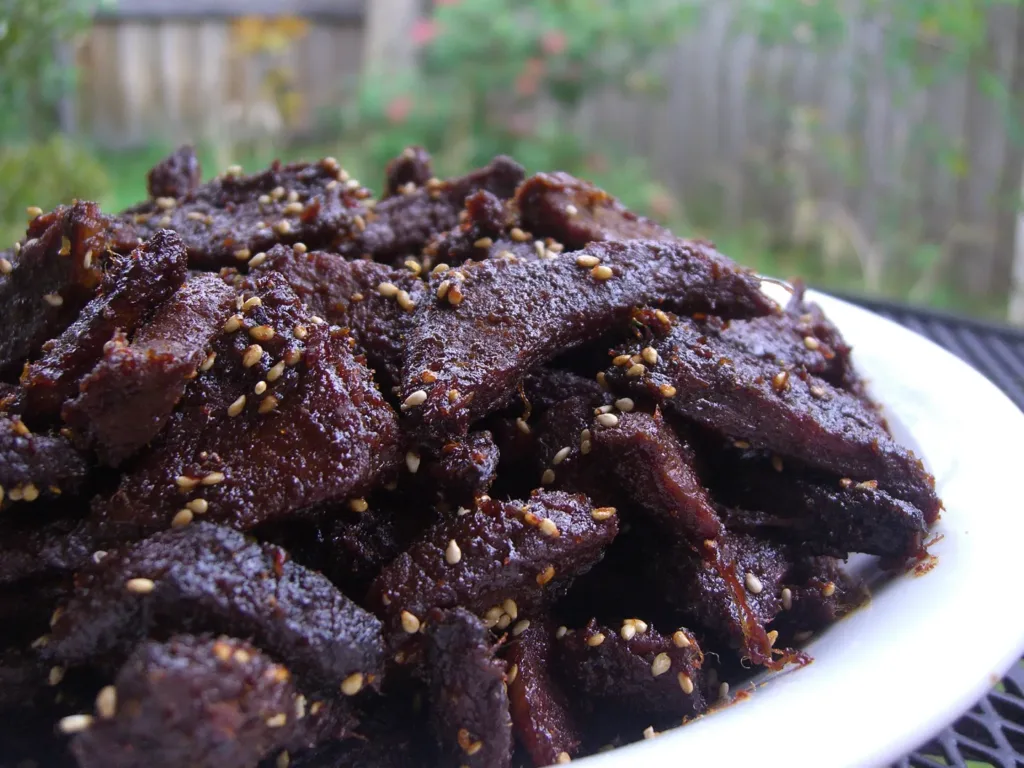
- Off-site illustrative photograph of orange-marinated beef jerky; it shows the kind of cured beef texture discussed here, not Pingba niu ganba, an Anshun venue, or a specific local recipe. Photo: Alpha (Flickr username avlxyz)Photo: CC BY-SA 2.0