

Wild Vegetable Banquet 野菜宴
Wild Vegetable Banquet is featured among the local specialties of Hainan.
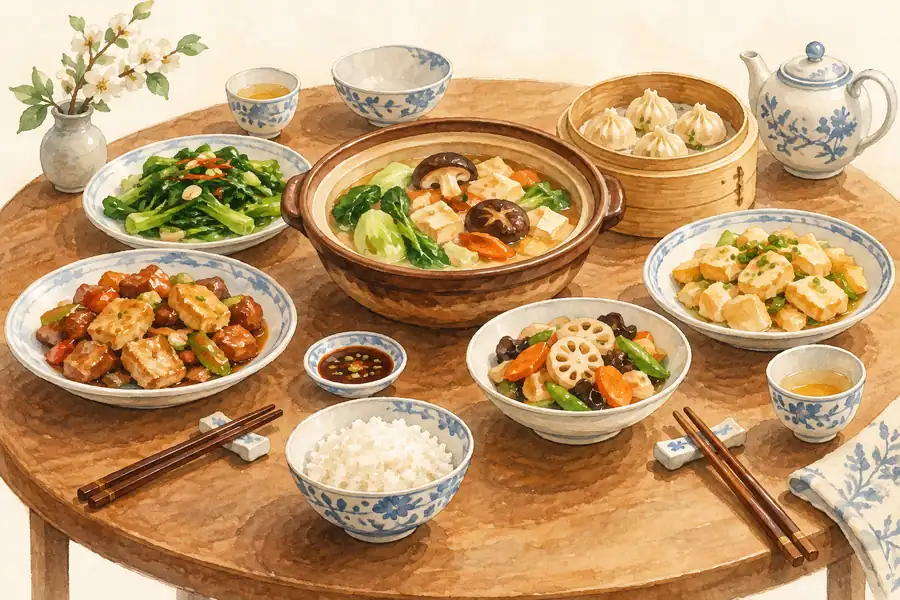
Wild Vegetable Banquet (野菜宴) is a Hainan mountain meal built around wild vegetables: a spread of foraged shoots, leaves and herbs cooked in several ways, strongly associated with the island's central highlands.
How it is made
A 野菜宴 is not one recipe but a style of meal, so the cooking changes from dish to dish: the competition report describes chefs at work with straight, diagonal and flat cuts, frying, stir-frying, braising and deep-frying, each vegetable handled to suit its own texture. What holds the table together is that the wild vegetables are the main ingredient rather than a garnish, and that several plates are served in the same sitting. Some wild greens are blanched or pickled first to soften bitterness; others are cooked quickly so that they keep their bite.
What it tastes like
The flavours of a wild-vegetable table are bitter, herbal, faintly sour and sometimes slightly astringent, and they are usually set against something rich: at Wuzhishan the same events cook 五脚猪 and 蚂蚁鸡 alongside the greens. That contrast, rather than heat or strong seasoning, is the character of the meal; a cook who drowns the vegetables in sauce is going against the style.
Where it belongs
Hainan's central counties market wild vegetables as an island speciality. The People's Daily Online Hainan report on the 雨林味道 2024 Wuzhishan wild-vegetable cooking competition, sourced to the Wuzhishan municipal publicity department, records fifteen chef teams cooking at 三月三广场 in a competition split into signature dishes, Wuzhishan wild vegetables and Wuzhishan sour-fish soup, with a wild-food market running alongside. The same report says the county has been building a wild-vegetable industry and turning the leaves into income for villagers. This entry is associated with Baoting Li and Miao Autonomous County, the neighbouring mountain county, so treat 野菜宴 as a central-Hainan practice rather than the property of one town.
Ingredients and dietary questions
The competition report names 树仔菜 and 食叶草 as Wuzhishan-grown vegetables, used with 五脚猪 and 蚂蚁鸡. Beyond that, the mix depends on the season and the forager, which is exactly why the details matter for a visitor: wild greens can be fibrous, can be bitter, and a few species need proper cooking before they are eaten. Ask what each plate is, whether it has been blanched or pickled, and whether the kitchen uses pork fat, chicken stock or fermented seasoning, since a vegetable-only request does not mean the dish is vegetarian in the Chinese sense.
Ordering it
Ask for 野菜宴 or simply 野菜, and let the kitchen choose the day's vegetables, which is usually the point. Useful phrases: 有什么野菜 (what wild vegetables do you have), 清炒 (plain stir-fry), 凉拌 (dressed cold) and 不要辣 for no chilli. Because a set spread can run to many plates, ask for a small or half portion first, and confirm whether the price is per dish or per table.
How it is eaten
The plates are shared in the middle of the table and eaten with rice, usually with one or two meat dishes for contrast and often with a soup. Bitter greens are eaten first or in small amounts, which is how local diners pace a meal; if a vegetable proves too bitter, the usual fix is to take it with rice rather than to add sauce.
More dishes to compare
Explore related local specialties and compare their names, preparation notes and ordering guidance.
Wuzhishan Wild Greens 五指山野菜 →
Wuzhishan Wild Greens (五指山野菜) names the wild vegetables of Wuzhishan themselves, while 野菜宴 names the meal built around them. The first is an ingredient or a category of plates; the second is a table of several such plates cooked in different ways, with meat dishes alongside. The Wuzhishan competition reported by People's Daily Online is the clearest public example of both: a wild-vegetable category inside a larger cooking contest, and a market where visitors eat the results.
Questions before you order
Is a wild-vegetable banquet vegetarian?
Not necessarily: the Wuzhishan competition cooked wild vegetables alongside 五脚猪 and 蚂蚁鸡, and kitchens may use pork fat, chicken stock or fermented seasoning, so ask dish by dish.
Is it a fixed menu?
No. What is on the table depends on the season and what was foraged or delivered that day, so the right order is to ask what is available and let the kitchen pick.
Sources & reading
The supplied food list supports this name and regional association. The culinary terms below are explained as menu vocabulary; a local recipe, origin story and venue availability have not been independently verified.