

Crispy Battered Prawns 脆皮虾
Crispy Battered Prawns is featured among the local specialties of Hebei.
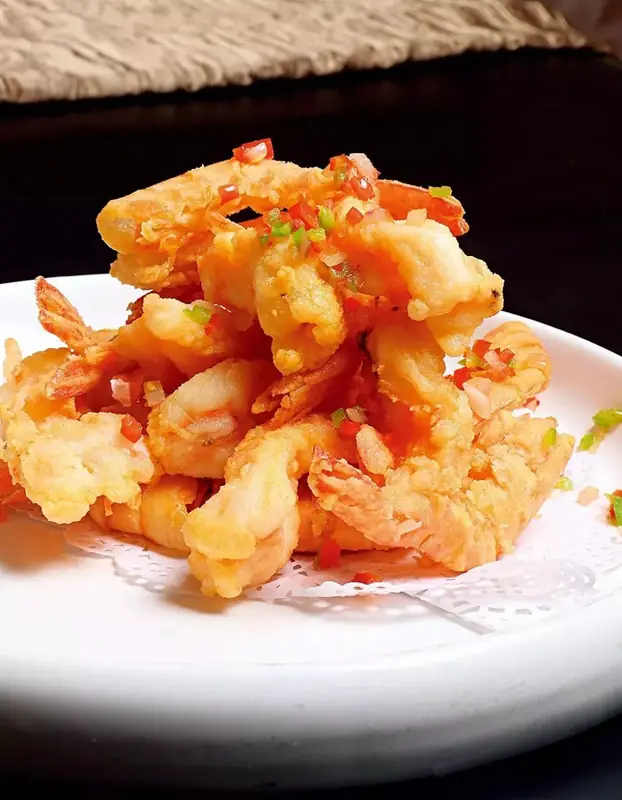
Image notes
Resized for the web; the photo itself has not been edited.
Crispy Battered Prawns (脆皮虾) is a Hebei dish of battered prawns: fresh prawns marinated with salt, cooking wine and pepper, coated and deep-fried until the shell of batter is crisp.
Marinate, batter, fry
The method is short and the order matters. Fresh large prawns are cleaned first, then marinated with salt, cooking wine and pepper so the seasoning reaches the flesh before any coating goes on. Only then are they put into batter and deep-fried. Because the marinade is liquid, the prawns need to be drained or the batter will not hold; because the fry is hot and brief, the prawn cooks through while the coating sets.
Crisp outside, tender inside
The description the dish carries is 外脆里嫩 with 鲜美香浓 — crisp on the outside, tender within, and savoury in flavour. That contrast is the whole point of a battered fry: the coating has to set hard enough to crack under a spoon while the prawn inside stays moist. The pepper in the marinade gives a background warmth rather than heat, and the cooking wine is there to lift the flavour of shellfish rather than to be tasted on its own.
On Hebei's classic list
This is not a home-kitchen accident. 脆皮虾 appears among Hebei's ten classic dishes in the China Cuisine Association's 2018 China Cuisine series, in a group that includes 白玉鸡脯 from Baoding and 皇家御品锅 from Chengde. Being listed at provincial level places it in a banquet register rather than a snack one — the kind of dish that turns up at a formal table, where a fried item is expected to close the savoury part of the meal.
What is in it and what to ask
Prawns, salt, cooking wine, pepper, batter and frying oil are the components the source names. Two things are worth checking at the table: shellfish allergies are a hard stop for this dish, and cooking wine means it is not alcohol-free unless the kitchen says otherwise. Ask 用的是什么虾 (what prawns are these), 里面放酒了吗 (does it contain cooking wine) and 辣不辣 (is it spicy) — the pepper is usually mild but kitchens vary.
How to order it
Ask for 脆皮虾 by name. Useful phrases are 一份 (one portion), 要几只 (how many pieces), 少放盐 (less salt), 不要放味精 (no MSG) and 可以打包吗 (can I take it away). It is normally a shared plate rather than an individual portion, so order it for the table along with rice and a vegetable dish. Because it is fried to order, it is worth asking 是现炸的吗 (is it freshly fried).
Eating it
Serve and eat it immediately: a battered prawn loses its point once the coating steams soft, so this is the dish that arrives last and is finished first. It is eaten with the fingers or with chopsticks, dipped if the restaurant offers a dip, and it works best as one part of a shared table rather than as a main course by itself. Two or three pieces per person is a normal share.
More dishes to compare
Explore related local specialties and compare their names, preparation notes and ordering guidance.
Golden Lion's Mane Sweet-and-Sour Carp 金毛狮子鱼 →
Golden Lion's Mane Sweet-and-Sour Carp (金毛狮子鱼) shows the same technique pushed to its limit: a fish is cut into fine strands and fried so the whole surface turns crisp and golden. 脆皮虾 keeps it simpler — prawns are marinated, battered and fried whole — so the crisp shell and the tender prawn inside are the entire point.
Questions before you order
Is 脆皮虾 a classic Hebei dish?
Yes. It appears among Hebei's ten classic dishes in the China Cuisine Association's 2018 China Cuisine series, in the list reported by the source used here.
How are the prawns seasoned?
The source gives the marinade as salt, cooking wine and pepper, applied after the prawns are cleaned and before they are battered and deep-fried.
Sources & reading
The supplied food list supports this name and regional association. The culinary terms below are explained as menu vocabulary; a local recipe, origin story and venue availability have not been independently verified.