

Imperial Clay Lotus-Leaf Chicken 御土荷叶鸡
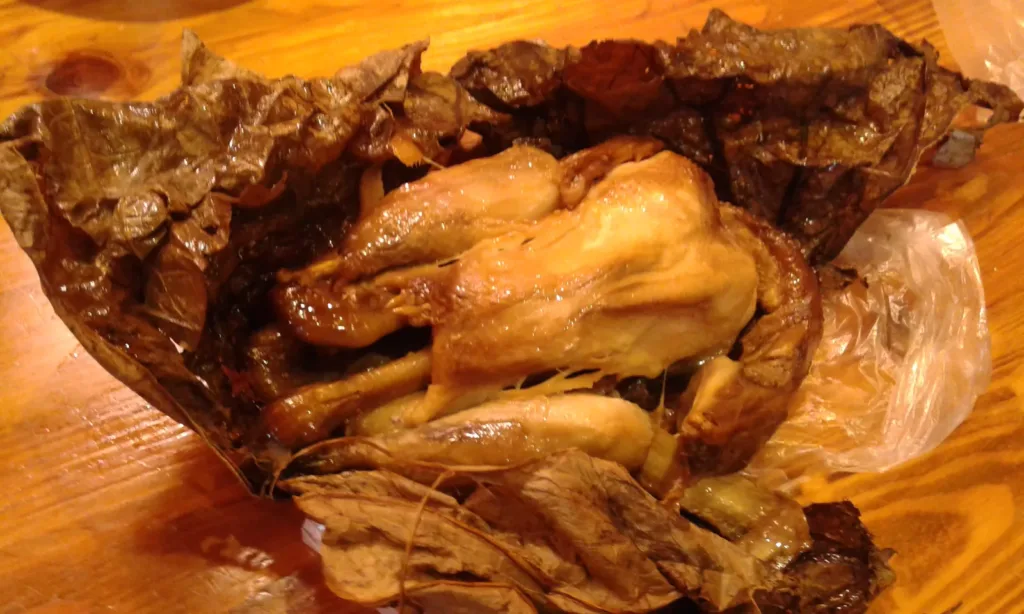
Yutu Heyeji (御土荷叶鸡) is a Chengde-associated clay-baked chicken related to beggar’s chicken. Local accounts tie its name to yellow earth from Chengde’s imperial retreat, Rehe Spring water and lotus leaves; the documented method wraps the bird in lotus leaf, seals it in clay, fires it, then serves the opened chicken in pieces with a dipping seasoning.
What to look for
The classic description starts with a cleaned whole chicken that is left unplucked. It is wrapped in lotus leaves, covered with yellow-earth clay mixed with Rehe Spring water, and cooked over a fire. When the bird is done, the clay shell is broken open; the feathers come away with it. No cooking time or temperature is fixed in the sources, so do not treat a recipe card as a single universal formula.
At the table, the chicken is cut into small pieces with a knife and fork and eaten with a seasoned dip. The descriptions emphasise tender meat and a light lotus-leaf fragrance rather than a heavily spiced sauce. The exact filling, seasoning and serving style can vary by kitchen. Because chicken is the main ingredient, this is not a vegetarian dish; the sources do not establish an allergen-free or standard restaurant recipe.
Why it belongs to Chengde
The dish is best understood as a Chengde-area food tradition, not as a claim that Chengde invented beggar’s chicken. The Ministry of Agriculture and Rural Affairs included 御土荷叶鸡 in its 2018 list of 100 rural foods under Hebei, describing the same Chengde materials and knife-and-fork serving style. A Chengde municipal-government report also listed it among the specialties associated with the area around Zhoutaizi Village in Luanping County.
A Chengde tourism feature repeats the local explanation of the name and the faint lotus aroma, while an older Sina travel account records the same clay-sealed, fire-cooked technique. These sources preserve a food tradition, but they do not prove that every modern serving still uses earth, spring water or lotus leaves from the named places.
Practical tips
Ask what is in the current preparation if you have allergies or dietary restrictions, since the sources describe a traditional method rather than one binding modern recipe.
Where to eat it
You can find Yutu Heyeji all over Hebei, so there is no need to seek out one particular restaurant. To find one near you, search for “御土荷叶鸡” in Meituan (美团) or Amap (高德地图) and check recent reviews, distance and opening hours.
Sources & reading
Image credits & notes (1)
- Illustrative photo of beggar's chicken packed with lotus leaves, photographed in China; this is a regional reference rather than a Chengde-specific serving of Yutu Heyeji. Photo: Pauloleong2002Photo: CC BY-SA 4.0