

Stewed River Fish 炖江鱼
Stewed River Fish is featured among the local specialties of Heilongjiang.
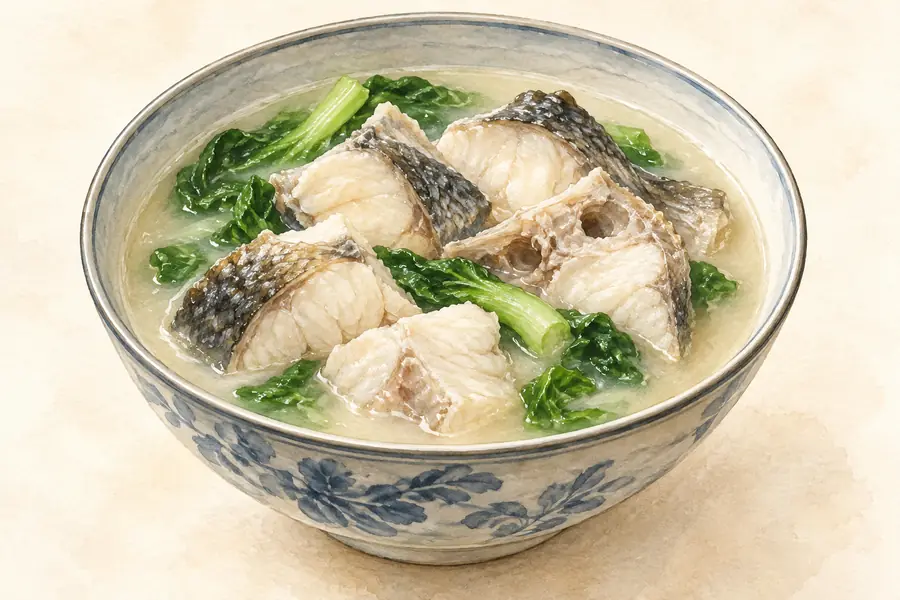
Stewed River Fish (炖江鱼) is river-fish stew: in Heihe, a city on the Amur in northern Heilongjiang, it is a plain pot of river fish simmered until the broth is ready to drink.
Simmered, not fried
The method is the one Heilongjiang cooks use most for fish: the fish goes into a pot with liquid and is simmered gently rather than seared, so the flesh stays intact and the broth takes on its flavour. The covered pot does the work, and the liquid is reduced until it is strong enough to serve as a soup in its own right.
Water quality matters more here than in most cooking. Heilongjiang material notes that mineral-rich spring water changes the taste of fish dishes, and the province's fish cookery is generally built on fresh river catch rather than on stored or salted fish.
Clean broth, mild flesh
River fish from cold northern water is mild and faintly sweet, so the broth reads as clean rather than strongly seasoned. Salt, a little vinegar or soy, and aromatics such as ginger and scallion are usually enough; the dish is valued for tasting of the fish.
Because the fish is not deep-fried first, there is no heavy crust or oil to mask the flavour. What you taste is the water, the fish and the aromatics together.
Heihe, on the river
Heihe faces Russia across the Amur, and river fish is a normal part of the local table rather than a speciality brought in for visitors. Heilongjiang cooking as a whole is noted for freshwater fish and shrimp, and the province has a well-known fish stew of its own in the Demoli style.
Along the Amur, households and restaurants cook whatever the river provides, which is why the dish has no single canonical recipe: the pot changes with the catch.
Fish, water and a short list
A fresh river fish, water or light stock, ginger, scallion, salt and a small amount of soy or vinegar; sometimes tofu or potato is added to take up the broth. Nothing in the dish is designed to disguise the fish, so freshness is the first consideration.
Asking the right questions
Ask what was caught today and whether the stew is made from one fish or several. Mixed-catch pots give a more complex broth; single-fish pots are cleaner tasting.
If you are unused to eating fish with bones, ask for a species with larger bones, or ask whether the kitchen can serve the fish in sections, which makes the pot easier to share.
At the table
The stew is brought out in its pot, and the broth is as much the dish as the fish. Diners take fish first, then pour the liquid over rice or noodles, and the meal ends with a bowl of the broth on its own.
Cold vegetable dishes or pickles are usually ordered alongside, because the soup is mild and benefits from something sharp between spoonfuls.
More dishes to compare
Explore related local specialties and compare their names, preparation notes and ordering guidance.
Demoli fish stew 得莫利炖鱼 →
Demoli stewed fish is the fish stew that Heilongjiang lists by name, which makes it the standard against which other river-fish pots are read. Heihe's Dun Jiang Yu has no fixed recipe attached to it, so it stays a household and restaurant dish shaped by the catch. Comparing them shows how one version became a brand and the other stayed ordinary.
Questions before you order
Is Stewed River Fish a soup or a main dish?
It is both. The fish is the main dish and the reduced broth is drunk or poured over rice, so it usually replaces a separate soup.
Which fish is used?
Whatever the river or market provides that day. Ask before ordering, since the flavour and the bones differ a lot between species.
Source introduction: Wikipedia contributors: 龙江菜 · CC BY-SA 4.0 (Wikipedia text, attribution required). English guide adapted from the cited material, with additional preparation and ordering guidance.
Source introduction: Wikipedia contributors: 东北菜 · CC BY-SA 4.0 (Wikipedia text, attribution required). English guide adapted from the cited material, with additional preparation and ordering guidance.
Sources & reading
The supplied food list supports this name and regional association. The culinary terms below are explained as menu vocabulary; a local recipe, origin story and venue availability have not been independently verified.