

Fish Floss 鱼毛
Fish Floss is featured among the local specialties of Heilongjiang.
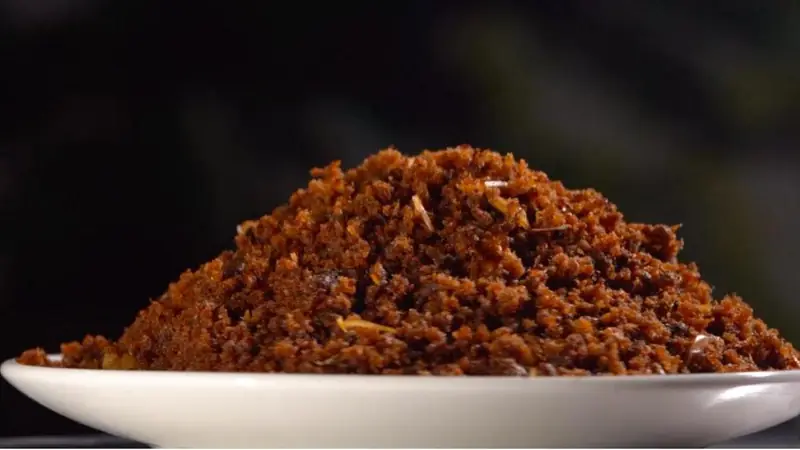
Image notes
Resized for the web; the photo itself has not been edited.
Fish Floss (鱼毛) is a dish of the Hezhen people (赫哲族), a river-fishing people of Heilongjiang; Chinese Wikipedia lists it as tasihan (它斯罕), also called stir-fried fish floss (炒鱼毛).
How it is made
Chinese Wikipedia describes tasihan as a well-known Hezhen dish made from fresh, fatty fish of various kinds. The fish is cut into thin threads and stir-fried with white sugar and other seasonings. The finished floss tastes good and keeps for a long time without spoiling.
Where it comes from
The ancestors of the Hezhen lived in the basins of three rivers: the Amur (黑龙江), the Songhua (松花江) and the Ussuri (乌苏里江). In China today they live mainly in Tongjiang (同江), Raohe (饶河), Fuyuan (抚远) and Jiamusi (佳木斯), and their culture is largely built around fish.
Fish Floss is one of two Hezhen specialty dishes that Chinese Wikipedia singles out. The other, taleka (他勒卡), is raw fish dressed with vegetables. Traditionally the Hezhen ate fish skin, roe and flesh raw, grilled fish on skewers or steamed it, and preserved surplus fish from the peak catch by sun-drying and fire-roasting it for the lean season. Fish Floss is cooked instead, and it keeps. Today most Hezhen households eat much as Han Chinese families do.
How it is eaten
Fish floss (鱼松) also goes into one of the two traditional Hezhen staples, lala rice (拉拉饭): a very thick soft rice of millet or cracked corn, eaten mixed with fish floss or with animal fat.
Sources & reading
Written from the linked sources and fact-checked against them on 2026-09-24. Recipes and servings vary between kitchens.