

Mandarin Fish Balls 鳜鱼丸
Mandarin Fish Balls is featured among the local specialties of Hubei.


Photo adjustments
Full frame retained; EXIF orientation normalized, proportionally resized to at most 800 pixels and converted to WebP. No generated pixels or subject changes. Cards may crop the display.
Mandarin Fish Balls (鳜鱼丸) is the mandarin-fish ball listed among the local specialities of Ezhou in eastern Hubei, where freshwater fish paste cooking is one of the region’s recognised strengths.
From paste to ball
A fish ball starts as a paste. The fish is filleted, the skin and bones removed, and the pale flesh scraped away from the darker muscle, then worked with salt and a little water until the paste turns sticky.
Forming the balls is quick once the paste is right: it is squeezed between thumb and forefinger or shaped with a spoon, and the balls are set in warm water so they hold their shape before being finished in soup or stock. Mandarin fish suits this because its flesh is firm and fine and takes less working than a softer fish.
Light, springy and clean
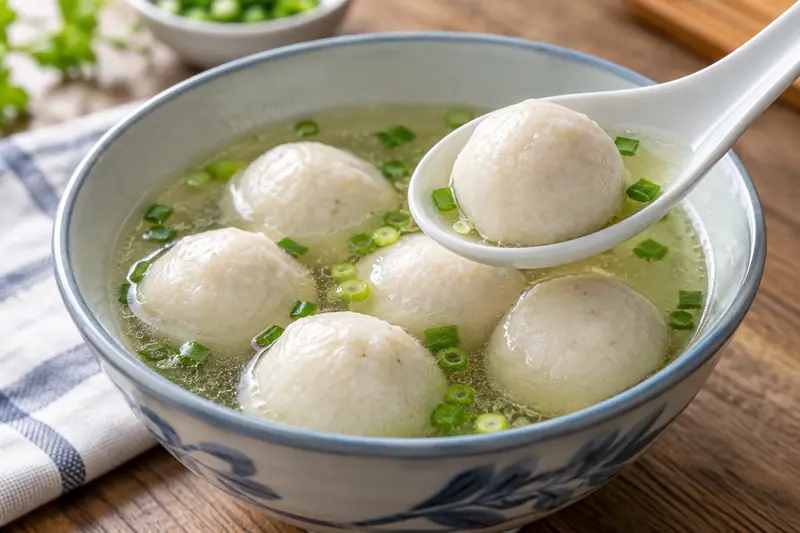
A well-made mandarin-fish ball is pale, almost white, with a fine grain and a springy bite rather than a crumbly one. Because the flavour comes from the fish itself, the seasoning is deliberately light: salt, a little ginger water and sometimes a touch of egg white or starch to hold the paste.
Hubei’s fish cooking is described by the province as producing reduced juices and full, clean flavours, and the fish-ball tradition sits at the delicate end of that spectrum. A mandarin-fish version is subtler than ball made from mixed river fish, and slightly more yielding.
Fish balls on an official Ezhou list
Ezhou’s city government publishes an official ranking of its ten signature dishes, compiled by the city’s master-chef committee and an online public vote. The list includes the old Ezhou fish balls, and it also includes a Xiebu dish that cooks mandarin fish with thousand-sheet tofu, which is how the two elements of this entry — fish balls and mandarin fish — both appear in the same official list.
Fish paste cooking is a broader Hubei strength rather than an Ezhou invention. The province’s cuisine writing treats fish balls and fish cake as a speciality of the Jingnan school covering Jingzhou, Jingmen and Yichang, and Ezhou, on the Yangtze and beside Liangzi Lake, works in the same idiom.
Ingredients and dietary questions
Mandarin fish flesh, salt, water and usually a little starch or egg white, with ginger water to lift the flavour. A kitchen may blend the paste with other fish to control the cost, which is the main reason to ask what goes into the ball.
Fish balls are normally free of meat, but they are often simmered in a pork or chicken stock and served with lard or a meat garnish. Anyone avoiding pork should ask about the cooking liquid as well as the ball itself.
How to order it
Say 鳜鱼丸, or simply 鱼丸 if you are happy with the everyday version. In Ezhou the fish balls appear in soups, in hotpots and alongside other dishes rather than on their own as a main course.
Ask whether the ball is made in-house that day or bought in. Texture is the whole point of the dish, and a fresh mandarin-fish ball is noticeably springier than a factory one.
How it reaches the table
Most often it arrives in a clear soup with a little greens and spring onion, or as an item in a table hotpot. It is eaten early in the meal while the balls are hot, because they firm up as they cool and lose the yielding quality that makes them worth ordering.
In a set meal the fish balls are one dish among several; in a family lunch they may simply be the soup that comes with rice.
More dishes to compare
Explore related local specialties and compare their names, preparation notes and ordering guidance.
Ezhou Fish Balls 鄂州鱼丸 →
Ezhou Fish Balls is the general Ezhou fish ball, made from the white flesh of freshwater fish and formed into bouncy spheres. Gui Yu Wan names the mandarin fish as the raw material, which changes both the colour and the cost: a mandarin fish paste is whiter, softer and more delicate than a mixed-fish ball, and kitchens treat it as the premium version rather than the everyday one.
Questions before you order
Is 鳜鱼丸 the same as ordinary 鱼丸?
The technique is the same, but the fish is specified. A mandarin-fish ball is paler, softer and more expensive than the mixed-fish balls used for everyday soups.
Are fish balls boneless?
Good mandarin-fish balls are boneless because the fillet is scraped free of the skeleton before the paste is made. Ask if you are ordering a version made from whole minced fish, which can contain fine bones.
Sources & reading
The supplied food list supports this name and regional association. The culinary terms below are explained as menu vocabulary; a local recipe, origin story and venue availability have not been independently verified.