

Xinghua Morning Tea 兴化早茶
Xinghua Morning Tea is featured among the local specialties of Jiangsu.
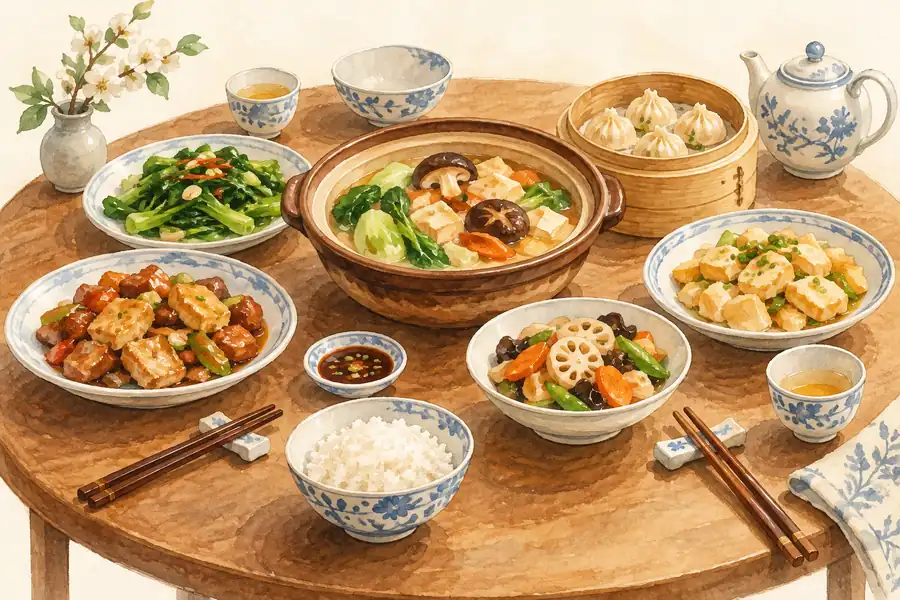
Xinghua Morning Tea (兴化早茶) is the breakfast banquet of Xinghua (兴化), a city in Taizhou (泰州), Jiangsu. The writer Wang Gan (王干), in a 2026 People's Daily essay, writes that Jiangsu morning tea is best known in Yangzhou (扬州) and Taizhou, but that Xinghua, lying between the two, has a style of its own, one that turns morning tea into a banquet.
How the meal runs
The essay gives the scale: at least 20 dishes and as many as 48, covering cold dishes, hot dishes, buns and sweets, with more than an hour of dishes arriving. Xinghua people once described a wealthy family by saying "他们家天天吃早茶" ("they eat morning tea every day"); now ordinary people can too, and the city's morning-tea restaurants are busy from first light.
The "tea" that opens the meal is not a costly tea from elsewhere but the local barley tea (大麦茶), amber-coloured, poured from a red-copper pot and tasting of roasted grain. Eight cold dishes follow on small white plates set out in a plum-blossom pattern, among them salted pork terrine (肴肉), drunken shrimp, salted duck egg and wafer-thin slices of sugared ginger that are sweet with a sharp bite. Hot dishes come next: crab-roe tofu still bubbling in a small clay pot, stir-fried river shrimp, crisp eel shreds, and scalded tofu threads (烫干丝), cut fine enough to thread a needle, rolled through chicken stock, piled up and topped with dried shrimp, young ginger shreds and shredded terrine.
The yipin dabao (一品大包) is a fist-sized bun pleated more than 30 times at the top and filled with crab roe, pork and diced bamboo shoot. It always comes with a bowl of fish-soup noodles, the broth simmered overnight from crucian carp bones until it is white. A bowl of clear soup holds four rou tuozi (肉坨子), the local name for lion's-head meatballs: three parts fat to seven lean, cut fine, chopped coarse and shaped loose but holding together.
Sweets, seasons and tofu threads
The sweets include small sesame cakes (小麻饼), yunpian cake (云片糕), large and small jingguo (京果), and a bowl of jingguo powder mixed with boiling water, smelling of toasted glutinous rice flour and sugar. The line-up changes with the season: white rice-flour balls filled with black sesame or bean paste around the Lantern Festival, green qingtuan (青团) at Qingming, and niangao rice cake at the year's end.
The Xinghua city government describes the tofu threads (干丝) as a local speciality with several hundred years of history, eaten at breakfast with tea by friends or families. They are made by hand from local soya beans: soaking, grinding, straining, boiling, adding the brine coagulant, and pouring, pressing and peeling thin tofu sheets (百叶), which are then cut into soft, fine threads.
More dishes to compare
Explore related local specialties and compare their names, preparation notes and ordering guidance.
Yangzhou three-diced buns 扬州三丁包 →
Yangzhou's morning tea is one of the two better-known Jiangsu morning-tea traditions that the People's Daily essay sets Xinghua's banquet-style morning tea against.