

Liangpi 凉皮
A cool, tangy Shaanxi street-food family found throughout Xi'an: choose between softer rice sheets, springier wheat-starch sheets, and regional styles with different textures and dressings.
Tap any red Chinese text to hear it in Mandarin.
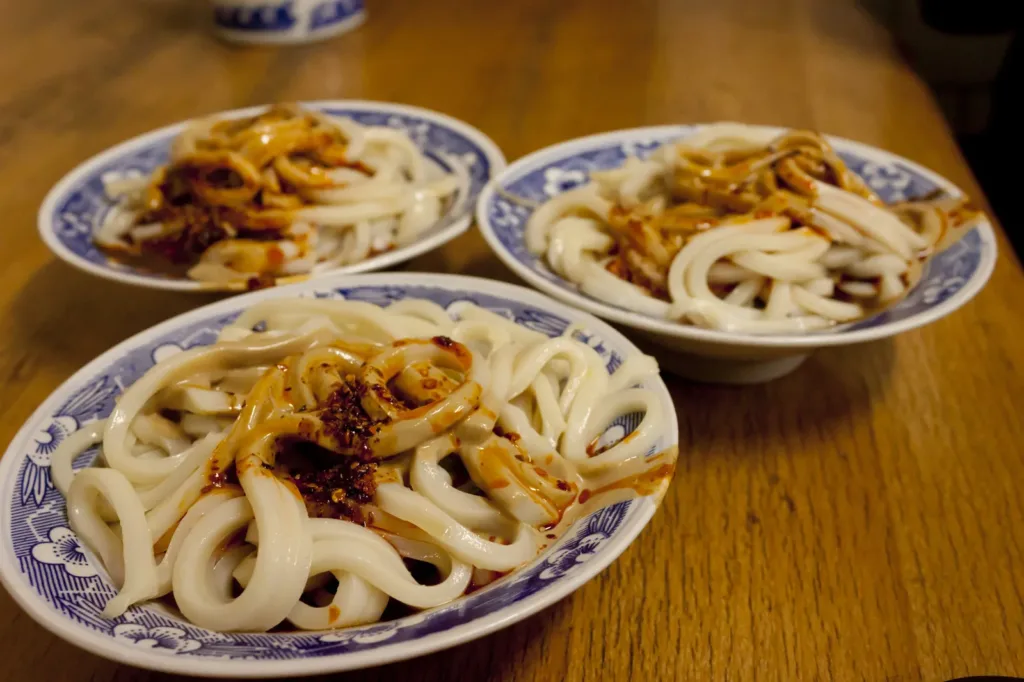
What arrives in the bowl
Liangpi (凉皮, “cold skin”) is a family of cool, broad noodle sheets associated with Shaanxi and familiar in Xi’an, not a dish exclusive to one city or one recipe. Shaanxi styles include Hanzhong rice sheets, Qin Town rice sheets, sesame-sauce niangpi and Qishan rolled sheets. Qishan is in Baoji, outside Xi’an municipality, though its chewy guanmianpi is also eaten in Xi’an. Hanzhong-style rice sheets are often served warm; Qin Town rice-skin noodles are a distinctive Xi’an-area connection.
The basic ingredients depend on the style. For wheat liangpi, cooks knead wheat flour and water into dough, wash it repeatedly so starch disperses into the water while gluten gathers into an elastic mass, then let the starch settle. The concentrated starch is loosened into batter, spread thinly and steamed into sheets. Once cooled, the sheets are cut into ribbons. The separated gluten is commonly steamed and added in pieces, giving the bowl a spongy, sauce-catching contrast. Some kitchens start with prepared wheat starch instead, so this process is a useful explanation rather than a universal shop recipe.
Rice liangpi follows a different route: rice is soaked, ground or milled into slurry, and steamed as thin sheets. Qin Town rice skin is associated with Qin Town in present-day Huyi District, Xi’an; reporting describes locally grown indica rice, soaking, grinding and steaming. Its ribbons are soft yet resilient. Qishan guanmianpi is different again: dough is rolled and steamed before being sliced, producing a thicker, firmer and more springy bite than a delicate rice sheet. These are related regional foods, not interchangeable names for one exact texture.
A good bowl balances the cool, slick sheets with a sharp, fragrant dressing. Vinegar brings a clean sour edge; garlic water and chili oil add pungency and heat, while the oil contributes a vivid red sheen and toasted, aromatic warmth. Depending on the shop and style, expect soy sauce, sesame oil, cucumber, bean sprouts, coriander or celery leaves, and soft pieces of wheat gluten. Rice sheets tend to feel gentler and softer; wheat sheets are chewier and more resilient. Chili intensity, acidity and the amount of sesame paste vary by vendor. In Xi’an, a sesame-rich version may be ordered as 麻酱凉皮 (májiàng liángpí), while a Qin Town-style bowl is known for its fragrant chili oil.
How to order and eat it
Ask which kind of sheet the shop serves: 你们是米皮还是面皮? Nǐmen shì mǐpí háishi miànpí? (Do you serve rice skin or wheat skin?). If you want sesame sauce, ask for 麻酱凉皮 májiàng liángpí; if not, say 不要麻酱 bú yào májiàng. Set your heat before the bowl is mixed: 少辣 shǎo là means less chili and 不要辣 bú yào là means no chili. The dressing is usually tossed through the ribbons, so taste the first bite for vinegar, garlic and heat, then add more only if the shop offers extra condiments. Liangpi works as a light meal or snack; some diners pair it with roujiamo, but that is an option rather than a required set meal.
A useful starting point is simply to look for 凉皮 on a local menu and ask which regional style is being made that day.
Where to eat it
You can find Liangpi all over Xi’an, so there is no need to seek out one particular restaurant. To find one near you, search for “凉皮” in Meituan (美团) or Amap (高德地图) and check recent reviews, distance and opening hours.
More dishes to compare
Explore related local specialties and compare their names, preparation notes and ordering guidance.
Golden-thread steamed towers 金线油塔 →
Wheat dough is layered with oil or fat, stretched into fine strands, coiled into small towers and steamed. The strands are loosened at serving rather than fried to a crisp shell. The result is soft and light in layers, with a rich wheat aroma and a delicate threadlike bite. Accompaniments supply sharper flavor.
Stone-baked flatbread 石子馍 →
Thin wheat dough is baked among or against hot pebbles, which leave characteristic depressions on the surface. Seasoning and added fat vary by producer. The bread is dry and crisp, with toasted wheat flavor and uneven crunchy ridges. It is intended for breaking into bites rather than folding around a filling.
Sources & reading
Recipes and servings vary between kitchens.
Image credits & notes (1)
- Three bowls of liangpi; image illustrates the dish and does not imply all local styles use sesame paste. Photo: JucemberPhoto: CC BY-SA 3.0