

Ningbo sweet rice balls 宁波汤圆
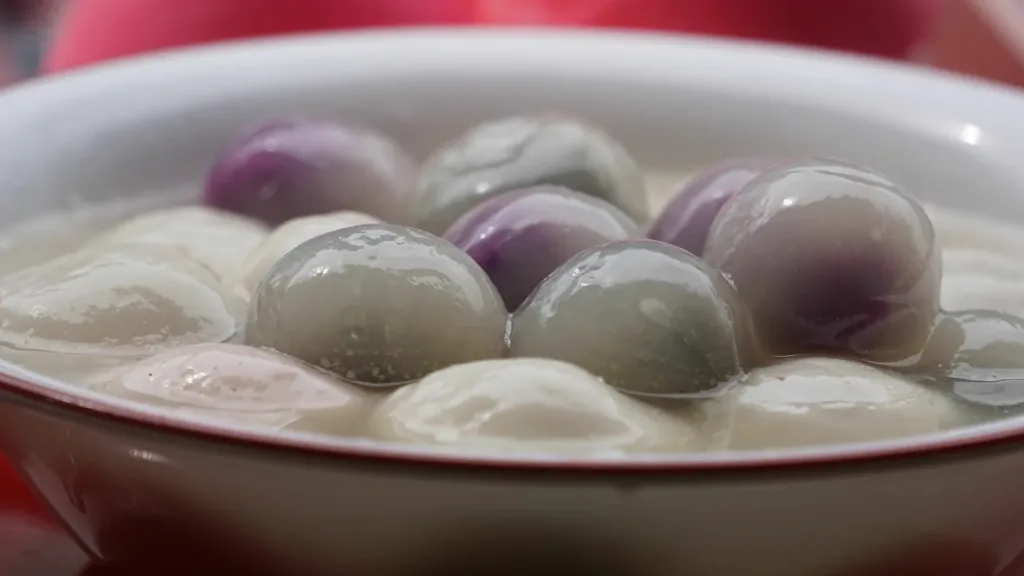
Ningbo tangyuan are tender, water-milled glutinous-rice balls with a thin, elastic skin around a rich sesame-and-lard filling. Their hot, melting centre and place in Ningbo’s winter family table make them a useful local taste to seek out.
Tap any red Chinese text to hear it in Mandarin.
What makes Ningbo tangyuan distinctive
Ningbo tangyuan are a regional style of the wider Chinese tangyuan tradition, not a completely separate kind of food. The classic Ningbo version uses a soft glutinous-rice wrapper around toasted black sesame, white sugar and fresh pork fat. That simple filling gives the dumpling its deep sesame aroma and a rich, almost flowing centre when served hot.
The wrapper is traditionally made from water-milled glutinous rice flour. Rice is soaked and ground with water, then the slurry is drained through cloth before it becomes flour. This produces a smoother, thinner skin than a dry-milled dough. A maker portions the dough, shapes it into a small cup, places the filling inside, closes the opening and rolls it round by hand.
Flavour, texture and cooking
Expect a smooth, slightly elastic skin and a sweet, oily black-sesame centre. The dumplings are boiled and served hot; ginger, brown sugar, osmanthus or a plain cooking liquid may be used depending on the kitchen. One local cooking method adds small amounts of cold water after the dumplings rise, allowing the filling to heat through without splitting the skin.
Tangyuan and the northern yuanxiao are often translated with the same English name, but the making methods differ. Tangyuan are generally shaped around the filling by hand, while yuanxiao is traditionally formed by rolling a filling in dry rice flour. Ningbo’s version belongs to the hand-rolled southern tradition.
Local roots and seasonal meaning
Local accounts place an early Ningbo form in Song–Yuan-era Mingzhou, the city’s former name, where the dumplings were associated with the name “fuyuanzi” because they floated and sank while cooking. The dish remains closely tied to the winter solstice, Lunar New Year and Lantern Festival, when round dumplings are eaten as a family food associated with reunion.
The classic black-sesame-and-pork-fat filling is the baseline, not a rule that every modern dumpling must follow. Red-bean, fruit and savoury meat fillings also appear in contemporary Ningbo-related offerings. Ask what is inside if you want the traditional flavour, or if you avoid pork, sesame or particular sweeteners.
How to order
Show 宁波汤圆 Níngbō tāngyuán when ordering. 猪油芝麻汤圆 zhūyóu zhīma tāngyuán means lard-and-sesame tangyuan and is the clearest phrase for the classic filling. Break one open over a spoon before taking a full bite: the centre can stay very hot and liquid even when the white skin looks cool.
Menus and fillings vary by shop; ask about the day’s filling and broth rather than assuming that every item labelled “Ningbo tangyuan” uses the traditional recipe.
Where to eat it
You can find Ningbo sweet rice balls all over Zhejiang, so there is no need to seek out one particular restaurant. To find one near you, search for “宁波汤圆” in Meituan (美团) or Amap (高德地图) and check recent reviews, distance and opening hours.
More dishes to compare
Explore related local specialties and compare their names, preparation notes and ordering guidance.
Jiaxing leaf-wrapped rice dumplings 嘉兴粽子 →
Glutinous rice is wrapped tightly in leaves around a sweet or savory filling and cooked until the grains bind together. Pork versions often include a balance of lean meat and fat. The rice is sticky and richly seasoned, with a faint leaf aroma. Pork fat softens into the rice, while sweet versions offer a very different balance.
Longyou fermented rice cake 龙游发糕 →
Rice batter is fermented, sweetened and steamed so it rises into a porous cake. The fermentation and steaming create the structure rather than a conventional oven-baked crust. The crumb is soft and spongy, with a lightly fermented aroma and gentle sweetness. Warm slices are especially supple, while cooling makes them firmer.
Sources & reading
Recipes and servings vary between kitchens.
Image credits & notes (1)
- A bowl of tangyuan, photographed in Singapore during the Winter Solstice; a generic dish illustration, not a specific Ningbo shop or a claim of Ningbo provenance. Photo: GT - thank you for your supportPhoto: CC0 1.0