

Qumarleb Yak Jerky 曲麻莱牦牛肉干
Qumarleb Yak Jerky is featured among the local specialties of Qinghai.

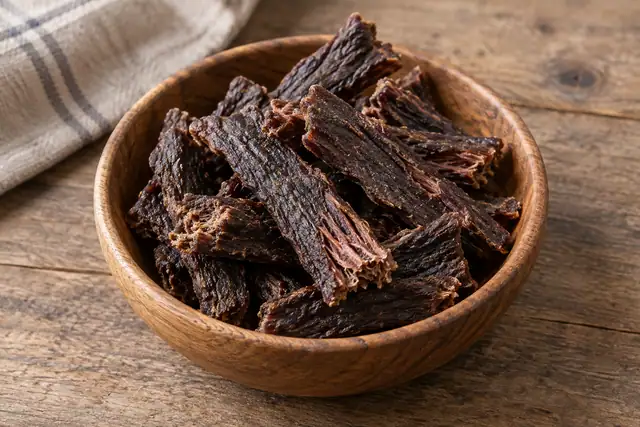
Qumarleb Yak Jerky (曲麻莱牦牛肉干) is dried yak beef from Qumalai County in Yushu, the high pastoral county that sells its winter meat at a festival each December.
From plateau herd to dried meat
Qumalai is a herding county, and its meat is sold in two states. Fresh carcasses and vacuum-packed cuts dominate the county’s winter-meat trade, when households and outside buyers stock up before the hardest part of the season, and processed products such as dried beef are the form that travels.
Drying is a high-altitude method rather than a factory one. Meat is cut into strips and dried in the cold, dry air of winter — the same air-dried beef that Yushu herders sell to local cooperatives — which firms the outside of the meat and concentrates the flavour without smoking it.
What dried yak tastes like
Yak is leaner and more strongly flavoured than lowland beef, and drying sharpens both qualities: the meat is dense, chewy and savoury, with a mineral edge that comes from grass grown at four thousand metres and above.
This is not a spice-led product. Salt is the main seasoning in the plain version, and the interest lies in how long the meat was dried and how it was cut. Thicker strips stay soft in the middle; thin ones become brittle enough to snap.
Why Qumalai
The county sits in the Yushu Tibetan Autonomous Prefecture on the Sanjiangyuan headwaters, and it promotes a "wild-blood" yak herd under a breeding-improvement programme. Yushu yak carcasses are the headline product when the county stages its winter-meat buying festival, and buyers come from as far as Tibet and Sichuan.
That matters for the beef: the supply is a named herd in a named valley, not anonymous cattle. It also explains the seasonality. Qumalai sells meat when the animals are in condition and the weather will keep it, and the dried form is the way that season reaches the rest of the year.
Meat, salt and time
The plain product has two ingredients: yak beef and salt. Spiced versions add chilli, Sichuan pepper or a braising liquid before drying, and those are worth asking about separately, because they change the taste far more than the drying does.
Qinghai cuisine as a whole cooks mainly by roasting, frying, steaming, braising and boiling, with mutton and beef at the centre — and because the province sits on the plateau, much of its beef is yak rather than ordinary cattle. Dried beef is the most portable expression of that.
Buying it well
Ask whether the meat was air-dried plain or braised and then dried. The first is saltier and chewier, the second is darker, softer and often spicier; both are sold vacuum-packed, which is what you want if it is going into a suitcase.
Check the cut as well as the seasoning. Strips cut along the fibre pull apart into threads; slices cut across it bite cleanly and are easier to eat cold. If you are buying in bulk, ask to try a piece from the batch you are actually buying.
Eating it on the road
Dried beef is travel food. It is eaten cold in strips while walking or driving, torn into pieces by hand rather than sliced, and it is the standard thing to keep in a bag on a long plateau journey.
At home it works as a drinking snack or shredded into noodles and soups, where it rehydrates and gives the broth a stronger, meatier base. A little goes a long way, so a small vacuum pack is a reasonable first purchase.
More dishes to compare
Explore related local specialties and compare their names, preparation notes and ordering guidance.
Yak Jerky 牦牛肉干 →
The generic dried yak beef of Qinghai and the Qumalai version start from the same idea: beef from plateau herds, cut into strips, salted and dried in cold air. What differs is provenance and the way it is sold. The generic product is a province-wide travel snack found in any market; the Qumalai version is tied to one herding county, its breeding programme and a December meat festival, and is more often sold vacuum-packed from the county itself.
Questions before you order
Is Qumalai dried beef the same as jerky?
It is closer to air-dried meat than to cured jerky. The plain version is beef and salt, dried slowly in cold, dry highland air.
When is the meat sold?
The main season is winter, when Qumalai stages its meat-buying festival; vacuum-packed and dried products are available the rest of the year.
Source introduction: Wikipedia contributors: 青海菜 · CC BY-SA 4.0 (see https://creativecommons.org/licenses/by-sa/4.0/). English guide adapted from the cited material, with additional preparation and ordering guidance.
Sources & reading
The supplied food list supports this name and regional association. The culinary terms below are explained as menu vocabulary; a local recipe, origin story and venue availability have not been independently verified.