

Tibetan Yogurt 酸奶
Tibetan Yogurt is featured among the local specialties of Qinghai.
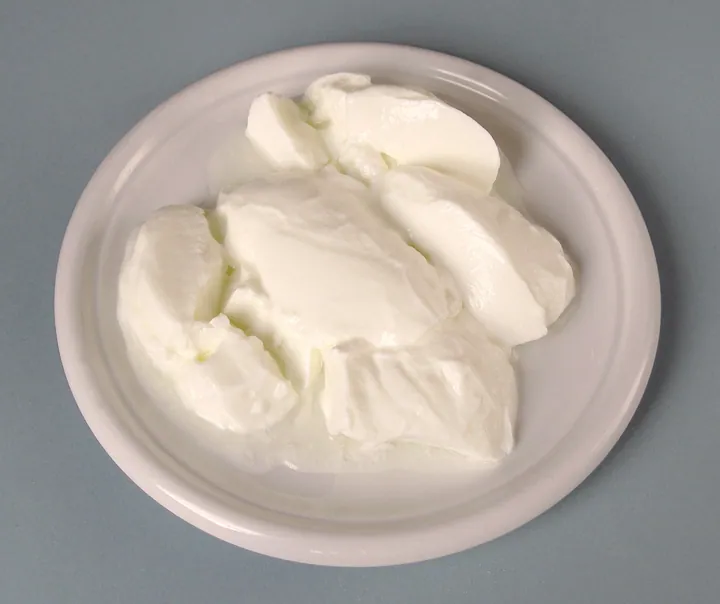

Photo adjustments
Full frame retained; proportionally resized and converted to WebP. No retouching or changes to the photographed subject. Card displays may crop the view.
Tibetan Yogurt (酸奶) in Qinghai means the thick, set yogurt of the plateau — milk fermented in a bowl until it is firm, tart and spoonable, not a drink.
Set in the bowl
The documented local method is simple and deliberate. Milk from local herds is pasteurised with high-temperature treatment, then cooled and fermented by hand in the traditional way, rather than being stirred in a vat and pumped into cartons.
Because it sets where it is fermented, the bowl is the mould. The surface firms into a skin, the body underneath holds a spoon upright, and whey is often visible at the edges or around the top of the pot — a sign of a live set rather than a stabilised product.
Tart, dense and clean
Plateau yogurt is more sour than sweetened supermarket yogurt and noticeably denser, because the milk carries more fat and less water than lowland milk. The flavour is clean and lactic rather than sharp, and it finishes short instead of coating the mouth.
Sugar is added at the table, often as a spoonful on top, and the eater stirs it through or takes a little with each spoonful so that the tartness stays in play. Toppings like raisins or a spoon of jam are common at stalls.
A Qinghai staple
This entry is recorded for Haibei Tibetan Autonomous Prefecture in the north of the province, a herding and dairy area, and the dish is general across Qinghai rather than specific to one town.
The version with the clearest paper trail is from Datong, near Xining, where hand-made set yogurt is registered as intangible heritage and its makers sell over a thousand bowls a day at busy events. It is treated as one of the province’s heritage foods, alongside the eight-dish banquet and the earth hotpot.
Milk, culture, sugar
Milk and a live culture are the whole product in the plain version; sugar, honey, raisins or fruit go on at the point of sale. The milk is the ingredient that changes everything, and pastoral country herds give a richer base than the milk that reaches the cities.
Qinghai cooking runs to sour, spicy and salty flavours and to boiled, braised and roasted meat, which is exactly the context this yogurt belongs to. It is the cool, acid note that cuts through a table of mutton and beef.
Choosing a bowl
At street stalls and food fairs the yogurt is sold by the bowl, already set, with the sweetening added in front of you. Say how much sugar you want; unsweetened is the version that shows what the milk tastes like.
Look for the whey. A bowl that has separated a little is more likely to be a live set made that day than a transported industrial product, and it is also the bowl worth stirring before you eat.
When it is eaten
It is eaten as a snack in the afternoon, as a cool finish after a heavy meat meal, and increasingly as the thing visitors buy to take away in sealed portions. Eaten after mutton, it clears the palate in a way that tea does not.
It is also one of the easiest Qinghai foods to try in a short trip: it is sold in markets and along the main tourist streets of Xining, needs no ordering language beyond a point at the bowl, and travels reasonably well if kept cold.
More dishes to compare
Explore related local specialties and compare their names, preparation notes and ordering guidance.
Zekog Yogurt 泽库酸奶 →
Zeku yogurt comes from a high pastoral county in Huangnan and is the same family of set, hand-made milk, sold by reputation rather than by brand. Set against the general Qinghai bowl, the difference for a visitor is mostly place and herd: a named county with a grazing tradition on one side, and a province-wide heritage technique with its clearest public face in Datong on the other. Both are tart, thick and best judged before the sugar goes in.
Questions before you order
Is 酸奶 in Qinghai a drink?
No, it is a set yogurt eaten with a spoon. Drinkable yogurts exist but they are a different product from the bowl-set version.
Is it served sweet?
Sugar, honey or fruit is added at the table. Ask for it plain if you want to taste the milk and the fermentation on their own.
Source introduction: Wikipedia contributors: 青海菜 · CC BY-SA 4.0 (see https://creativecommons.org/licenses/by-sa/4.0/). English guide adapted from the cited material, with additional preparation and ordering guidance.
Sources & reading
The supplied food list supports this name and regional association. The culinary terms below are explained as menu vocabulary; a local recipe, origin story and venue availability have not been independently verified.