

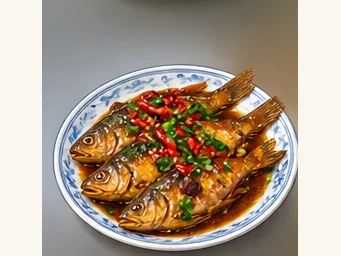
Quanzhou braised rice-field fish 全州黄焖禾花鱼
A small, locally prized carp raised in rice paddies in Quanzhou County, north of Guilin. Try it whole, braised or pan-fried; the seasoning and serving style vary by cook.
Tap any red Chinese text to hear it in Mandarin.
What it is
禾花鱼, often called rice-flower carp in English, is the local name for Quanzhou carp selected and long raised in rice paddies. The fish share shallow paddy water with rice and feed on naturally available food such as fallen rice flowers, plankton and small bottom-dwelling organisms. This is a Quanzhou County specialty within Guilin’s prefecture-level area, not a claim that every Guilin restaurant serves it or that the dish originated only in the city centre.
The fish themselves are small, short-bodied carp. A fisheries study describes the Quanzhou variety as having fine scales, thin skin, tender flesh and few fine bones. Individual fish still have a backbone and bones, so eat carefully rather than assuming a boneless fillet.
How the braise tastes and is made
“黄焖” signals a covered, moist-cooking style, but there is no single fixed recipe across kitchens. A locally documented preparation removes the bitter gall bladder while otherwise keeping the small fish whole, then simmers them with salt, ginger, whole garlic and fermented black beans; green and red pepper, huoxiang (藿香, a mint-family herb) and scallions may be added near the end. The source describes the broth becoming milky as the fish cooks. Other common treatments include whole-fish frying or pan-braising, so a restaurant’s sauce, aromatics and degree of reduction can differ.
Expect delicate, moist flesh and a savory, aromatic cooking liquid rather than a standardized sauce. Ginger and garlic add warmth; fermented black beans bring salty depth, while peppers and huoxiang (藿香, a mint-family herb), when used, make the finish brighter and more herbal. This describes the cited version, not a guaranteed ingredient list. Fish from paddy culture can taste more intensely savory, but a 2023 comparison also found stronger earthy odor compounds in its samples than in pond-raised fish; that research compares cultivation modes, not every serving or diner’s perception.
Eat the fish in small bites, separating the backbone and checking for bones. Rice is a useful accompaniment for the sauce. Ask whether the fish is whole, how spicy it is, and whether the kitchen uses huoxiang (藿香, a mint-family herb) or fermented black beans. Recipes and condiments vary; the Chinese name is useful to show when ordering: 全州黄焖禾花鱼 Quánzhōu huángmèn héhuāyú.
Practical tips
The specialty is associated with Quanzhou County, in the northern part of Guilin’s prefecture-level jurisdiction. The county’s rice-fish farming tradition remains an active agricultural practice, with seasonal paddy harvests reported in late summer; this does not guarantee a particular restaurant’s supply or menu on a given day.
When in Quanzhou County, ask a currently open local restaurant whether it has 全州禾花鱼 Quánzhōu héhuāyú and specifically whether it can prepare it 黄焖 huángmèn.
Where to eat it
You can find Quanzhou braised rice-field fish all over Guilin, so there is no need to seek out one particular restaurant. To find one near you, search for “全州黄焖禾花鱼” in Meituan (美团) or Amap (高德地图) and check recent reviews, distance and opening hours.
More dishes to compare
Explore related local specialties and compare their names, preparation notes and ordering guidance.
Yangshuo beer fish 阳朔啤酒鱼 →
Freshwater fish is cooked with beer and vegetables in a savory braise. The fish may first be browned, helping the skin and sauce develop a fuller flavor. The flesh is tender beneath a rich, aromatic sauce; beer forms part of the cooking liquid rather than making the dish taste like a cold drink. Tomato or peppers may add freshness.
Longsheng sour fish 龙胜酸鱼 →
Fish is preserved through a sour fermentation process, then prepared for serving according to the household or restaurant. A cooked portion gives visitors a straightforward way to try the preserved ingredient. The fish has a concentrated tang and fermented aroma, with firmer flesh than fresh fish and seasoning that varies by maker.
Sources & reading
Recipes and servings vary between kitchens.