

Rice sausage 米肠
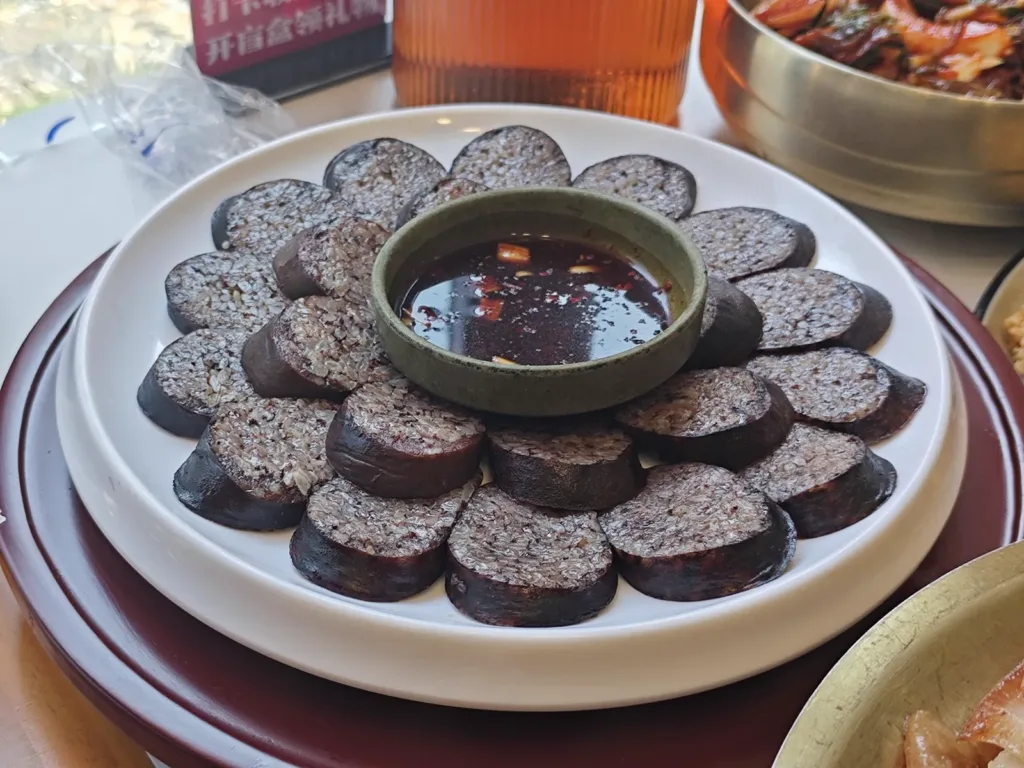
Rice sausage (米肠) is a Yanbian Korean-Chinese food made by filling cleaned pork intestine with a rice-based mixture. Documented local versions may include pork blood, glutinous rice, vegetables, pork and seasonings; it is cooked, sliced and often served with a dipping sauce. Ask what is in the day's batch rather than treating one recipe as universal.
Tap any red Chinese text to hear it in Mandarin.
In brief: Rice sausage (米肠) is a Yanbian Korean-Chinese food made by filling cleaned pork intestine with a rice-based mixture. Documented local versions may include pork blood, glutinous rice, vegetables, pork and seasonings; it is cooked, sliced and often served with a dipping sauce. Ask what is in the day’s batch rather than treating one recipe as universal.
Why it belongs in Yanbian
米肠 is a regional food rather than a dish with one fixed shop or one prefecture-wide recipe. Yanbian’s government list of prefecture-level intangible cultural heritage places 朝鲜族米肠制作技艺 Cháoxiǎnzú Mǐcháng Zhìzuò Jìyì under traditional handicrafts and associates the listed project with Xiangshang Subdistrict in Tumen. That is evidence of a named local craft, not a claim that every batch across Yanbian follows one formula.
A 2024 Xinhua feature on eating in Yanbian includes rice sausage among the foods encountered in the prefecture. It also describes rice sausage as a local specialty of Longjing and reports rice sausage among the breakfast-stall foods at Yanji’s Water Market. A later Yanbian government report on Helong’s G331 rural tourism corridor likewise names 米肠 among the foods found along the route’s towns and villages. These references show why the dish can appear in several parts of the prefecture; they do not establish a permanent stall or a single “authentic” address.
What is inside and how it is made
Do not read “rice sausage” as simply rice in an edible wrapper. A local Yanji food feature describes cleaned pork intestine filled with glutinous rice, pork blood, mung-bean sprouts and cabbage stems. Its fuller traditional-style recipe also uses vegetables, soybean paste, diced pork and seasonings, and explains that the filled casing is cooked, cooled and sliced. A Xinhua description similarly identifies pork blood, rice and glutinous rice packed into pork intestine.
The filling is what gives the centre its soft, compact chew; the casing holds each slice together and contributes a firmer bite. Seasoning, vegetables, fat, meat and the use or omission of blood can change the flavour substantially. The same local account describes sliced rice sausage with a dipping sauce, as well as stir-fried rice sausage and rice sausage cooked in soup. Those are documented ways to serve it, not a promise that every kitchen offers all three.
How to order it
For a first taste, a small plate of warm, sliced 米肠 Mǐcháng with sauce makes the ingredients easy to identify. Before ordering, show or say:
请问这里的米肠有猪血吗?肠衣是猪肠吗?里面有猪肉、猪油或大酱吗?今天有现做或现热的吗?
This matters if you avoid pork, blood, organ meats, soybean products or spicy seasoning. Do not infer that a slice is vegetarian, pork-free or suitable for an allergy from its name or appearance. Recipes and fillings vary between kitchens, and the documented local version uses pork intestine and may use pork blood.
Finding it without chasing a fixed restaurant
Search for 米肠 Mǐcháng on Meituan (美团) or Amap / Gaode Maps (高德地图). If the results are broad, add the city you are visiting, such as 延边 Yánbiān, 延吉 Yánjí or 龙井 Lóngjǐng. Open the current menu and recent reviews, check the listing’s opening information, and ask whether the dish is available today before choosing. Search ranking is not proof of quality, tradition or current supply.
Yanji’s Water Market and Longjing are useful locality clues from the Xinhua report, while the Helong G331 report shows the dish in a rural-corridor context. Neither source makes a specific stall a standing recommendation. Rice sausage has no single visitor entrance, ticket, station, last-mile route or return line: it is a dish sold by changing restaurants and market stalls. Once you select a current listing, use that venue’s current map directions and keep a practical return option.
More dishes to compare
Explore related local specialties and compare their names, preparation notes and ordering guidance.
Three-ingredient offal stir-fry 溜三样 →
Three selected meat or offal ingredients are cut into manageable pieces and quickly cooked with aromatics and a glossy sauce. The precise trio varies, so the name describes a format more than a universal recipe. Different cuts supply contrasts of tenderness, springiness and chew. The sauce ties those textures together with a pronounced savory flavor.
Pounded rice cake 打糕 →
Steamed glutinous rice is pounded until the grains merge into an elastic mass, then cut and coated or served with accompaniments. Bean powder is a familiar finishing choice. The cake is dense, stretchy and gently grain-sweet; the coating adds a dry, nutty contrast. It firms as it cools and ages.
Sources & reading
Recipes and servings vary between kitchens.
Image credits & notes (1)
- Sliced Yanbian rice sausage with a dipping sauce, photographed in Yanji, Jilin, China. Photo: LiuxingyPhoto: CC BY-SA 4.0