

Salty Milk Tea 咸奶茶
Hulunbuir’s salty milk tea (奶茶) is a savory Mongolian tea of brick tea, milk and salt, often shared with toasted millet and other dairy or meat accompaniments; the recipe and serving style vary by household and kitchen.
Tap any red Chinese text to hear it in Mandarin.
In Hulunbuir, salty milk tea (奶茶) is a savory Mongolian tea made from brick tea, milk and salt. It is often shared with toasted millet and other dairy or meat accompaniments, but recipes and serving styles vary by household and kitchen.
Why it belongs on a Hulunbuir table
奶茶 is not the sweet café drink many international visitors may expect. Across Hulunbuir, it belongs to a wider northern pastoral food tradition, and it is not tied to one restaurant or one “official” recipe. A 2022 China News feature quotes Balajinima, a herder who grew up on the Hulunbuir grassland, saying that every day began with the milk tea his mother brewed and that he drank it with meals, when thirsty and when tired. This is a personal account rather than a visitor survey, but it explains the drink’s place in everyday life.
The region also has local variations in what is eaten alongside the tea. A Hulunbuir Daily feature carried by Inner Mongolia News describes Russian families in Erguna keeping lieba bread on the table to eat with milk tea brewed by the mother of the house, or with Russian black tea. That pairing reflects Erguna’s Russian-influenced food culture; it does not mean every cup of milk tea in Hulunbuir is served with lieba.
How it is made
The basic method is direct: boil green or black brick tea to the desired strength, add milk, and season with salt. Inner Mongolia News describes this as the traditional pattern of Mongolian milk tea, while stressing that the drink is savory rather than sweet.
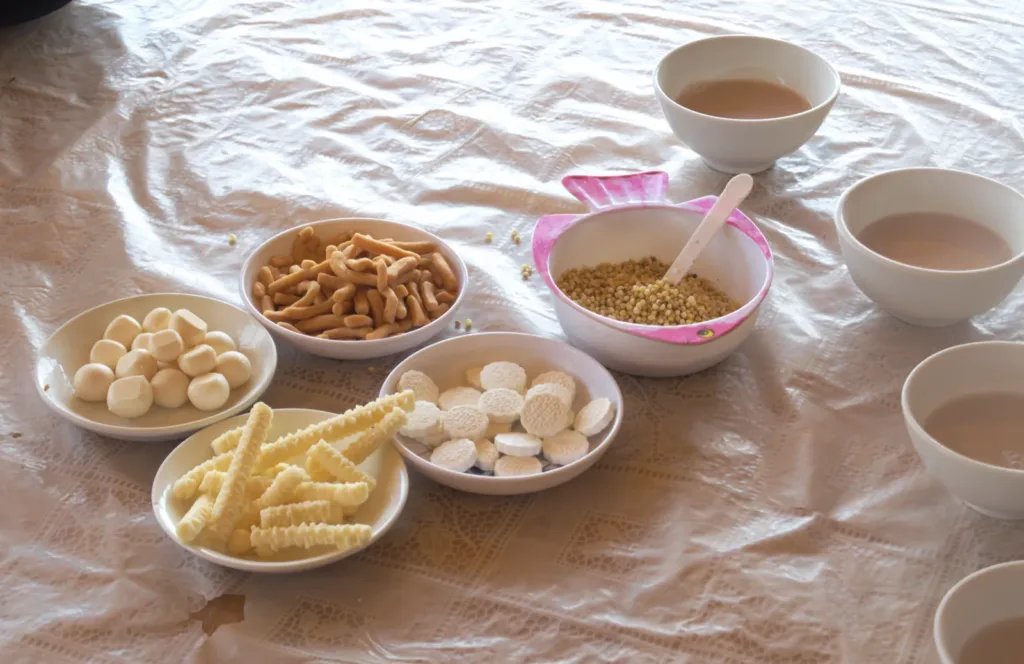
A China News report records a more elaborate preparation at a milk-tea house in Hohhot. The staff used green brick tea made from Hubei old green tea, brewed and boiled the tea liquor, repeatedly lifted and poured it to draw out the aroma, then strained it. They melted butter, fried toasted millet (炒米), and added tea liquor, fresh milk and salt by proportion before stirring in cream. Milk skin, milk curd, dried meat and fried dough strips were added as accompaniments. The often-quoted figure of 81 lifts belongs to that reported Hohhot preparation; it should not be treated as a compulsory Hulunbuir household rule. Add-ins, saltiness and thickness can change with the family, restaurant or occasion.
How to drink it
Traditional service is described by the pot rather than by a standard cup or bowl. In the same report, leftover tea in a Mongol home is kept warm over a low flame so family members can pour it later, and a guest is offered a full serving as a sign of respect. For a visitor, the interesting part is the combination of tea, milk, salt and whatever the table provides: toasted millet can add a grainy bite, while dairy products or dried meat make the drink closer to a small shared meal than to a sweet beverage.
Do not assume that a pale bowl is vegetarian, dairy-free or gluten-free. Butter, milk skin, milk curd, meat and wheat-based fried dough may be added in some preparations. Ask in Chinese whether the pot contains 牛奶, 黄油, 奶皮, 奶豆腐, 肉干 or 果条, and mention allergies before ordering.
Finding it while travelling
奶茶 is a dish, not a fixed attraction with a single entrance, ticket, address or station-to-restaurant route. Search for 奶茶 Nǎichá on Meituan (美团) or Amap / Gaode Maps (高德地图); if results are broad, add 呼伦贝尔 Hūlúnbèi’ěr, 海拉尔 Hǎilā’ěr or 额尔古纳 É’ěrgǔnà to the search. Open the menu, read recent reviews, check opening information and confirm that it is available today. Map ranking is not evidence of quality or authenticity, and a listing may describe a sweet modern drink rather than Mongolian salty milk tea.
If your itinerary includes a grassland cultural experience, a 2025 Xinhua report described visitor programs in Chen Barag Banner that included making Mongolian milk tea. Treat that as an example of an organised activity, not a current timetable: confirm the operator, meeting point and return transport before leaving town. Otherwise, choose a nearby listing in the town or area you are already visiting rather than planning a long detour for a drink whose recipe and daily supply vary.
More dishes to compare
Explore related local specialties and compare their names, preparation notes and ordering guidance.
Milk curd 奶豆腐 →
Milk is fermented or curdled, then heated, drained and pressed into a firm dairy product. Pieces may be eaten fresh, dried or softened in hot milk tea depending on their texture. Fresh milk curd can be mildly sour and chewy, while drier pieces are more concentrated and firm. Sweetened preparations taste different from plain ones.
Mongolian milk skin 蒙古奶皮子 →
Milk is gently heated and worked, then left to cool so a thick layer collects at the surface. The layer is carefully lifted and drained. Further drying creates the folded, firmer form often seen among other dairy foods. Fresh milk skin is rich and creamy, whereas a dried piece can be firmer and more concentrated in flavour. It softens in warm tea, changing the experience from chewing a sheet to drinking a fuller, milk-rich bowl.
Sources & reading
Recipes and servings vary between kitchens.
Image credits & notes (1)
- Mongolian salty milk tea (süütei tsai) with fried millet and dried dairy or cheese sweets, photographed in grassland north of Hohhot, Inner Mongolia, China, in 2015; a regional illustrative reference rather than proof of current service in Hulunbuir. Photo: PopolonPhoto: CC BY-SA 4.0