

Dali Pork Knuckle with Trotter Attached 大荔带把肘子
Dali Pork Knuckle with Trotter Attached is a Shaanxi steamed pork dish whose bone-and-hoof presentation, long steaming, and scallion-and-flour-paste accompaniments make it a festive taste of Dali County.
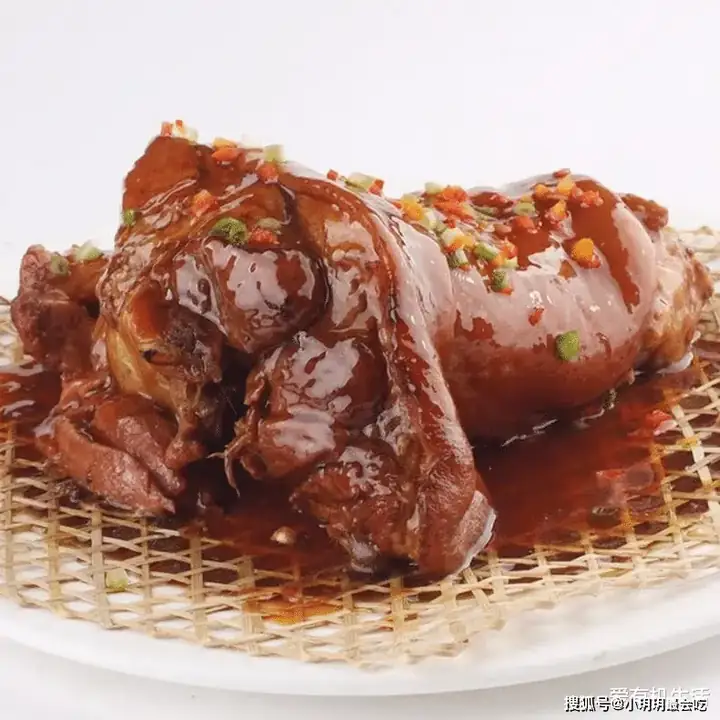
Image notes
Resized for the web; the photo itself has not been edited.
Tap any red Chinese text to hear it in Mandarin.
What makes it distinctive
大荔带把肘子 (Dali Pork Knuckle with Trotter Attached) is not an ordinary boneless braised pork knuckle. It uses a pork fore knuckle with the hoof and part of the leg bone left attached. When plated, the exposed bone resembles a handle, which explains the name. The finished piece is typically date-red, with soft meat and skin that still holds its shape.
In Dali County, the dish belongs to the local banquet tradition rather than to a single restaurant. Reports place it on festive and New Year tables, where it is served as a substantial centrepiece. It is also associated with the broader “九品十三花” banquet pattern, but recipes and portion sizes vary between kitchens.
How the texture is made
The work begins well before serving. One documented method soaks the knuckle overnight, then singes the hair, scrubs the skin, opens the large bone, and settles the meat in an earthenware bowl. The sauce in that account combines scallion, ginger, chilli, dahurian angelica root, star anise, flour sauce, fermented tofu, soy sauce and salt. The bowl then goes into a steamer; after the steam rises, the knuckle is cooked over high heat for about four hours and rested, covered, for another half-hour.
Another account blanches the prepared knuckle before coating it with sauce and steaming it with aromatics until tender. Read together, these descriptions show the stable idea rather than one compulsory recipe: keep the hoof and bone attached, season the skin and meat, and use prolonged steaming to soften the connective tissue without losing the characteristic shape. Do not treat one kitchen’s ingredient ratios or timing as a universal standard.
The result to look for is a glossy red-brown skin, translucent-looking fat beneath it, and meat that yields easily when lifted with chopsticks. “肥而不腻、瘦而不柴” is the local shorthand reported for the balance: rich enough to carry the sauce, but not dry or stringy.
How to eat it
A traditional presentation has a theatrical final step. The cooked knuckle sits in its earthenware basin; a porcelain plate is placed upside down over it, and the two are turned together before the basin is lifted away. This reveals the rounded mound and the exposed “handle” in one move. Serve it with scallion sections and flour paste, taking a little of the meat and skin with the accompaniments rather than eating the sauce by itself.
Because the preparation is long and the dish is often banquet-sized, ask about today’s availability and serving size before ordering. It is a pork dish, not a vegetarian option. The documented sauces include fermented tofu, soy sauce and flour sauce, but individual kitchens can change the mixture; travellers with soy, wheat or other food allergies should ask for the exact ingredients.
Finding it without a made-up restaurant recommendation
大荔带把肘子 is a dish, not a fixed address. In Dali County, search the exact Chinese name 大荔带把肘子 Dàlì Dàibà Zhǒuzi on Meituan (美团) or Amap / Gaode Maps (高德地图). Check the current menu, recent reviews, opening information and whether a whole portion is available that day. If the results are ambiguous, add 大荔县 Dàlì Xiàn to the search. A platform ranking is not proof of authenticity, so this method deliberately leaves the final choice to the current menu and your dietary needs.
Getting there and going back
For a rail arrival, use 大荔站 (Dali Station) in Dali County. The station is on the Datong–Xi’an high-speed railway and is in Nianqiao Town on North Fourth Ring Road; it is an operating passenger station, not a food venue. From the station, use a taxi or ride-hailing car to the current map result you selected by the Chinese dish name. There is no dish-specific entrance, and no fixed bus number, exit or journey time is given here because the serving location changes.
Before leaving, reverse the same last-mile arrangement and set 大荔站 Dàlì Zhàn as the return destination. Check the actual train schedule and ticket conditions for your date before travelling; do not assume a particular departure or a late-night local connection. If you arrive by road instead, keep the Chinese dish name and the county name ready for the driver, then confirm the return pickup point after you have chosen a currently open place.