

Suide Sheep Offal Soup 绥德羊杂碎
Suide Sheep Offal Soup is featured among the local specialties of Shaanxi.
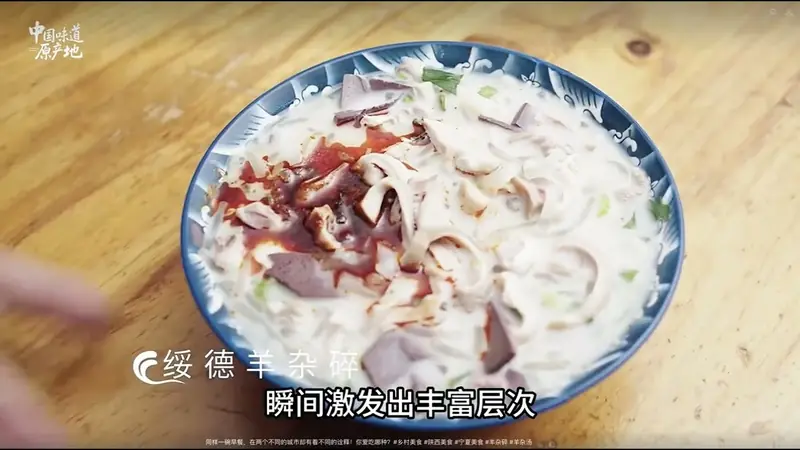
Image notes
Resized for the web; the photo itself has not been edited.
Suide Sheep Offal Soup (绥德羊杂碎) is a soupy braise of sheep offal, thin glass noodles and celery in sheep-bone broth, and the Suide County (绥德县) government calls it a traditional food with a strongly local flavour. Suide lies in Yulin (榆林), Shaanxi. The county describes the finished bowl as spicy but refreshing, fragrant without a gamey smell, and oily without being greasy.
How it is made
The main ingredients are yangnao (羊脑, literally "sheep's brain"), tripe, sheep's blood, sheep-bone broth, thin glass noodles and celery; the seasonings are sheep fat, ground ginger, ground Sichuan pepper, coriander, scallion and salt. The cooked yangnao, tripe and blood are cut into small strips, the softened noodles into 15 to 20 centimetre lengths and the celery into pieces about 3 centimetres long.
Sheep fat is heated in an iron wok until red, scallion is fried in it until yellow, and the yangnao and tripe are stir-fried briefly before the ginger and pepper go in. Bone broth is poured over and brought to the boil; the blood, celery and noodles follow, with boiling water added to set the thickness. The bowl is finished with coriander, scallion, chilli fried in sheep fat, and salt. The county account adds that the marrow in the bone broth gives the depth of flavour, and that monosodium glutamate or chicken bouillon must never be added.
Where it comes from
A Suide story credits a restaurant helper who, to save effort, tipped chopped yangnao and tripe straight into his heated glass-noodle soup. The county account says the dish had largely taken its present form by the end of the Yuan dynasty, and calls it a product of the meeting of grassland and loess-plateau cultures. In the 1940s and 1950s Wang Zhiquan (王治全) and Bai Henian (白鹤年) were well-known sellers. The Macun (马存) offal shop opened under its own sign in 1983, carrying on a family recipe the county cultural centre describes as a century old.
How it is eaten
The offal is eaten on its own or with firm steamed buns (硬面蒸馍) or fried flatbread (油饼), and winter is when it sells best. The county government counts close to a hundred sellers in Suide town, and names Macun and Anqi (安旗) in Xuejiapan (薛家畔) and Ma Shifu (马士富) in Luoyanbian (落雁砭) as established names.

Sources & reading
Written from the linked sources and fact-checked against them on 2026-09-24. Recipes and servings vary between kitchens.