

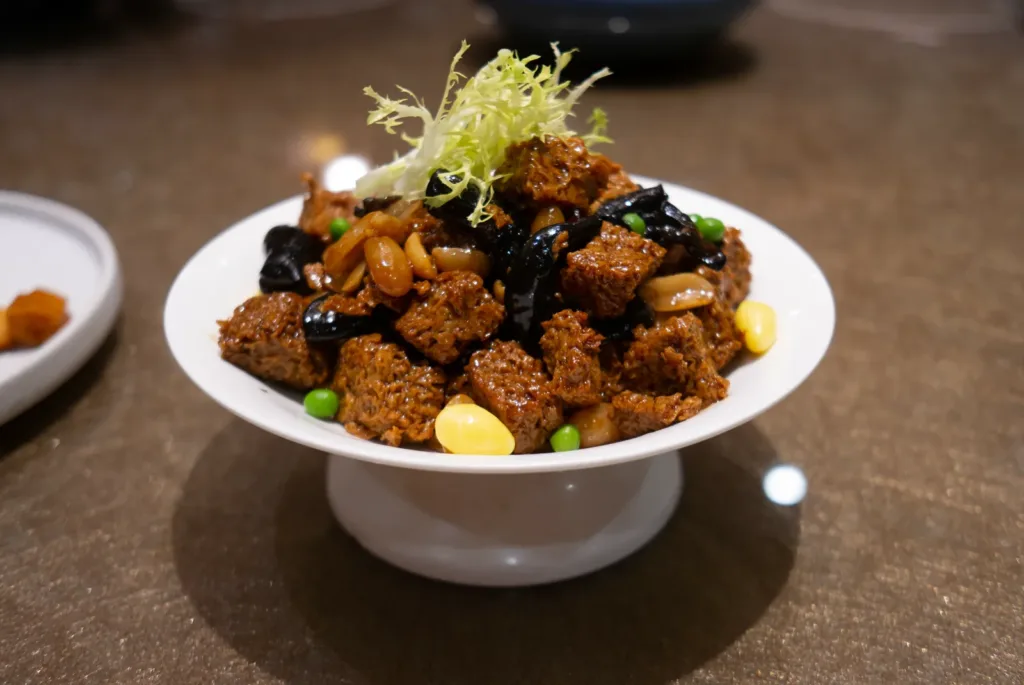
Shanghai four-happiness wheat gluten 四喜烤麸
A Shanghainese cold appetizer of airy wheat-gluten kaofu braised in a glossy, sweet-savoury soy sauce, often with shiitake, wood ear, peanuts and dried lily buds. The exact combination varies; it is commonly served chilled, though some kitchens serve it warm.
Tap any red Chinese text to hear it in Mandarin.
What it is
Show 四喜烤麸 (sìxǐ kǎofū, often romanised sixi kaofu) when ordering. The key word is 烤麸, kaofu: a porous food made from wheat gluten, not tofu. A recipe description explains that the gluten is fermented and steamed into a soft, airy structure; that open texture is what lets the pieces take up braising liquid.
Sixi kaofu is associated with Shanghai and often appears as a cold starter in Shanghainese cooking. The word “four” should not be read as a guarantee of one canonical set of four additions. Recipes and menus differ: shiitake, wood ear fungus, peanuts and dried lily buds are a familiar combination, while bamboo shoot also appears in other versions.
How it is cooked and tastes
A cook may rehydrate dried kaofu, rinse or blanch it, and then fry or brown it before simmering. The accompaniments are softened or rehydrated as needed; soy sauce, sugar and water or stock form the braising liquid. Slow cooking draws the seasoning into the gluten’s many pores, and the sauce is often reduced until it clings. The order and details vary: one documented recipe blanches then fries the gluten, while another fries it with ginger before adding the liquid.
Look for a deep brown, glossy finish rather than a dry coating. Soy brings salt and savouriness; sugar gives a rounded sweetness that can be more or less pronounced from kitchen to kitchen. The braise has a cooked-soy and mushroom aroma where mushrooms are included. The kaofu is springy yet sponge-like, shiitake is tender, wood ear has a firmer, lightly crisp chew, and peanuts add a dense, nutty bite. Dried lily buds may be soft and slightly chewy. These are typical contrasts, not a promise that every bowl contains every ingredient.
Serving and ordering
It is commonly cooled and served as a small appetizer before the main dishes. Some recipes also serve it warm. Share a few pieces alongside other dishes, or spoon a little sauce over plain rice if you want a more substantial bite.
The dish is often prepared without meat, but do not assume a restaurant’s version is vegan: stock and seasonings differ. Ask whether the braising liquid contains meat stock, and whether sesame oil is used. Kaofu contains wheat gluten; soy sauce commonly contains soy, and peanuts are a frequent ingredient. If these matter to you, confirm the ingredients and kitchen handling directly.
More dishes to compare
Explore related local specialties and compare their names, preparation notes and ordering guidance.
Butterfly pastry 蝴蝶酥 →
Laminated pastry is folded into a double spiral, cut into slices and baked so the layers open into a butterfly shape. Sugar on the surface caramelizes during baking. The pastry breaks into thin, crisp flakes with a buttery aroma and sweet, toasted edges. Humidity quickly softens that delicate structure.
Crab-shell-shaped sesame pastries 蟹壳黄 →
Small wheat pastries are layered with fat, filled and baked under a sesame-covered crust. Sweet and savory fillings coexist, so appearance alone may not identify the contents. The shell is crisp and flaky, with toasted sesame fragrance and a softer center. Savory versions may taste richer than their small size suggests.
Sources & reading
Recipes and servings vary between kitchens.
Image credits & notes (1)
- Kaofu served at a Shanghai restaurant. The photographed garnish is one restaurant’s version, not a fixed ingredient list. Photo: MemmPhoto: CC BY-SA 4.0