

Shaoxing fried fermented tofu 绍兴臭豆腐
Shaoxing fried fermented tofu (绍兴臭豆腐) is tofu soaked in fermented amaranth-stem brine and fried until the outside is crisp while the centre stays soft. Its strong fermented aroma, local brine tradition and variable dipping sauces make it a distinctly Shaoxing way to meet China’s wider stinky-tofu tradition.
Tap any red Chinese text to hear it in Mandarin.
What makes the Shaoxing version different
The defining step is not the frying alone. A traditional Shaoxing brine is made from pickled and fermented amaranth stems (霉苋菜梗); tofu is soaked in that liquid before it goes into the oil. CCTV’s preparation note explains that dehydrated tofu develops many small holes and quickly takes up the fermented brine. Recipes and handling are not identical across makers, so the name describes a local style rather than one fixed formula.
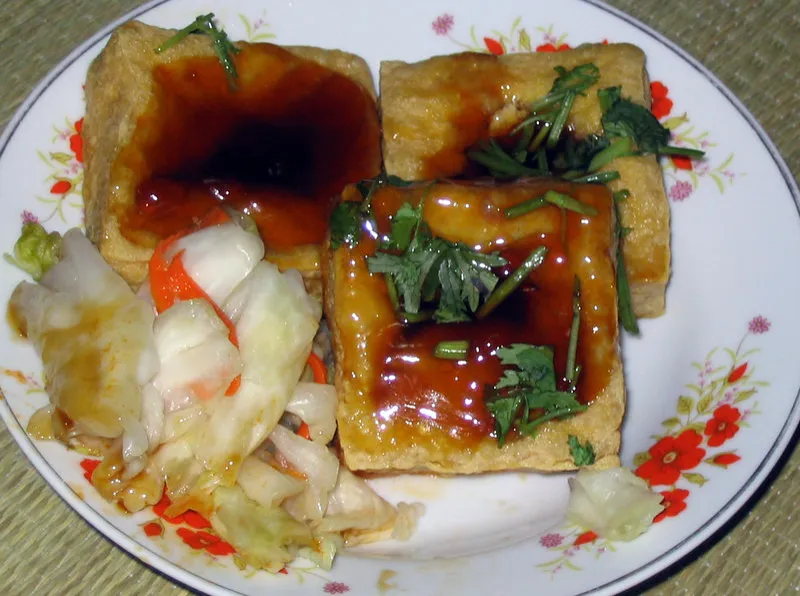
In the pan, look for a thin golden, crisp skin and a soft, brine-seasoned interior. The aroma can be forceful, while the centre tastes gentler; frying heat, the moment it is lifted from the oil and the sauce ratio all affect the result. This is why a freshly fried portion is more useful than judging the dish from its smell alone.
How to try it
Ask for 绍兴臭豆腐 Shàoxīng chòudòufu (“Shaoxing stinky tofu”). For a first taste, start with a small portion, eat one piece while it is freshly fried, then add the shop’s dipping sauce gradually. The sauce is part of the shop’s version, not a universal recipe; it may shift the bite toward salty, sweet or spicy.
If you have dietary restrictions, ask what is in the fermentation liquid and dipping sauce rather than assuming that tofu alone describes the whole preparation.
Local context
Shaoxing臭豆腐 is identified as a traditional local snack and has been listed as a representative item of Shaoxing’s municipal intangible cultural heritage. That status does not make every stall’s batch identical: the brine, fermentation conditions, frying and seasoning remain maker-dependent. It also should not be confused with every other city’s stinky tofu. The best way to meet the Shaoxing style is to keep the Chinese name visible and try it as a small, freshly fried snack in the city’s everyday food scene.
Where to eat it
You can find Shaoxing fried fermented tofu all over Zhejiang, so there is no need to seek out one particular restaurant. To find one near you, search for “绍兴臭豆腐” in Meituan (美团) or Amap (高德地图) and check recent reviews, distance and opening hours.
More dishes to compare
Explore related local specialties and compare their names, preparation notes and ordering guidance.
Shengzhou steamed buns 嵊州小笼包 →
Small portions of wheat dough are wrapped around savory filling, pleated and steamed in closely packed baskets. Shengzhou shops offer variations, including meat-based and tofu-containing fillings, rather than a single universal combination. The wrapper is soft and fairly substantial, surrounding a juicy, seasoned center. A fresh basket keeps the dough at its most tender.
Huzhou tofu-skin parcels 湖州千张包 →
Thin sheets of tofu skin are wrapped around a minced savory filling and cooked, often in broth. The wrapper absorbs soup while holding the filling together in a compact parcel. The skin is tender with a slight bean-like chew, contrasting with the juicy, finer filling and light surrounding liquid.
Sources & reading
Recipes and servings vary between kitchens.
Image credits & notes (1)
- Fried stinky tofu with sauce and pickled vegetables at Taipei's Nan Ji Chang Night Market, Taiwan; a regional stinky-tofu illustration, not a photograph of Shaoxing. Photo: Richy (original uploader at Chinese Wikipedia; via Wikimedia Commons)Photo: CC BY-SA 3.0