

Shaoxing rice cake 绍兴年糕
Shaoxing rice cake is a family of firm, sliceable rice cakes eaten as both a staple and a festive food across Shaoxing. It is especially interesting as a base for local cooking: the same mild, springy cake can be stir-fried, simmered in soup, steamed or pan-fried, with local rice, greens, bamboo shoots, meat or sugar shaping the final dish.
Tap any red Chinese text to hear it in Mandarin.
A local food family, not one fixed recipe
“Shaoxing rice cake” is best understood as a local food family rather than a single fixed recipe. A Shaoxing report names Fengqiao rice cakes from Zhuji, Lianghu rice cakes from Shangyu, Ding Daxing rice cakes from Yuecheng, and pillow-shaped cakes from Shengzhou and Xinchang as local examples. Their shapes and rice blends vary by place, so do not expect every serving called 绍兴年糕 to look identical.
The production method is part of the appeal. One current account from Yuecheng describes a water-milled version: glutinous rice is soaked, ground into slurry, pressed into shape, steamed and cooled. The result is soft, chewy and fragrant with rice. Other local descriptions stress that the balance between glutinous and non-glutinous rice, as well as the shape of the finished cake, changes between Shaoxing’s localities.
Once sliced, the cake has a mild flavour and a resilient chew that takes on sauce. Local accounts describe cutting it into slices or strips before roasting, steaming, simmering or stir-frying.
How it is cooked
White rice cake is a flexible everyday ingredient. A local recipe fries slices until lightly golden, then tosses them with pork, cooked winter bamboo shoots, chives, scallions, Shaoxing wine and soy sauce; the exact combination depends on the kitchen and the season. Sweet versions with brown or white sugar may be steamed or pan-fried instead.
If a menu says 嵊州炒年糕, expect a more specific Shengzhou style rather than treating it as the definition of every Shaoxing rice cake. The distinctive “soup-fried” technique is recognised as a Shengzhou preparation: the cake is fried first, then finished with hot liquid and other ingredients. The result is a bowl in which the rice cake keeps some bite while taking on the broth.
Ordering notes
Show 绍兴年糕 Shàoxīng niángāo when you order. Ask whether the serving is dry-fried or soupy, and ask which meat, greens, bamboo shoots or pickles are included. If you need a vegetarian or alcohol-free dish, say so and confirm the broth and sauce rather than relying on appearance: one local recipe uses pork and Shaoxing wine.
Where to eat it
You can find Shaoxing rice cake all over Zhejiang, so there is no need to seek out one particular restaurant. To find one near you, search for “绍兴年糕” in Meituan (美团) or Amap (高德地图) and check recent reviews, distance and opening hours.
More dishes to compare
Explore related local specialties and compare their names, preparation notes and ordering guidance.
Longyou fermented rice cake 龙游发糕 →
Rice batter is fermented, sweetened and steamed so it rises into a porous cake. The fermentation and steaming create the structure rather than a conventional oven-baked crust. The crumb is soft and spongy, with a lightly fermented aroma and gentle sweetness. Warm slices are especially supple, while cooling makes them firmer.
Ningbo sweet rice balls 宁波汤圆 →
Glutinous-rice dough encloses a sweet filling, commonly black sesame, and is boiled until tender. Traditional rich fillings may include pork fat as well as sugar and ground sesame. The wrapper is soft and elastic, while the center becomes fluid, aromatic and very hot. Plain cooking liquid keeps attention on the filling.
Sources & reading
Recipes and servings vary between kitchens.
Image credits & notes (1)
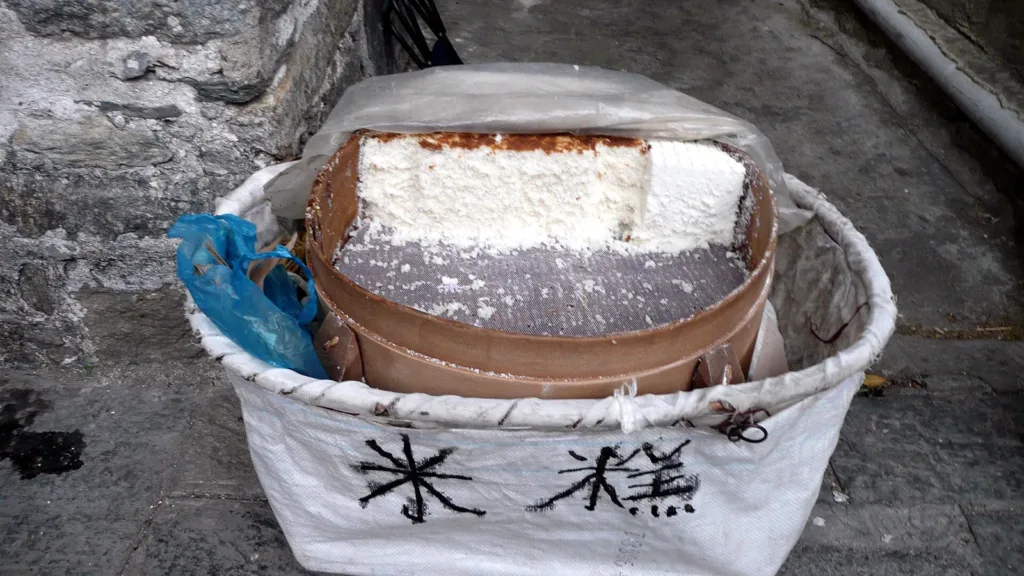
- A Chinese rice cake (米糕) in a street-side steamer in the old town of Dali, Yunnan; a regional rice-cake reference rather than a verified Shaoxing preparation. Photo: Brücke-OsteuropaPhoto: CC0 1.0