

Shigatse pengbi pea jelly 朋必
Pengbi (朋必) is Shigatse’s savory pea-jelly snack: a soft, set pea mixture seasoned with scallion, curry and oil, often served with chili and sometimes made with minced meat, with recipes and availability varying by stall.
Tap any red Chinese text to hear it in Mandarin.
In brief: Pengbi (朋必) is Shigatse’s savory pea-jelly snack: a soft, set pea mixture seasoned with scallion, curry and oil, often served with chili and sometimes made with minced meat, with recipes and availability varying by stall.
What to look for
Pengbi is a local Shigatse snack, not a fixed attraction. Reports describe vendors carrying aluminum pots through city streets and near Tashilhunpo Temple, while a local non-heritage festival also sold it in a temporary food market. These are useful places to ask around, but they are not a current address or a guaranteed daily schedule.
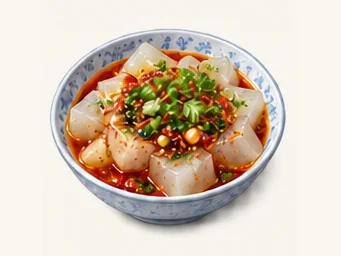
A fresh portion may be pale green and jelly-like. The appeal is the contrast between a mild pea base and a savory, spicy dressing; public descriptions call the texture smooth, soft and slightly glutinous.
How it is made and why batches differ
A detailed local description starts by grinding Tibetan peas and letting the mixture settle. The thicker middle liquid is kept, cooked to a paste, and seasoned with salt, Tibetan scallion, curry powder and a little oil; minced meat is an optional, more elaborate addition. Cooling turns it into a soft, green-tinged jelly.
Other reporting describes the pea material being cooked with oil, scallion, curry and salt before it is cooled and portioned. Taken together, the sources support a family of local preparations rather than one rigid formula. Ask what is in that day’s batch, especially whether it contains meat or a strong chili sauce.
Taste, observation and ordering
When a vendor is preparing a batch, watch the cooked mixture being portioned after cooling and ask which toppings were added. If chili is served separately, ask for a little first and add more only if you want it. The snack’s main flavor should remain the mild, earthy taste of pea, with curry, scallion and chili changing the aroma and heat.
Show the Chinese name 朋必 Péngbì when asking for the snack. You can also search for 朋必 Péngbì on Meituan (美团) or Amap / Gaode Maps (高德地图) to look for nearby listings. Check the menu, recent reviews, opening information and that day’s availability yourself; search ranking is not proof of quality or authenticity.
Variants and dietary notes
The usual local descriptions allow variation in the seasoning and in whether minced meat is included. A 2024 competition dish called Jixiang Barley Pengbi added highland barley, but that is an identified innovation, not evidence that every street portion contains barley.
Peas are a legume. Some versions include minced meat, and the sauce or oil may vary. Ask about the batch and toppings; do not assume a serving is vegetarian, allergen-free or mild.
Access and return
Pengbi has no ticketed entrance, fixed restaurant address or dish-specific transport stop. Once you are in Shigatse, search 朋必 Péngbì on Meituan or Amap / Gaode Maps, then confirm that a nearby stall or market is serving it that day. The public sources identify general street, temple-area and market settings, but they do not establish a current opening schedule.
Because there is no fixed venue, no metro station, bus route, exit number, walking time or return route applies to the dish itself. After choosing a public place, use the current taxi, ride-hailing or city-transit option shown for that place; do not plan around an old stall report.
More dishes to compare
Explore related local specialties and compare their names, preparation notes and ordering guidance.
Dried yak meat 风干牦牛肉 →
Yak meat is salted or seasoned and dried to reduce moisture; commercial products may include additional cooking stages. Thickness, drying time and spice mixtures vary. The result is concentrated in meat flavor, with a firm chew that can range from pliable to very hard. Fat content changes the texture substantially.
Khapse fried pastries 卡塞 →
Wheat dough is shaped into twists, braids or other decorative forms and fried until golden. The shapes may be large for display or small enough to eat with tea. The pastries are crisp and crumbly, with a lightly sweet or plain fried-dough flavor that varies by recipe.
Sources & reading
Recipes and servings vary between kitchens.