

Jiangji Soft Tofu 蒋记豆花
Jiangji Soft Tofu is featured among the local specialties of Sichuan.
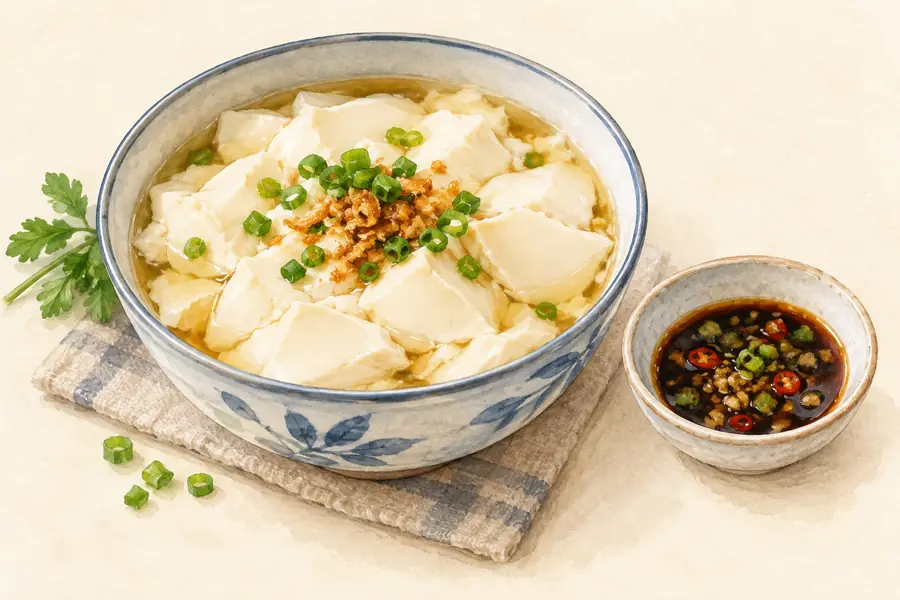
Jiangji Soft Tofu (蒋记豆花) is a soft bean-curd specialty listed for Mianyang, Sichuan. 豆花, literally bean flower, is curd that is set loosely and spooned out rather than pressed, and the opening 记 is a long-standing habit in Chinese shop names.
How 豆花 is made and served
Dou hua is set with less pressure than block tofu, so it stays delicate and holds a little of the liquid it was made in. It is spooned into a bowl rather than cut into cubes, and served warm, either in its own mild liquid or drained and dressed. The softness is the whole point: it should break under a spoon without falling apart.
Because the curd is barely seasoned, the dip does the work. A small dish of chilli oil, soy, vinegar, minced garlic or chopped herbs sits beside the bowl, and you lift a spoonful of curd, dip it, and eat. Kitchens vary the balance; some keep the dip sharp and thin, others thick and aromatic.
What it tastes like
The curd itself is mild, faintly sweet and almost silky, closer to a savoury custard than to firm tofu. Almost all of the flavour comes from the dip, so the first bite should taste of chilli, vinegar and aromatics, with the curd cooling and softening them behind.
If the bowl tastes flat, you have not dipped deep enough or the sauce needs more acidity. Ask for extra vinegar or chilli oil rather than salt, and stir the dip before you start so the oil and the solids do not stay separate.
The Mianyang setting
Mianyang lies in northern Sichuan, and dou hua is everyday food across the region: cheap, quick and eaten at any hour, from breakfast to a late snack. It is the kind of dish a city keeps for itself rather than one reserved for visitors, which is why it appears in plain shops as often as on a formal menu.
Reading the name
The core of the name is 豆花, soft bean curd made from soybeans, and the dip is where the rest of the ingredients live. A typical dip may hold chilli oil, soy sauce, vinegar, garlic, sesame and chopped herbs, but the exact mix belongs to the kitchen. Tell staff if you avoid soy, chilli, garlic or vinegar, since almost all of it arrives in the one small dish.
How to order
Ask for 豆花 and say how many bowls you want, since it is normally ordered per person rather than as a shared plate. Ask whether the curd comes in its liquid or drained, and whether the dip is already made hot. 不要辣 removes the chilli, and 蘸水少一点 asks for less dip on the side.
At the table
Eat dou hua soon after it reaches the table: the curd keeps releasing liquid as it stands and the dip separates. Spoon a little curd into the dip rather than pouring the dip over the whole bowl, so the last spoonfuls still taste fresh. Rice or a plain bun alongside makes it a full meal rather than a snack.
More dishes to compare
Explore related local specialties and compare their names, preparation notes and ordering guidance.
Fushun douhua 富顺豆花 →
Fushun douhua (富顺豆花) is the same loose-set curd from another part of Sichuan, and the two are worth tasting side by side because the difference sits almost entirely in the dip. The curd is similarly soft; the seasoning is where each place marks its own taste.
Questions before you order
Is 豆花 the same as tofu?
It is the same base ingredient set more loosely and served with a dip, so it tastes mild like tofu but feels much softer.
Can I order it without chilli?
Yes. The chilli sits in the dip, so ask for a plain dressing and the curd itself will arrive unseasoned.

Sources & reading
The supplied food list supports this name and regional association. The culinary terms below are explained as menu vocabulary; a local recipe, origin story and venue availability have not been independently verified.