

Yak Meat Soup Hot Pot 牦牛肉汤锅
Yak Meat Soup Hot Pot (牦牛肉汤锅) is a shared Tibetan-style pot associated with Garzê’s highland yak culture: broth, yak meat and changing vegetables are served as a table meal rather than a single fixed recipe. Similar names in Garzê include 牦牛汤锅 and 牦牛肉野菌汤锅, so read the menu for the actual ingredients and serving style.
Tap any red Chinese text to hear it in Mandarin.
What the name means in Garzê
牦牛肉汤锅 literally identifies a yak-meat soup hot pot. In Garzê, it is better understood as regional Tibetan-style dining than as an invention of one town. A 2022 Ganzi state public notice for “Shengjie Ganzi”特色餐饮 listed a Snowland ecological yak-meat wild-mushroom soup pot in Kangding, along with entries called 牦牛汤锅, 草原牦牛汤锅 and 高原有机牦牛汤锅 in Litang and Luhuo. A 2020 report from Litang’s Qianhu Tibetan Village also described yak-meat soup hot pot as an evening food offering during a National Day visitor programme. These records show regional use and named variations, not one restaurant’s priority or a current guarantee.
The Garzê connection begins with the ingredient landscape rather than a claim that the prefecture created one standard recipe. Sichuan Online described Garzê as a major yak-producing area and reported local work on breeding, pasture, processing and traceability. That background explains why yak is a meaningful local ingredient; it does not make every soup pot identical.
What to look for in the pot
Expect the broth and the meat to lead the meal, but do not assume a single Garzê formula. A 2024 Xizang Daily report on a Tibetan yak soup pot in Lhasa describes yak-bone broth prepared in advance, with the pot simmered for about 30 minutes before service. Its example arranges baby cabbage, yak ribs, white radish, celtuce, carrot and vermicelli with sliced yak meat, tongue and tripe. The same report notes that home versions may use water and whatever vegetables the family prefers. This is a documented Tibetan variation, not a recipe card for every kitchen in Garzê.
The Ganzi public notice records a wild-mushroom version, so mushrooms may be part of the local offer, but the notice does not establish a universal ingredient list. Ask whether the current pot includes wild mushrooms, which vegetables are included, and whether offal or processed additions are part of the set.
How to eat it
If the pot arrives with separate ingredients, taste a little broth before adding a dipping sauce. Add vegetables or other pieces in the order the server suggests, and eat meat while it is hot rather than leaving it to cool at the side of the pot. Rice or noodles at the end are not guaranteed, so ask before ordering them.
Useful questions in Chinese are:
- 这是牦牛肉汤锅吗? Zhè shì máoniúròu tāngguō ma? — Is this yak meat soup hot pot?
- 锅里有牦牛骨汤、牛舌或牛肚吗? Guō lǐ yǒu máoniú gǔtāng, niúshé huò niúdǔ ma? — Does the pot contain yak bone broth, beef tongue or tripe?
- 有野菌和哪些蔬菜? Yǒu yějūn hé nǎxiē shūcài? — Which wild mushrooms and vegetables are included?
- 辣不辣?有没有蘸料? Là bu là? Yǒu méiyǒu zhànliào? — Is it spicy? Is there a dipping sauce?
Finding it without a fixed address
Search for “牦牛肉汤锅” on Meituan (美团) or Amap / Gaode Maps (高德地图) to find nearby places serving this dish. Check menus, recent reviews, opening information and today’s availability before choosing.
You can also try the shorter name 牦牛汤锅 Máoniú Tāngguō or the variant 牦牛肉野菌汤锅 Máoniúròu Yějūn Tāngguō. Because the dish has been documented in more than one Garzê county-level setting, search in the town where you are staying rather than treating it as a single destination. Search ranking does not prove quality or authenticity.
This is not a fixed venue, so there is no single restaurant address, entrance or route for this dish. Prices, portions, opening hours and same-day supply need to be checked locally.
Dietary and practical notes
牦牛肉 means yak meat, so this is not a vegetarian dish. The documented Tibetan version can also include ribs, tongue, tripe and processed lunch meat, but those additions are not guaranteed in Garzê. Ask exactly what is in the broth and the set before ordering.
A clear-looking broth is not proof of vegetarian stock or an allergen-free meal. If you avoid meat, offal, dairy, soy, gluten or particular mushrooms, ask about the broth, dipping sauce, noodles and processed ingredients, and remember that a shared pot and ladle can create cross-contact. If you avoid alcohol, ask whether any sauce or processed ingredient contains it; do not assume brief heating removes it.
More dishes to compare
Explore related local specialties and compare their names, preparation notes and ordering guidance.
Jiu Zhai Gou Mao Niu Rou Tang Guo 九寨沟牦牛肉汤锅 →
Jiu Zhai Gou Mao Niu Rou Tang Guo (九寨沟牦牛肉汤锅) is the same yak-meat soup pot with a national park rather than a prefecture in front of it. Reading the two names together shows what the place word does here: the technique and the animal stay the same, and what changes is which kitchen's reading of the pot you are being offered.
Image credits & notes (1)
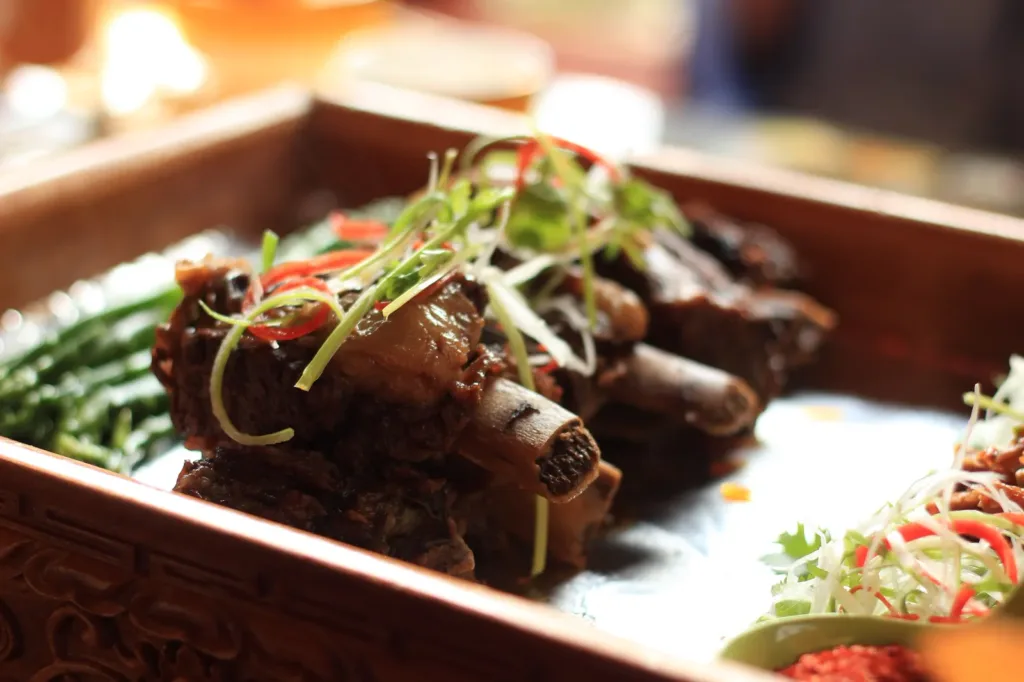
- A Tibetan yak meat dish with cooked meat and fresh herbs, used as an ingredient-level visual reference; it is not identified as a Garze soup hot pot. Photo: yuhanlikefilm (Pixabay)Photo: CC0 1.0