

Sour-soup fish 酸汤鱼
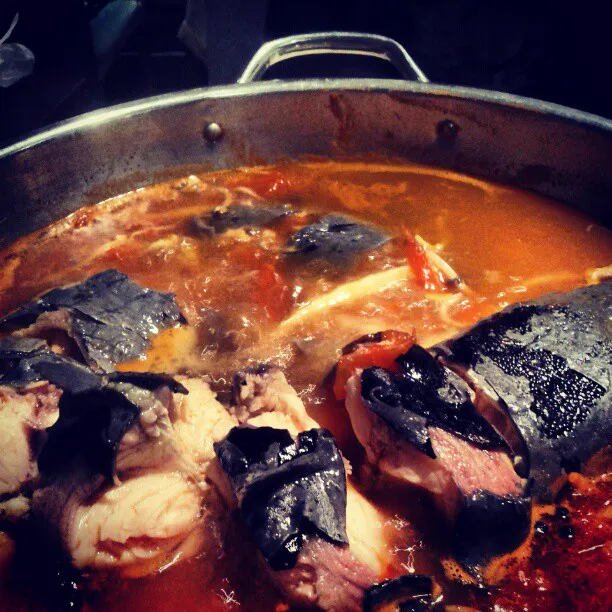
Sour-soup fish is a communal fish hotpot associated with Kaili and the wider Qiandongnan area of Guizhou. Its defining feature is not one fixed recipe, but fresh fish cooked in a fermented sour broth, commonly in red or white styles.
Tap any red Chinese text to hear it in Mandarin.
At a glance: Sour-soup fish is a communal fish hotpot associated with Kaili and the wider Qiandongnan area of Guizhou. Its defining feature is not one fixed recipe, but fresh fish cooked in a fermented sour broth, commonly in red or white styles.
Sour-soup fish is best understood as a regional way of eating rather than a single restaurant dish. The national intangible-cultural-heritage record for the Kaili sour-soup fish cooking technique identifies Kaili in Qiandongnan as the applicant area and gives the technique a core distribution across Kaili, Leishan, Taijiang and Jianhe, with wider reach across the prefecture. It describes the dish as a hotpot: the sour broth, fish, seasonings and cooking happen in the same shared pot. That makes 酸汤鱼 a useful food stop when you are travelling through Qiandongnan, but it should not be recast as a Guiyang-origin dish merely because the two destinations are presented in one travel group.
What makes the broth distinctive
The heritage record describes two broad broth families. White sour soup (白酸汤) begins with a cooked glutinous-rice liquid that is cooled and fermented with an older starter. In the documented traditional method, it is left in a jar for several days, producing a clear broth with a rice fragrance and rounded acidity. Red sour soup (红酸汤) uses fresh tomatoes and red chillies with other seasonings; the documented traditional process involves a much longer fermentation before the mixture is ground and fermented again. The record describes the resulting broth as bright, fragrant, moderately hot and rounded in acidity.
These details explain why two bowls called 酸汤鱼 can look and taste different. The heritage description is a record of a traditional technique, not a promise that every current kitchen follows one exact timetable or ingredient list. A 2024 report on Qiandongnan’s sour-soup industry also records red sour, white sour, rice sour, bean sour and fish-sauce sour products, showing that “sour soup” is a wider local tradition rather than a single tomato formula. Ask which broth is being served before ordering, especially if you want a clear white broth or a tomato-and-chilli red one.
How to order and eat it
Show the Chinese name 酸汤鱼 Suān Tāng Yú when searching or ordering. If a menu also says 凯里酸汤鱼 Kǎi Lǐ Suān Tāng Yú, it is referring to the Kaili-associated version; that name is a useful regional clue, not a reason to assume one restaurant is the definitive source. The fish should be cooked in the simmering pot, so ask which fish is available, whether the price is calculated by weight, and what the pot already includes before it is prepared. Fish bones are normal: take small pieces and check the broth and fish carefully as you eat.
The sourness and chilli heat are separate questions. Tell the server both how much sourness and how much chilli you can handle. If you have a fish allergy, avoid fish, or need to know about fermented rice, tomato, chilli, herbs, alcohol or animal ingredients, ask what is in the broth before ordering. A red colour does not by itself identify the souring method or tell you how hot the pot will be.
Finding it without choosing a particular shop
Search 酸汤鱼 Suān Tāng Yú first, and then 凯里酸汤鱼 Kǎi Lǐ Suān Tāng Yú if you are in Kaili or elsewhere in Qiandongnan, in Meituan (美团) or Amap/Gaode Maps (高德地图). Treat the results as a way to find nearby possibilities, not as a ranking or endorsement. Open each candidate’s current menu photos or menu text to confirm that 酸汤鱼 is actually offered. Then check several recent dated reviews, the current opening hours, and whether fish is being served that day; message or call the venue if the listing is unclear. Before cooking, confirm the fish weight, total fish charge, broth style and extra-pot or accompaniment charges. This guide does not recommend a named restaurant, brand or address.
There is no ticketed attraction, standard visitor entrance or dish-level transport route for 酸汤鱼. It is a food served by individual venues, so there is no honest single address, metro stop or return route to publish. Once you have chosen a currently open listing, use that listing in Amap for the actual route and recheck its hours and supply on the day. The dish itself has no published visitor season; fish selection, menu availability and venue hours can change, so do not infer future seasonal supply from an older event or promotion.
More dishes to compare
Explore related local specialties and compare their names, preparation notes and ordering guidance.
Wujiang tofu fish 乌江豆腐鱼 →
The fish is cooked with tofu so the bean curd absorbs the surrounding flavour without losing all its shape. Tender fish contrasts with soft, broth-soaked tofu. The seasoning can be rich and spicy, but the local name does not mandate one exact sourness.
Zhe'ergen herb salad 凉拌折耳根 →
The tender parts are selected, trimmed, washed and cut into short pieces, then mixed with dressing. Some preparations briefly blanch the plant; others use it raw. The chosen parts and treatment change both the crunch and intensity of aroma. The stems have a clean snap, while the aroma can seem medicinal, earthy or fish-like to a first-time diner. Garlic, chilli and sourness add their own flavours. It is reasonable to enjoy a small taste without expecting to like the herb immediately.
Sources & reading
Recipes and servings vary between kitchens.
Image credits & notes (1)
- Sour-soup fish in a red broth, photographed in Haidian, Beijing; used as an off-site illustration of the regional dish, not as a claim that this pot was photographed in Qiandongnan. Photo: shizhaoPhoto: CC BY-SA 2.0