

Tibetan-Style Yak Meat 藏式牦牛肉
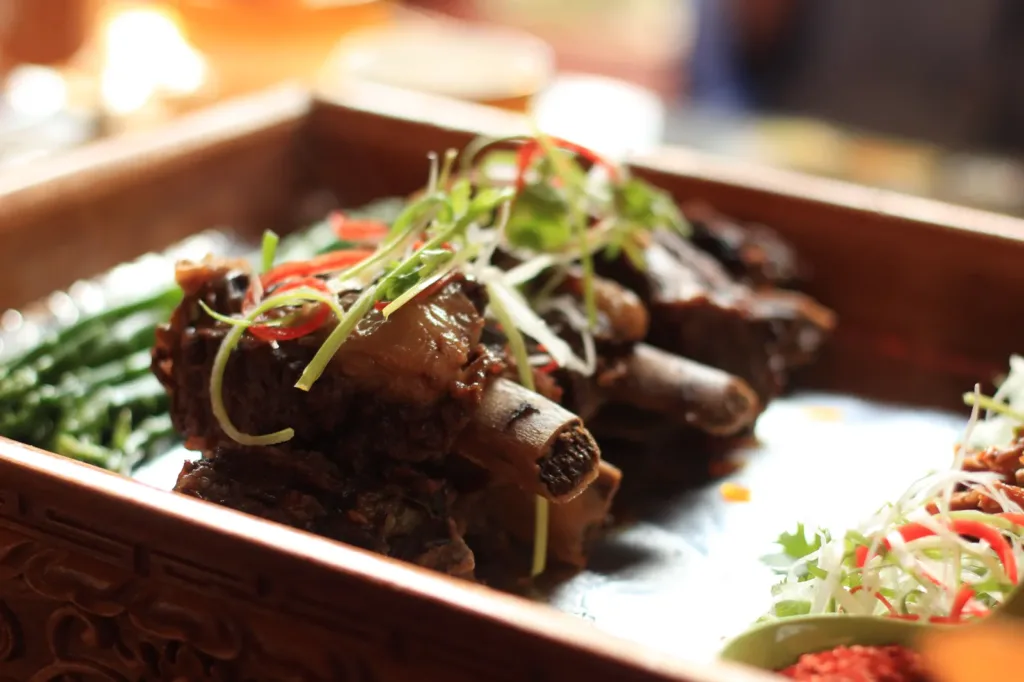
A Shigatse menu label for yak meat in southern Tibetan cooking, with versions that may be boiled, braised, stir-fried, hot-potted, or dried. Ask which preparation is available instead of assuming one fixed recipe.
Tap any red Chinese text to hear it in Mandarin.
What the name means in Shigatse
“藏式牦牛肉” is not one protected recipe or a single restaurant dish. In Shigatse, it is best understood as a practical menu name for yak meat prepared in the local Tibetan food tradition. An official account of Tibetan cooking places Lhasa, Shannan, and Shigatse in the 藏南流派, a farming and semi-pastoral style whose flavors are described as fresh, lightly seasoned, and balanced between meat, dairy, and crops. It lists boiling, stir-frying, roasting, braising, and frying among the methods used in this regional cooking.
Yak is part of the wider plateau food system rather than a novelty ingredient. A Smithsonian Folklife account of Tibetan foodways describes yak as a main source of meat and dairy in highland communities, with roasted barley flour, yak butter tea, and meat appearing in everyday meals. That account is from a Tibetan community in Gansu, not a Shigatse recipe book, so it is useful cultural context rather than proof of one local formula.
Choose the preparation, not a “standard” recipe
Fresh yak meat may appear in a Tibetan hotpot or another cooked dish. A Shigatse dining guide also describes a preserved version: meat is cut into chunks, boiled without spicy seasoning, then hung in a cool, shaded place to dry. The result is closer to a firm, portable jerky than to a sauced meat dish.
On a menu, 炖 or 焖 usually signals a moist, slower preparation; 煮 points to a simpler boiled version; and 炒 means a quicker stir-fry. The official regional description supports these broad method differences, but it does not establish one fixed cut, spice mix, or cooking time for every kitchen. A light broth can leave the meat dense and meaty, while a stir-fry will give you smaller pieces and a more direct seared flavor. The same guide lists fresh yak meat in hotpot as well, so “Tibetan-style” should not be read as “always a stew.”
Dried yak meat is a separate variation, not a reliable test of how fresh yak should taste. For packaged jerky, Lhasa market regulators describe legitimate pieces as naturally dark red to deep brown, firm, and marked by long visible fibers that tear along the grain. Those are consumer checks for a packaged product, not proof that an unlabelled restaurant serving is yak. In a September 9, 2026 report, Lhasa Customs said that two local standards for dried yak meat—one for the product and one for production hygiene—had been formally issued and implemented; this is a product-safety reference, not proof that an unlabelled restaurant serving is yak.
Flavor, texture, and what comes with it
The southern Tibetan style is described as savory and restrained rather than defined by a hot chili sauce. Chili may be offered separately, but availability and seasoning are venue-specific, so ask before ordering if you avoid heat. Lean yak can feel denser and more fibrous than a fatty beef dish; wet cooking is generally the easier way to make a firm cut comfortable to chew, while dried meat is intentionally chewy. Do not treat “stronger” or “more tender” as a fixed promise: cut, age, moisture, and cooking method all matter.
Tsampa (roasted barley flour) and butter tea are useful companions for understanding the meal, but they are separate items rather than automatic sides. Tibetan food accounts describe tsampa, yak butter, dairy, and meat as connected parts of highland meals. If you have a dairy, wheat, soy, or other allergy, ask about the broth, sauce, dumpling or noodle sides, and shared cookware; a dish name alone does not guarantee an allergen-free meal. This is meat and is not a vegetarian order.
How to order and find it
Keep the Chinese name 藏式牦牛肉 Zàngshì Máoniúròu ready. In a restaurant, you can ask:
- 这是牦牛肉吗? Zhè shì máoniúròu ma? — Is this yak meat?
- 今天是炖、煮还是炒? Jīntiān shì dùn, zhǔ háishì chǎo? — Is today’s version stewed, boiled, or stir-fried?
- 辣不辣? Là bu là? — Is it spicy?
- 多少钱一份? Duōshao qián yí fèn? — How much is one portion?
For a packaged dried product, check the production date, shelf life, manufacturer and address, conformity mark or certificate, and the seller’s traceable information. Tibetan-area market regulators have warned against unlabelled or unknown-source products and against ordinary beef products being repacked and sold as yak meat.
This is a dish, not a fixed venue. Search 藏式牦牛肉 Zàngshì Máoniúròu on Meituan (美团) or Amap / Gaode Maps (高德地图); add 日喀则 Rìkāzé if the results are too broad. Check the current menu, recent reviews, opening information, and whether the preparation is available that day. Search ranking is not proof of quality or authenticity. A nearby venue may list the dish under a shorter name such as 牦牛肉 Máoniúròu, 牦牛肉火锅 Máoniúròu Huǒguō, or 风干牦牛肉 Fēnggān Máoniúròu, so compare the Chinese description and ask the questions above.
Arrival and return
There is no single entrance, ticket, address, metro station, last-mile route, or return line for 藏式牦牛肉. After you reach Shigatse, choose a currently open venue from the map search and verify that venue’s own entrance and map pin; arrange your return to your accommodation or onward transport from that venue. This food entry does not establish foreign-visitor access to Shigatse, Tibet travel authorization, or any extra permits for border and high-altitude routes. Confirm those destination rules separately before planning a meal stop.
More dishes to compare
Explore related local specialties and compare their names, preparation notes and ordering guidance.
Pa Li Mao Niu Rou 帕里牦牛肉 →
Pa Li Mao Niu Rou is the yak beef of Pali, a high valley on the road south of Shigatse, named for where the animals are raised. 藏式牦牛肉 is the general Tibetan treatment: the same lean, strongly flavoured meat cooked by braising, boiling or stir-frying with light seasoning.
Sources & reading
Image credits & notes (1)
- A braised Tibetan yak-meat dish on a carved wooden tray, shown as a representative Tibetan variation; the source file does not identify a Shigatse venue. Photo: yuhanlikefilmPhoto: CC0 1.0