

Shigatse Cheese Curd Cake 奶渣糕
Naizha gao (奶渣糕) is a Tibetan dairy sweet associated with Shigatse: a documented preparation kneads crumbly milk curd with butter and red sugar, while related versions may be pressed, steamed or enriched with other ingredients. Supply varies by household, market and season.
Tap any red Chinese text to hear it in Mandarin.
In brief: Naizha gao (奶渣糕) is a Tibetan dairy sweet associated with Shigatse: a documented preparation kneads crumbly milk curd with butter and red sugar, while related versions may be pressed, steamed or enriched with other ingredients. Supply varies by household, market and season.
What it is in Shigatse
奶渣糕 is not a single restaurant dish with a standard address. In an official Tibet cultural description, 奶渣 Nǎizhā is the solid left after butter is extracted from milk; it is boiled so moisture evaporates, then used for cakes, blocks and everyday snacks. In Shigatse, a January 2026 report saw 酥油奶渣糕 Sūyóu Nǎizhā Gāo among the traditional foods sold at a New Year market before the city’s “Farmers’ New Year” (农事新年). The festival begins on the first day of the twelfth Tibetan month and follows an agricultural calendar, so this is a useful seasonal clue rather than proof of year-round availability.
Ingredients, making and what to observe
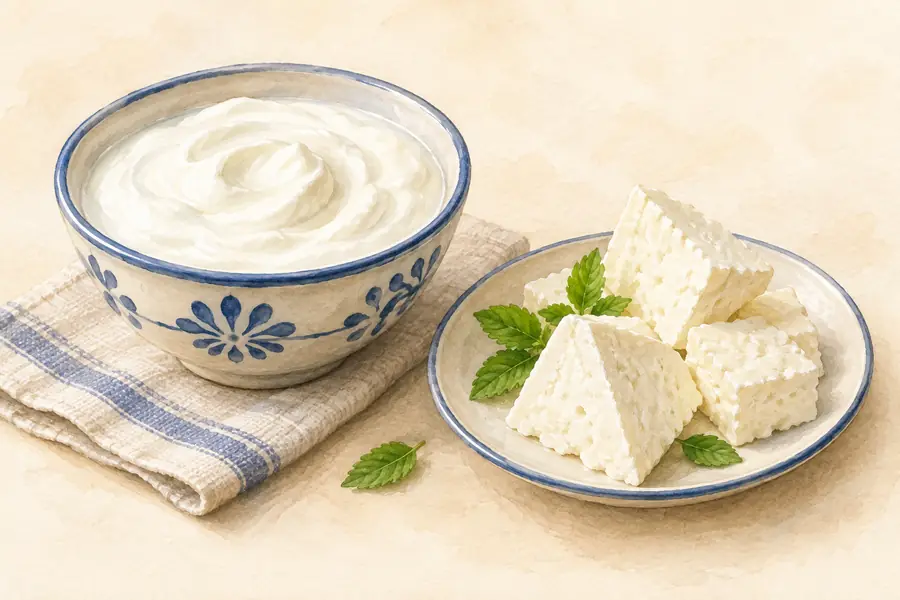
One documented curd-cake method crumbles the milk curd, mixes it thoroughly with butter and red sugar, adds a small amount of cooled boiled water, then kneads the mixture and cuts it into pieces. The result is a compact, sweet dairy bite rather than a baked Western cheesecake.
Related Tibetan preparations show why the name should not be treated as one fixed formula. A local government food guide describes 推嘎 Tuīgā as a cake made with butter, milk curd, egg and sugar, with a balanced sweet-and-sour taste. Another government description records a steamed 酥酪糕 Sūlào Gāo made from dried curd powder, butter, sugar, 人参果, raisins and walnuts, shaped round or square. These are documented regional variations, not evidence that every Shigatse market piece contains all of those ingredients.
If you find a fresh batch, look for the step that makes the texture: curd being crumbled and kneaded, pressed into a shape, or steamed. The flavor should be dairy-rich and sweet from the sugar, but the bite may range from crumbly and pressed to softer cake depending on the preparation. Ask whether the batch includes egg, tsampa, dried fruit or nuts instead of guessing from its appearance.
Keep the Chinese name 奶渣糕 Nǎizhā Gāo handy. If a seller uses the more specific seasonal wording, 酥油奶渣糕 Sūyóu Nǎizhā Gāo, ask whether it is the same item. You can search 奶渣糕 Nǎizhā Gāo or 酥油奶渣糕 Sūyóu Nǎizhā Gāo on Meituan (美团) or Amap / Gaode Maps (高德地图) for nearby listings. Check the menu, recent reviews, opening information, same-day supply and ingredients yourself; a search result is not an endorsement of a particular shop.
Variants and dietary notes
The sources support a family of dairy sweets rather than a universal recipe. Red sugar and butter are documented in the kneaded version; egg appears in the 推嘎 description; 人参果, raisins and walnuts appear in the steamed 酥酪糕 description. Do not silently combine these into one “authentic” ingredient list.
This is a milk-based food. Ask about butter, egg and nuts when relevant to your diet, and do not assume the piece is lactose-free, vegan or free of other allergens. The sources do not establish a single recipe, a guaranteed vegetarian preparation, or a standard portion size.
Access and return
奶渣糕 has no verified ticketed entrance, fixed restaurant address or dish-specific transport stop. The recent Shigatse evidence places 酥油奶渣糕 in a New Year market, while older regional material describes related dairy sweets in Tibetan-food settings; neither establishes a permanent 2026 vendor or daily schedule.
After you are in Shigatse, search 奶渣糕 Nǎizhā Gāo on Meituan or Amap / Gaode Maps and confirm that a nearby market or food outlet is serving it that day. Ask the chosen seller about ingredients, freshness and payment. Because the dish has no fixed venue, no specific metro station, bus route, exit number, walking time or return line can be stated without inventing a route; leave from the actual public place using the current taxi, ride-hailing or city-transit option shown for that place.