

Tsampa 糌粑
Tsampa is roasted highland-barley flour mixed to order with tea, butter or other dairy. In Lhasa, it is best understood as a staple and a way of eating: toasted, grainy flour becomes a hand-mixed dough or porridge, with local variations in grains and accompaniments.
Tap any red Chinese text to hear it in Mandarin.
What tsampa is
Tsampa is the Tibetan name for roasted grain flour, most commonly made from highland barley, or qingke (青稞). A Shannan government food guide describes the basic process as washing the grain, drying it, roasting it and grinding it into flour. The roasting is what gives the flour its dry, toasted character before tea or dairy is added.
It is a Tibetan food tradition rather than a dish invented by Lhasa. Lhasa is a practical place to encounter it, but recipes and serving styles vary between homes and kitchens. Local references describe tsampa as a staple and as food that travels and stores well, which helps explain why it appears as a simple bowl of flour as often as a finished menu item.
What arrives in the bowl
A serving may come as roasted flour with hot tea, butter tea, butter, fine dried curd, sugar or salt. Some kitchens mix it for you; others place the ingredients separately so you can adjust the consistency. Regional government descriptions also record versions using wheat, peas or broad beans, so “tsampa” does not guarantee one single grain blend. Ask which flour is being used if that matters to you.
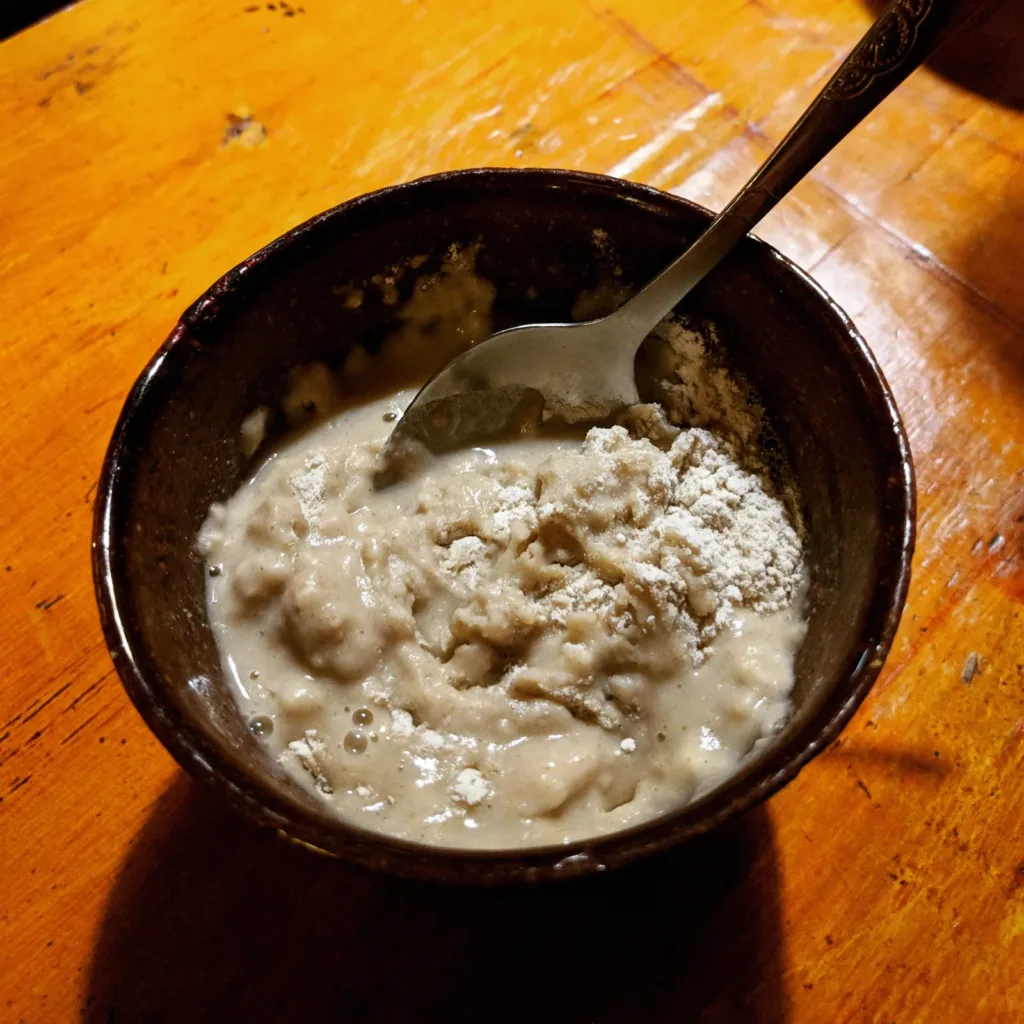
The traditional action is gradual mixing. Add tea a little at a time and knead with clean fingertips until the flour comes together; it may be eaten in small hand-formed pieces, or loosened into a softer porridge. The amount of liquid and fat changes the result from dry and crumbly to cohesive and dense. A host or server can show you the intended texture, so asking for a demonstration is more useful than trying to make a smooth paste immediately.
Expect toasted grain and a slightly coarse mouthfeel rather than the texture of wheat bread. Butter, salt, sugar and curd can change the balance more than the flour itself. In contemporary Tibetan food writing, tsampa with butter tea is still described as an everyday breakfast combination, while a softer, sweetened version with fine curd is another familiar variation.
Ingredients and dietary questions
Barley contains gluten. Health Canada identifies barley proteins as a concern for people with celiac disease and other gluten-related disorders, and notes that cross-contamination can occur through shared utensils, hands and preparation equipment. Butter and dried curd are dairy, but the exact accompaniments vary. Do not assume a bowl is vegan, dairy-free or safe for a gluten-free diet because it looks like dry flour; ask what grain, tea, dairy and sweeteners are included.
When ordering, show the name 糌粑 Zānba. You can ask 这是青稞糌粑吗? Zhè shì qīngkē zānba ma? (“Is this barley tsampa?”) and 里面有酥油或奶渣吗? Lǐmiàn yǒu sūyóu huò nǎizhā ma? (“Does it contain butter or dried curd?”). If you need a strict allergy-safe meal, explain the restriction before the flour is handled and ask about shared equipment; a generic “vegetarian” label does not answer a gluten or dairy question.
Where to eat it
You can find Tsampa all over Tibet (Xizang), so there is no need to seek out one particular restaurant. To find one near you, search for “糌粑” in Meituan (美团) or Amap (高德地图) and check recent reviews, distance and opening hours.
More dishes to compare
Explore related local specialties and compare their names, preparation notes and ordering guidance.
Tibetan masen barley & butter sweet 西藏玛森 →
The barley flour is moistened and shaped into a firm base. Butter and crushed curd or sugar are layered or incorporated according to the preparation. It is pressed or arranged for serving rather than baked like a Western cake. Expect toasted grain, rich dairy and sweetness, with a slightly crumbly or compact mouthfeel. Small curd pieces can add a tangy contrast to the butter and sugar.
Guthuk New Year soup 古突 →
Small dough pieces are cooked in a substantial soup with vegetables and often meat. Particular households may include symbolic dough parcels as part of the New Year custom. The soup is warming and filling, with soft dough and savory ingredients rather than a single dominant sauce.
Sources & reading
Recipes and servings vary between kitchens.
Image credits & notes (1)
- Tsampa in a bowl as yak-butter tea is blended in, illustrating the transition from roasted flour to a softer mixture. Photo: JpatokalPhoto: CC BY-SA 4.0