

White-bean rolls 芸豆卷
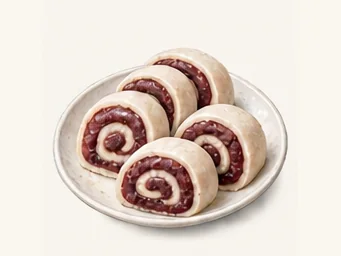
Yundou juan (芸豆卷) is a Beijing-associated sweet made by shaping a soft, pale paste of cooked white kidney beans around a sweeter filling, then slicing it into small rolls. Red-bean paste is a common center; the delicate bean layer and the darker, sweeter swirl make each bite mild outside and richer in the middle.
Tap any red Chinese text to hear it in Mandarin.
A rolled bean sweet, not a pastry
Yundou juan is a small, ready-to-eat sweet whose name describes its rolled form. Beijing’s tourism network identifies it as a traditional Beijing snack and describes white kidney beans and sweetened bean paste as its main components. A local recipe shows one way to turn soaked, peeled beans into a smooth layer and roll it with bean paste; it is an example, not a single required formula.
The Beijing tourism account says the snack moved from civilian food into the Qing court. It also repeats a story in which Empress Dowager Cixi heard a street vendor, tasted the rolls and ordered them made in the palace. Treat the Cixi episode as a local legend, not a documented origin story. The secure point for a visitor is its established place in Beijing’s traditional snack repertoire, not a claim that Beijing invented every bean roll or that one court anecdote is proven.
How it is made and what to expect
In one documented home-style method, white beans are soaked, peeled and simmered until very soft. They are drained, steamed and worked through a fine sieve, then kneaded and smoothed into a pliable sheet. A thin layer of sweet bean paste goes over it; the sheet is rolled up and cut into bite-size rounds. The process makes a tender bean layer rather than a baked or flaky crust. Recipes and fillings vary, so the precise sweetness and center are not fixed.
Expect an ivory-white exterior, a fine, soft texture and a gently bean-like flavor. The center is usually darker and sweeter, often red-bean paste; other reported versions use hawthorn, nuts, sesame or osmanthus. Hawthorn can add tartness, while nuts or seeds bring a little crunch. The contrast is modest and delicate rather than crisp or strongly flavored.
Ordering and eating
Look for the Chinese name 芸豆卷 (yún dòu juǎn). It is cut and served in small pieces, so take a small bite; the soft outer layer can crumble if handled roughly. Ask whether the shop has it that day and what filling is being served.
A simple order question is 请问今天有芸豆卷吗? Qǐngwèn jīntiān yǒu yúndòujuǎn ma? — “Do you have yundou juan today?” If the filling matters, ask 里面是什么馅? Lǐmiàn shì shénme xiàn? — “What is the filling?” Bean paste and sugar are typical; fillings can vary, and some versions may contain nuts or sesame. Confirm the specific piece if you need to avoid an ingredient.
Where to eat it
You can find Yundou juan all over Beijing, so there is no need to seek out one particular restaurant. To find one near you, search for “芸豆卷” in Meituan (美团) or Amap (高德地图) and check recent reviews, distance and opening hours.
More dishes to compare
Explore related local specialties and compare their names, preparation notes and ordering guidance.
Pea-flour pudding 豌豆黄 →
Peeled peas are cooked until soft, worked into a smooth sweetened paste and set before being cut into neat yellow pieces. The texture depends on careful cooking and straining rather than a heavy pastry crust. Each square is tender, fine-textured and gently sweet, with a recognizable pea flavor. It should feel smooth rather than sticky like a glutinous-rice cake.
Douzhi 豆汁儿 →
Mung-bean processing produces a liquid that is fermented and heated to make douzhi. It is commonly served with crisp fried rings called jiaoquan and finely shredded pickles. Expect a distinctly sour, earthy aroma and a thin texture, quite different from sweet soy milk. The pickles and fried dough change the balance of each mouthful.
Sources & reading
Recipes and servings vary between kitchens.