

Hejing Torghut Hand-Held Mutton 和静土尔扈特手把肉
Hejing Torghut Hand-Held Mutton is featured among the local specialties of Xinjiang.
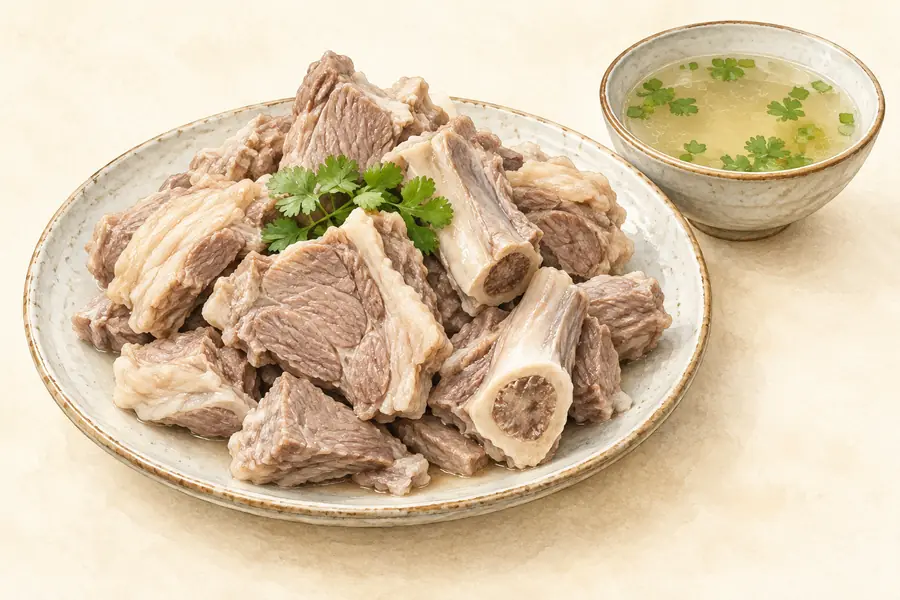
Hejing Torghut Hand-Held Mutton (和静土尔扈特手把肉) is lamb boiled on the bone and eaten with the hands, as served in Hejing County (和静县) in the Bayingolin Mongol Autonomous Prefecture (巴音郭楞蒙古自治州), Xinjiang. Hand-held meat, also called shouzhua rou (手抓肉), is a way of cooking meat shared by the nomadic peoples of the Mongolian steppe and the Dzungarian Basin (准噶尔盆地).
How it is made
The basic method takes fatty cuts of lamb on the bone, such as leg or ribs, and boils them in water until just cooked. Seasoning is kept to a little salt, with ginger or spring onion sometimes added against the mutton smell, so that the meat keeps its own flavour.
China News Service describes the Hejing version as made with lambs of about six months from the Bayanbulak (巴音布鲁克) black-headed sheep, slow-cooked with more than ten Chinese herbal ingredients.
How it is eaten
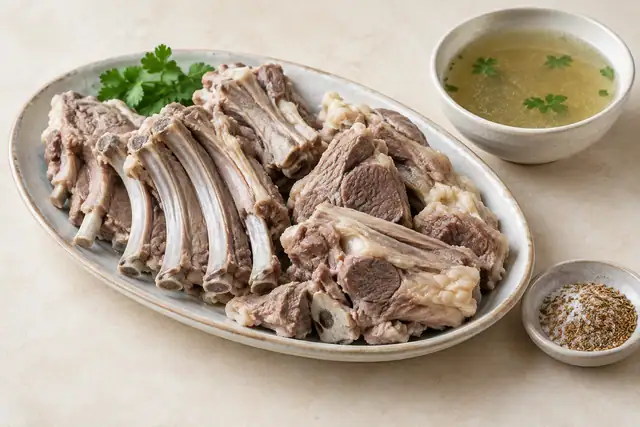
The boiled meat is lifted out and cut into small pieces, then eaten by hand rather than with chopsticks, dipped in crushed garlic and vinegar or in salt and pepper. In Hejing it is a dish that grassland families put out for guests.
Where it comes from
The Torghut (土尔扈特) in the name are the Oirat Mongol group that came back from the Volga basin in 1771. Under the Qianlong Emperor, the southern league of the Old Torghut (旧土尔扈特部) herded along the Zultus (珠勒图斯) and Kaidu River (开都河) basins, today's Bayanbulak grassland. The Bayanbulak district in the west of Hejing, about two thirds of the county's area, is a Mongol area.
Sources & reading
Written from the linked sources and fact-checked against them on 2026-09-25. Recipes and servings vary between kitchens.