

Hand-Pulled Noodle Strips 拉条子
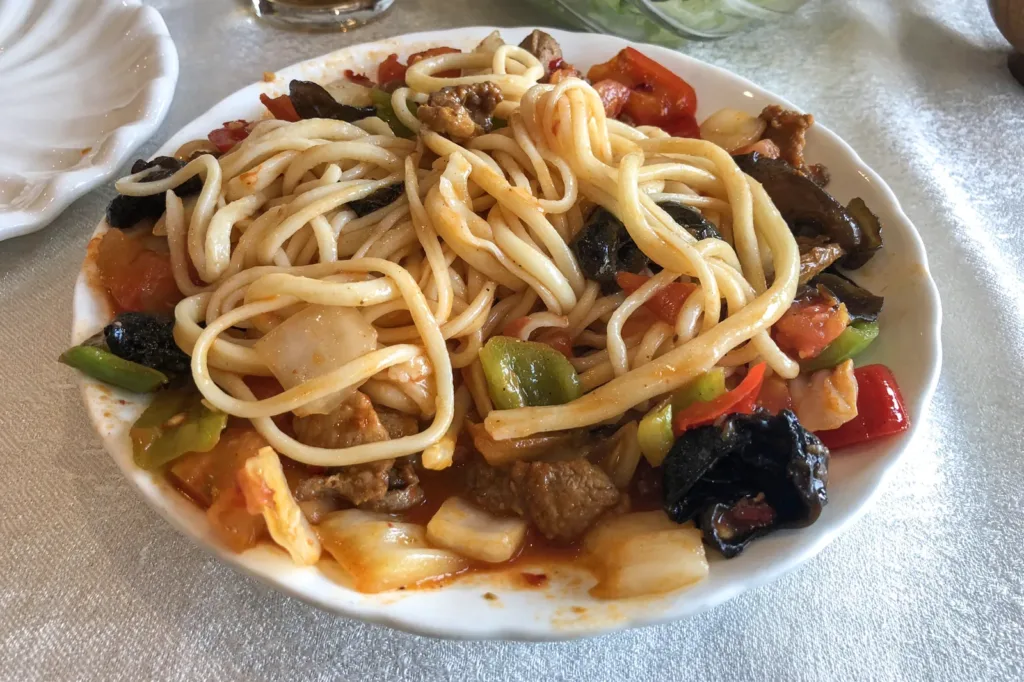
拉条子 (lātiaozi), also called 新疆拌面 and commonly described in English as laghman, is a plate of springy hand-pulled wheat noodles mixed with a separate stir-fried topping—often beef or lamb with peppers and tomato. It is an everyday Xinjiang food you can seek in Ürümqi, not a dish that should be presented as the city's exclusive invention.
Tap any red Chinese text to hear it in Mandarin.
In Ürümqi, look for the Chinese words 拉条子 Lā Tiáozi, 新疆拌面 Xīnjiāng Bàn Miàn, or 拌面 Bàn Miàn. The noodles are boiled and served with a cooked topping, usually separately, so you can pour it over and mix each strand. Recent coverage describes noodle shops in Ürümqi’s streets and lanes as a common fast-food setting, while government material treats the dish as a daily food across Xinjiang. English-language travel coverage commonly calls the dish laghman.
What makes it different
The texture begins with the dough, not a sauce. Flour is mixed with salted water, rested, kneaded and repeatedly rolled, stroked, or slapped before the dough is stretched into strands. After boiling, the noodles may be rinsed in cold water for a springier bite; an unrinsed version called 然窝子 Rán Wō Zi is mixed with its topping quickly so it does not clump. These are techniques and serving choices, not a single compulsory recipe.
The classic topping to try is 过油肉拌面 Guò Yóu Ròu Bàn Miàn. Thin marinated slices of beef or lamb are flash-fried, then combined with dried red chilli, spring onion, garlic, green pepper, tomato, and onion. The result should be a glossy stir-fry with tender meat and crisp vegetables, but each kitchen changes the balance. Other established menu variations include meat with aubergine, garlic chives, or minced meat, as well as tomato–pepper–egg and mixed vegetable-and-meat toppings.
How to order and eat it
Say 一份拉条子 Yífèn Lā Tiáozi (“one serving of latiaozi”) or 新疆拌面 Xīnjiāng Bàn Miàn; add the topping you want, such as 过油肉拌面 Guò Yóu Ròu Bàn Miàn. The noodles and topping may arrive in separate dishes. Pour the topping over the noodles and mix with chopsticks so the sauce reaches the strands. Garlic is a common accompaniment. Extra noodles and refill prices are restaurant-specific, so ask before assuming that another portion is included.
For a current nearby option, open Meituan (美团) or Amap/Gaode Maps (高德地图) and search the Chinese names 拉条子 Lā Tiáozi, 新疆拌面 Xīnjiāng Bàn Miàn, and 过油肉拌面 Guò Yóu Ròu Bàn Miàn. Check the current menu rather than relying on a photo, read recent reviews for whether the noodles and the chosen topping are actually available, and confirm opening hours and same-day supply in the listing or by phone before setting out. This is a way to find a dish, not an endorsement of any restaurant.
Regional context and practical cautions
拉条子 is strongly associated with Xinjiang, but it is not a dish to label as an Ürümqi-only invention. Sources describe different origin stories and name well-known regional styles from Qitai, Toksun, Yili, and Artux; Toksun’s version, for example, is discussed as its own local variation. The safest way to describe what you eat in Ürümqi is a local serving of a wider Xinjiang noodle tradition.
This is a dish rather than a fixed attraction: there is no admission ticket, passport procedure, citywide opening timetable, or dish-specific transport route. Availability follows the restaurant and the topping, not a citywide season. The noodles are wheat-based, and meat toppings commonly use beef or lamb; the dish name or appearance alone does not prove that a serving is halal, vegetarian, or free of allergens. Ask about the meat, stock, cooking oil, spice level, and cross-contact if those details matter to you.
Sources & reading
Image credits & notes (1)
- Xinjiang-style sautéed beef noodles (过油肉拌面) photographed in Beijing; a regional Xinjiang noodle-dish reference, not an Ürümqi restaurant or city scene. Photo: N509FZPhoto: CC BY-SA 4.0