

Rice-Stuffed Lamb Sausage 米肠子
Rice-Stuffed Lamb Sausage (米肠子) is a Xinjiang regional dish made by filling cleaned lamb intestine with rice, chopped offal and spices, then boiling it. It is often served sliced beside 面肺子 (stuffed lamb lung), so the dish is best understood as part of a paired street-food tradition rather than a Kashgar-only invention.
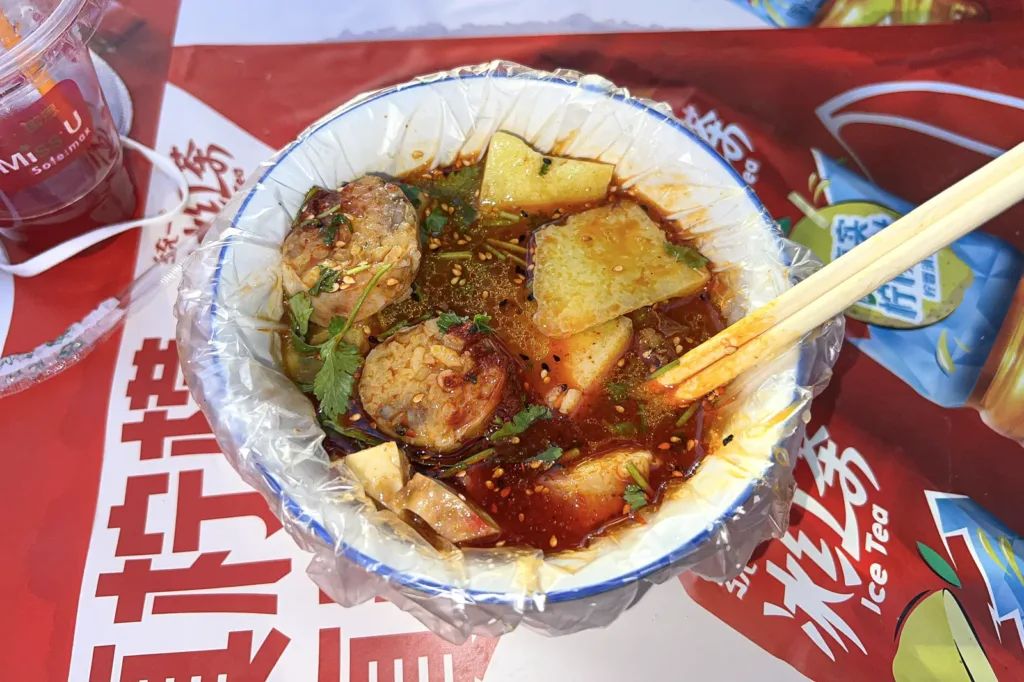
What you will be eating
The Chinese name 米肠子 (mǐ cháng zi) is a useful description: rice is packed into a cleaned lamb intestine, which is then cooked and sliced. Regional food references place it among Xinjiang dishes built around lamb offal. A 2017 Xinjiang-wide food selection included 面肺子和米肠子 as one entry, but that recognition describes a broader regional tradition rather than proving a Kashgar-only origin.
In Kashgar, treat it as a regional food to look for, not as a dish every restaurant must stock. A 2021 Kashgar government food guide highlights other local dishes and does not present 米肠子 as a fixed city signature. If you want to try it, show the Chinese name 米肠子 and ask whether the day’s batch is available.
Ingredients and preparation
A commonly documented version starts with repeatedly washed lamb intestine. Lamb liver and heart are chopped with a small amount of intestinal fat, then mixed with washed rice, salt, pepper and cumin. Another account mentions tripe among the chopped offal, so recipes are not identical from one kitchen to another.
The filling is packed into the intestine and boiled, often in the same pot as the stuffed lamb lung used for 面肺子. As the rice cooks and expands, the casing is pierced with a skewer to release air and water and prevent it from bursting. This is the small but important piece of technique that gives the finished sausage a compact, tender slice rather than a split casing.
How it is served
The cooked intestine is usually allowed to cool briefly, cut into short pieces and eaten with the accompanying 面肺子. Documented versions may also include lamb tripe and pieces of wheat gluten, with clear broth, chilli, cumin or other seasonings. The rice gives the sausage a soft, slightly sticky centre; the offal and fat supply a deeper savoury flavour. Regional descriptions also record cold-dressed and quick-fried versions, so a stall’s preparation may not look exactly like another stall’s.
Do not assume that every Uyghur restaurant has it. An English-language field account found the lung-and-intestine preparation uncommon even in Ürümqi and encountered it at small roadside eateries, which is a useful reason to ask before sitting down rather than promise a particular shop or market.
The documented ingredients include lamb intestine and organ meats, and the paired serving may include lamb lung or tripe. It is therefore not vegetarian and should not be treated as allergy-free. Ask what is in that day’s preparation if you need to avoid a particular ingredient; do not infer certification or dietary suitability from the dish name alone.
Where to eat it
You can find Rice-Stuffed Lamb Sausage all over Xinjiang, so there is no need to seek out one particular restaurant. To find one near you, search for “米肠子” in Meituan (美团) or Amap (高德地图) and check recent reviews, distance and opening hours.
Sources & reading
Image credits & notes (1)
- A serving of öpke-hésip (米肠子 with 面肺子) at the Ancient City of Kashgar, photographed on 23 September 2023. This is a Xinjiang regional dish shown in Kashgar, not evidence that the dish is Kashgar-only. Photo: N509FZPhoto: CC BY-SA 4.0