

Salted Milk Tea 奶茶
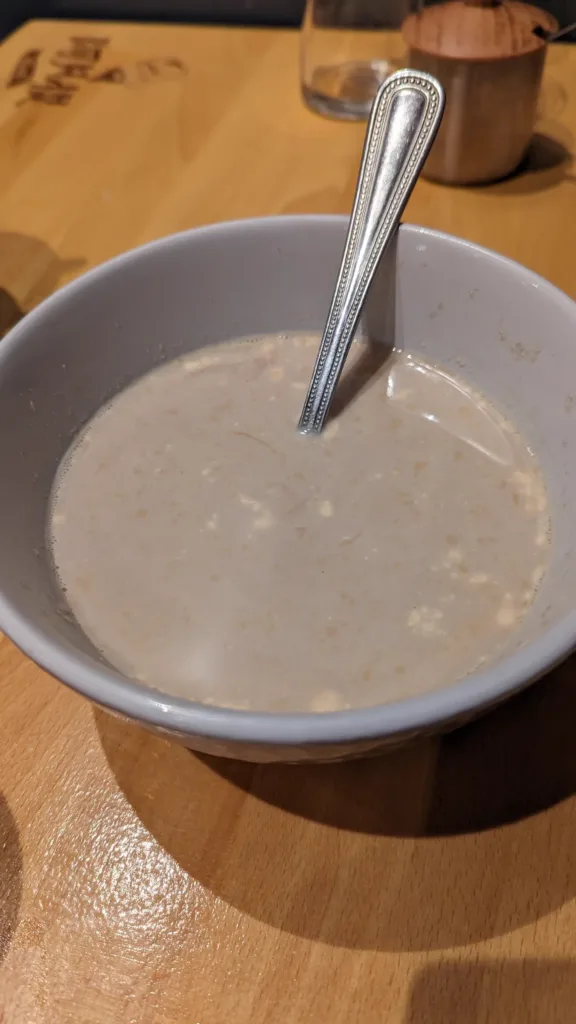
Salted milk tea (奶茶), often labelled 新疆奶茶 in Xinjiang, is a savoury tea-and-milk drink whose salty balance, tea base and add-ins vary by household and kitchen; Ürümqi lists it as a local specialty, not a city-of-origin claim.
Tap any red Chinese text to hear it in Mandarin.
What it is
The Chinese name to keep handy is 奶茶 (naicha). Ürümqi’s current food directory includes it among the city’s 14 local specialties, while a 2026 Xinjiang food-list announcement places 新疆奶茶 among the region’s ten classic drinks. Those listings make it a useful thing to look for in Ürümqi; they do not establish that Ürümqi invented the drink.
The usual idea is simple but not one fixed recipe: a strong tea liquor is combined with fresh cow’s or sheep’s milk and salt. Brick tea or Fu tea (茯茶), both compressed dark teas, appear in documented Kazakh preparations. One official scenic-area account describes slowly boiling the tea until it becomes strongly scented and reddish, gently boiling the milk so a thick cream layer forms, then combining tea, milk, salt and hot water. The result should be tea-forward, creamy and lightly savoury rather than a sweet bubble-tea drink.
Method matters to the texture. A report from Xinjiang describes adding a small piece of tea to boiling water, salting the brewed tea, pouring in fresh milk and repeatedly lifting the tea with a spoon until tea and milk are fully blended. A Xinjiang county government account records another everyday approach: steep the tea liquor in a teapot, then mix milk and a little salt in the bowl. These are documented regional methods, not instructions that every Ürümqi kitchen must follow.
Flavour, pairings and variations
Expect a warm, rounded drink with a noticeable tea edge and salt in place of sugar. In Kazakh food descriptions, milk tea accompanies meals and may be served with nang, fried wheat or other substantial foods; milk skin and clarified butter are reported additions in some preparations. They are possible regional or household features, not ingredients to assume in every city cup.
There is no single restaurant-independent formula. Sources describe differences between places and newer versions such as grain, dried-fruit and even leg-bone milk teas; another local account lists brick, Fu, black and green tea bases. Treat those as documented variations, not a promise that a particular Ürümqi menu carries them. If you want a plain savoury cup, ask whether the base is brick or Fu tea, whether the milk is cow’s or sheep’s milk, and whether any add-ins or sweeteners are included.
How to try it in Ürümqi
Search the Chinese name 奶茶 Nǎi Chá in Meituan (美团) or Amap/Gaode Maps (高德地图); if results are too broad, try 新疆奶茶 Xīnjiāng Nǎi Chá or 咸奶茶 Xián Nǎi Chá. Both are practical service platforms, but neither ranking is an endorsement. On Amap, enter the keyword, choose the closest matching result or press Enter for the full results page, then compare nearby listings. Check each current menu, recent reviews, opening status and same-day supply instead of treating a platform ranking as a recommendation.
Before ordering, ask about the tea base, salt level, dairy used, optional milk skin or butter, and whether the listed price includes any grain, dried fruit or food pairing. For allergies or dietary rules, ask about milk, butter or other animal fats, the tea blend, sweeteners and cross-contact. The appearance of a cup cannot prove halal status, vegetarian suitability or the absence of an allergen.
This is a drink rather than a fixed venue. It has no single address, visitor entrance, ticket, reservation counter or dish-specific public-transport route. Once you choose a current listing, follow that establishment’s own address and hours; those dynamic details belong to the individual business, not to 奶茶 as a citywide food.
Sources & reading
Image credits & notes (1)
- Uyghur milk tea served at Afanti Restaurant in Dublin; a regional dish illustration rather than a photograph of Ürümqi. Photo: LajmmoorePhoto: CC BY-SA 4.0