

Raisin Pilaf 葡萄干抓饭
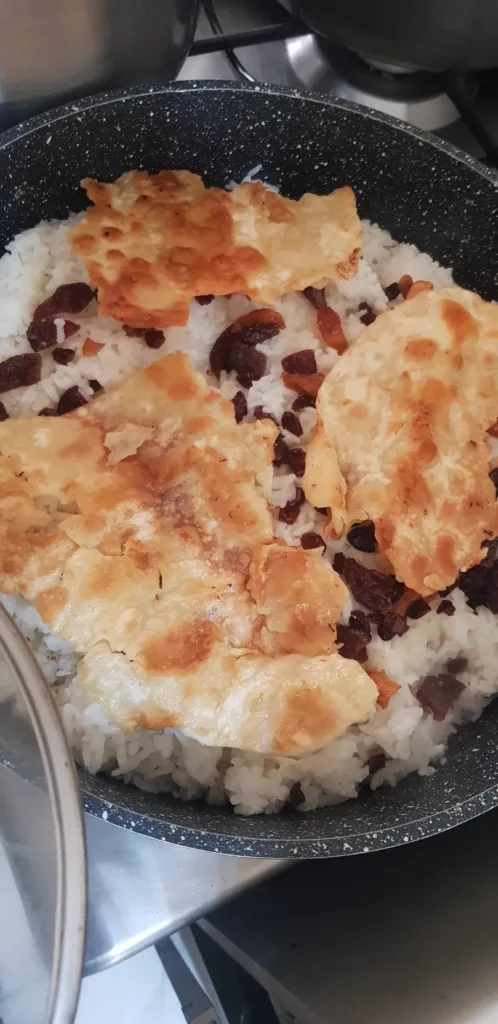
Raisin Pilaf is a Turpan-associated meatless pilaf made by cooking rice over oil-softened carrot, onion and raisins; it is worth trying for the contrast between tender rice, sweet dried fruit and savoury onion.
Tap any red Chinese text to hear it in Mandarin.
Raisin Pilaf is the specific Chinese name to use when you want the fruit-forward, meatless version of Xinjiang 抓饭 (pilaf). Turpan’s municipal cultural material lists 葡萄干抓饭 among the city’s “four treasures” of food and distinguishes it from the more common lamb pilaf. A separate government food guide places it within the wider Uyghur and Xinjiang pilaf tradition rather than treating every抓饭 recipe as one fixed dish.
The local connection makes sense at the table: Turpan is closely associated with grapes and dried fruit, while this version puts raisins into the rice itself. Do not read that association as a claim that every pilaf served in Turpan is meatless or raisin-only. The same Turpan account says that cooks may add dried apricot, dried peach or chickpeas, producing 甜抓饭 Tián Zhuā Fàn or 什锦抓饭 (sweet or mixed pilaf).
What goes into it
A documented 葡萄干抓饭 recipe uses rice, carrot, onion, raisins, salt, sugar and pepper. It describes the dish as a meatless pilaf, with the vegetables and dried fruit providing the main savoury-sweet profile. In the broader Xinjiang tradition, however, pilaf commonly includes lamb and may use different fats or other meats; fruit can replace meat in some versions, but that does not make every kitchen’s recipe identical.
If you avoid meat, ask before ordering whether the rice was cooked with lamb fat, meat stock or the same utensils as a meat pilaf. The golden rice and raisins do not prove that a serving is vegetarian, halal, or free of an allergen. Ask about nuts, dried-fruit mixes and the kitchen’s own ingredients if those details matter to you.
How it is cooked
One published local recipe cuts the carrot and onion into strips, then heats oil with a little sugar before adding the vegetables, raisins, pepper and salt. Once the vegetables soften, washed rice that has been soaked for about half an hour is spread over them. Water is added just above the rice, the pan is covered, and the heat is lowered as the liquid cooks away; the recipe says to turn the pan intermittently and allow roughly 20 minutes.
That method explains the dish’s texture better than a generic description of “fried rice.” The rice cooks above an oily, softened base rather than being stir-fried grain by grain. In the same account, the carrot and onion nearly dissolve into the rice, leaving it soft, lightly sweet and scented with onion, while the raisins add small pockets of concentrated fruitiness. Restaurant versions may change the oil, sweetness, dried fruit, rice texture or amount of seasoning.
How to look for it
Keep 葡萄干抓饭 Pútáogān Zhuā Fàn on your phone. Search that exact Chinese name in Meituan (美团) or Amap/Gaode Maps (高德地图), using your current location to see nearby listings. Check the menu wording, recent reviews, current opening status and whether the dish is available that day. A listing for 抓饭 Zhuā Fàn, 甜抓饭 Tián Zhuā Fàn or 什锦抓饭 Shíjǐn Zhuā Fàn may describe a related variation rather than the raisin-only version, so ask which dried fruits and cooking fat are used.
This is a dish, not a single attraction or restaurant. It has no central ticket, reservation, visitor entrance or guaranteed citywide serving schedule. There is therefore no dish-specific metro, bus or rail route to publish. After choosing a current listing, follow that listing’s address in Amap/Gaode Maps; walking, a taxi or a ride-hailing car are the practical last-mile alternatives. Confirm the address and return option for the individual listing, especially if it is outside the urban centre.
Sources & reading
Image credits & notes (1)
- A meatless raisin pilaf photographed in Armenia; used only as an external visual reference, not as a Turpan-specific serving. Photo: ArmineaghayanPhoto: CC BY-SA 4.0