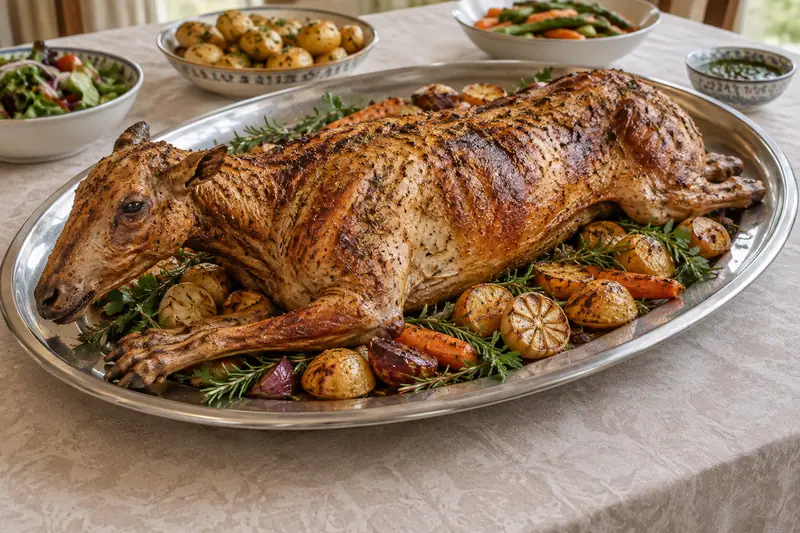
Shanshan Pit-Roasted Whole Lamb 鄯善烤全羊
Shanshan Pit-Roasted Whole Lamb is featured among the local specialties of Xinjiang.
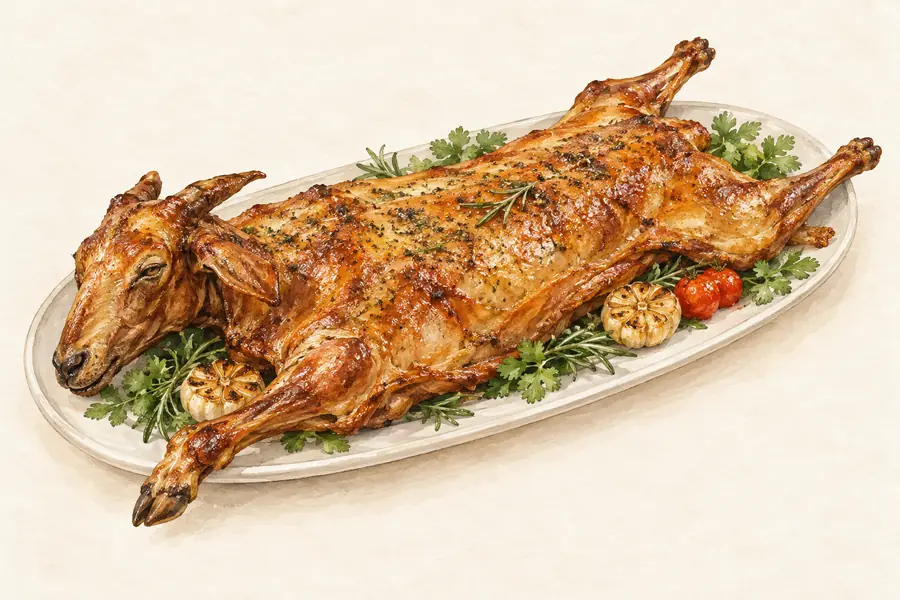
Shanshan Pit-Roasted Whole Lamb (鄯善烤全羊) is the roast whole lamb of Shanshan County in Turpan, Xinjiang: a young animal seasoned and baked head-down in a sealed clay pit until the skin turns golden.
How it is made
The method belongs to the clay pit rather than the spit. A carefully made roast whole lamb uses a two-year-old animal, dressed and coated in a paste of egg yolk, salt, cumin, pepper and flour, then hung head-down inside a heated nang pit with the mouth sealed so the heat stays in.
Timing is short by roasting standards. After roughly an hour the pit is opened and the lamb is lifted out once the surface has turned golden. The same salt-earth ovens are used for nang, for baked buns and for pit-roasted meat.
Flavour and texture
The result is crisp skin over tender meat. Because the animal is sealed in the pit rather than turned over a fire, the fat renders into the paste and the meat stays moist, and the seasoning stays cumin-forward and savoury.
Grilled meat in Xinjiang is generally seasoned with cumin and chilli powder, and this is the mild end of that range: the paste does the work, and cumin rather than chilli is the dominant note.
Local roots
In the region, roast whole lamb is banquet food. Serving it signals that the table is a formal one, and it is traditionally used to receive honoured guests, which is why it arrives on a trolley with a knife for the first cut.
Shanshan sits in the Turpan basin, where the clay-pit oven is standard kitchen equipment rather than a speciality. Nang, baked buns and pit-roasted meat all come out of the same kind of oven, so the lamb is one dish in a wider local technique.
Ingredients and dietary questions
Lamb, salt, cumin, pepper, egg yolk and flour. The yolk-and-flour paste is what forms the crust, so the skin is not gluten-free and not dairy-free once the paste is counted.
There is no vegetable and no acid in the dish itself. Ask for 皮牙子 (onion) or a yogurt dish alongside, and ask about dips if you want more than salt, cumin and chilli powder at the table.
How to order it
Order it as a table, not as a portion. If your group is small, ask for 羊腿 or 羊排 by weight instead, and ask 多少钱一公斤 first because lamb prices move with the season.
Ask 现在有吗 and 要等多久: a whole lamb is ordered in advance in most restaurants, since the pit takes about an hour and the animal is bought for the table.
How to eat it
Take the crisp skin with the meat, using the knife that comes with the trolley or your fingers. Salt and cumin are the usual finish, and a sour dairy dish or raw onion resets the palate between mouthfuls.
Eat it hot and plan the rest of the meal around it. Roast whole lamb is rich enough that rice or nang plus one vegetable is a full table, and the meat loses its crust when it cools.
More dishes to compare
Explore related local specialties and compare their names, preparation notes and ordering guidance.
Roast Whole Lamb 烤全羊 →
Roast Whole Lamb is the dish under its general name: a young lamb pasted, hung in a nang pit and served whole. The Shanshan version ties that banquet treatment to the Turpan basin, where the clay-pit oven is the everyday way of baking nang, buns and meat.
Questions before you order
How long does it take to cook?
About an hour in the pit. It is then left until the surface is golden, which is why whole lamb is usually ordered ahead rather than at the table.
Can a small group order it?
Usually not. Ask for lamb leg or lamb rack by weight instead, and check the price per kilogram before ordering.
Source introduction: Wikipedia contributors: 烤全羊 · CC BY-SA 4.0 (Wikipedia text, attribution required). English guide adapted from the cited material, with additional preparation and ordering guidance.
Source introduction: Wikipedia contributors: 馕坑 · CC BY-SA 4.0 (Wikipedia text, attribution required). English guide adapted from the cited material, with additional preparation and ordering guidance.
Source introduction: Wikipedia contributors: 新疆菜 · CC BY-SA 4.0 (Wikipedia text, attribution required). English guide adapted from the cited material, with additional preparation and ordering guidance.