

Shanshan Pit-Roasted Whole Lamb 鄯善烤全羊
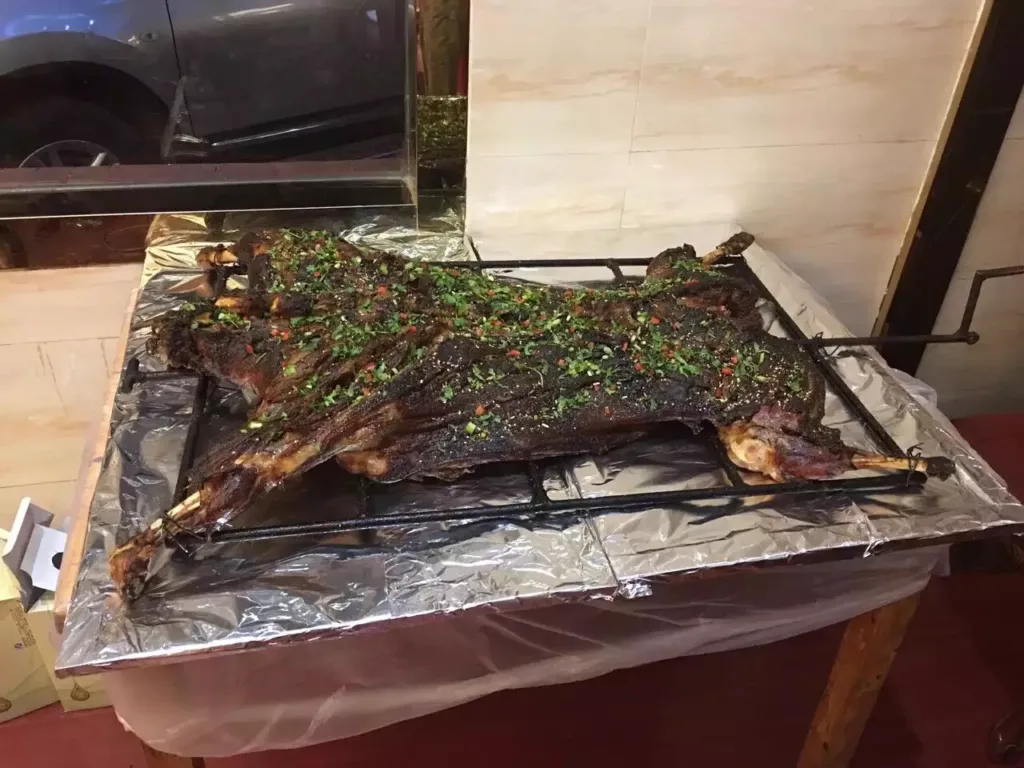
Shanshan Pit-Roasted Whole Lamb is a Turpan-area banquet dish of a whole marinated lamb cooked in a heated pit or oven; its appeal is the contrast between browned, crisp skin and tender meat, while the seasoning and timing vary by kitchen.
Tap any red Chinese text to hear it in Mandarin.
Why it belongs on a Turpan food list
Keep 鄯善烤全羊 Shàn Shàn Kǎo Quán Yáng in Chinese when you search for this dish. The name links the preparation to Shanshan County in the Turpan area, but it should not be read as a protected recipe or as a claim that Shanshan is the only place that makes whole roasted lamb. A Shanshan food overview lists roasted whole lamb among the area’s local meat dishes, while Turpan’s own public information describes whole lamb as one of the city’s substantial specialty foods and an important reception-banquet dish.
This is a shared centrepiece rather than a quick one-person snack. The point is the presentation of a whole lamb and the contrast between a browned outer layer and soft, cooked meat. A recent report on a Turpan maker also shows why the dish is treated as a craft: the result depends on the ingredients, seasoning, heat and timing, not only on putting meat in an oven.
How it is made
The common idea is simple: season a whole lamb, place it in a heated oven or 馕坑 (naan pit), and control the heat until the outside colours and the meat is cooked. The details are not one fixed Shanshan formula. A 2013 Turpan report describes a marinated whole lamb roasted for about three to four hours until the skin is crisp and the meat tender. A 2024 Xinjiang government food description from Hotan describes a different pit method: a lamb is coated with a paste, hung head-down in a hot naan pit, the opening is sealed, and the meat is checked as it roasts for roughly an hour. These are useful descriptions of regional techniques, not a universal timer for every Shanshan kitchen.
The same caution applies to the seasoning. The Hotan government description gives one common regional example containing egg yolk, salt water, turmeric, cumin, pepper and flour. Turpan reporting refers more generally to a marinade, salt water and each cook’s control of the seasoning. Ask the kitchen what it uses instead of assuming that every serving has the same coating.
A sealed pit can brown the surface while retaining heat and moisture around the meat. In Turpan descriptions, the finished lamb is golden or yellow-red on the outside, crisp at the skin and tender inside. The exact crust, fat level and spice profile will change with the lamb, paste, fire and cooking time.
What to expect at the table
Plan to share it. A whole lamb is a banquet-sized order, and the current venue may offer a smaller lamb dish instead, but there is no single portion rule to assume. If you want the whole lamb, ask before travelling whether it is available, whether it needs advance preparation, how long the wait will be, and whether the price is quoted by the whole animal or by weight. Useful questions are:
- 现在有鄯善烤全羊吗? Xiàn zài yǒu shàn shàn kǎo quán yáng ma? — Is Shanshan pit-roasted whole lamb available now?
- 需要提前预订吗?要等多久? Xūyào tíqián yù dìng ma? yào děng duō jiǔ? — Do I need to reserve it? How long will it take?
- 按只还是按重量算? Ànzhī háishì àn zhòngliàng suàn? — Is it priced by the whole lamb or by weight?
These are planning questions, not a guarantee that every restaurant uses the same ordering system. The dish has no citywide price, serving schedule or fixed reservation policy.
Ingredients and dietary questions
The basic ingredient is lamb, but the marinade and cooking fat are kitchen-specific. If egg, flour or gluten matters to you, ask whether they are in the coating. If you need to know about halal status, shared equipment, animal sourcing, spice level or possible allergens, ask the individual kitchen directly. A golden crust does not prove that a dish is halal, vegetarian, gluten-free, dairy-free or free of cross-contact. The regional examples above are not a guarantee of the recipe served in Shanshan.
How to look for it and get there
Search the exact Chinese name 鄯善烤全羊 Shàn Shàn Kǎo Quán Yáng in Meituan (美团) or Amap/Gaode Maps (高德地图) with your current location. Also check a listing written as 烤全羊 Kǎo Quán Yáng or 馕坑烤全羊 Náng Kēng Kǎo Quán Yáng, because a business may use a broader menu name. Read the current menu, recent reviews and same-day opening information, then ask about availability before setting out. This guide does not endorse a particular restaurant, brand, ranking or address.
A dish has no visitor entrance, ticket, passport check or dedicated metro, bus or rail stop. Once you choose a current listing, follow that listing’s Chinese address in Amap/Gaode Maps. Walking is the practical option for a nearby listing; a taxi or ride-hailing car is the realistic alternative for one farther away. Confirm the return plan if the listing is outside the urban centre. Do not use the old food-guide page as a current restaurant address.
There is no published citywide season calendar for this dish. A January 2023 report from the Shanshan Kumtag Desert describes whole lamb at a winter barbecue event, while Turpan reporting also describes holiday and festival demand. Those examples show that the dish appears in event and banquet settings; they do not promise daily supply at every time of year.
A good way to order
Treat the lamb as the main shared dish and ask what accompaniments the kitchen serves that day. Leave room for the crust and meat to be eaten hot, and ask for the ingredients before ordering if dietary restrictions are important. The most useful part of the name is not a promise of one “authentic” formula; it is a clear search term for finding a Shanshan/Turpan-style whole-lamb preparation and asking the cook how that kitchen makes it.
More dishes to compare
Explore related local specialties and compare their names, preparation notes and ordering guidance.
Kao Quan Yang 烤全羊 →
Kao Quan Yang is the dish under its general name: a young lamb pasted, hung in a nang pit and served whole. The Shanshan version ties that banquet treatment to the Turpan basin, where the clay-pit oven is the everyday way of baking nang, buns and meat.
Sources & reading
Image credits & notes (1)
- A whole roasted lamb on a serving rack; the Commons file is categorized as a Chinese meat dish. This is a non-Shanshan illustrative photograph, not evidence of a particular Turpan venue or recipe. Photo: W457137120Photo: CC BY-SA 4.0