

Hand-Grabbed Boiled Meat 手抓肉
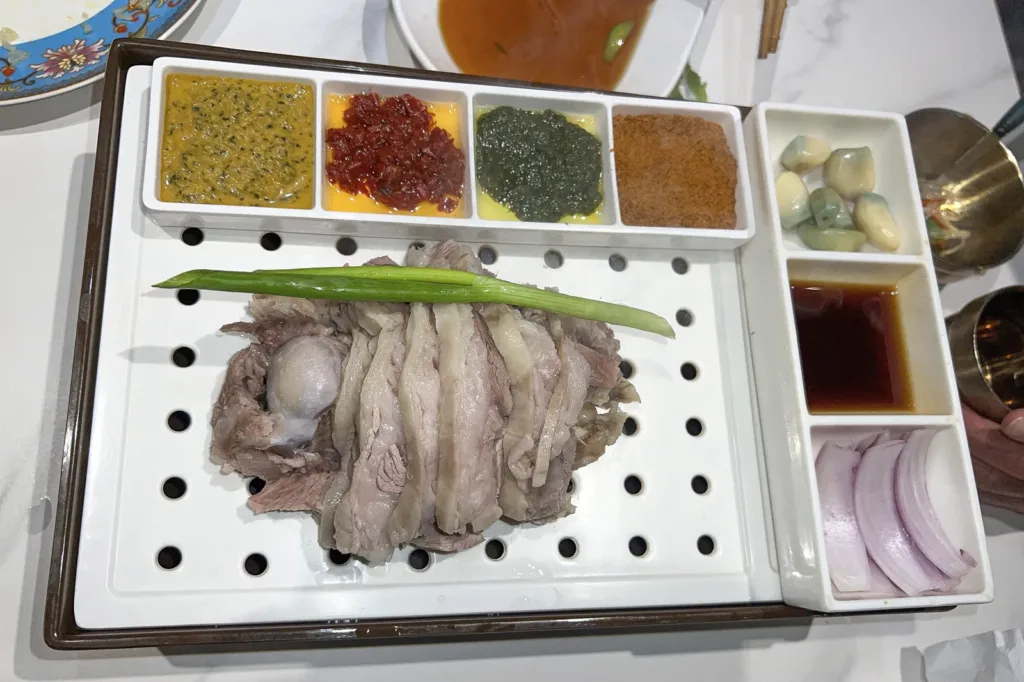
Hand-Grabbed Boiled Meat (手抓肉) is a simple Ili dish of tender bone-in lamb, with a local naren (纳仁) version served over noodles and broth. It is worth ordering when you want to taste the meat itself rather than a heavily spiced sauce.
Tap any red Chinese text to hear it in Mandarin.
Hand-Grabbed Boiled Meat (手抓肉) is a simple Ili dish of tender bone-in lamb, with a local naren (纳仁) version served over noodles and broth. It is worth ordering when you want to taste the meat itself rather than a heavily spiced sauce.
The Ili version
In Ili, 手抓肉 is best understood as a way of preparing and sharing meat, not as one fixed restaurant recipe. The Yining municipal government describes naren (纳仁) as a grassland-style dish served in Kazakh homes and says it is also called hand-grabbed meat or hand-grabbed lamb noodles. That local overlap is why menu names can point to either a meat-forward plate or the noodle-and-broth version.
The Ili prefecture government included 手抓羊肉 in its April 2026 list of ten classic Xinjiang dishes. That confirms its current regional place in the food vocabulary, not a claim that every kitchen follows one recipe.
The usual expectation is lamb cut into large bone-in pieces. A local description uses leg, ribs and breast sections, simmers them in water with salt, and serves the cooked meat after it has been cut smaller. In the version described by Yining, the same broth is then used to cook flat noodles, which sit under the meat and may be finished with onion juice, garlic or other table seasonings. A food-customs account from nearby Xinyuan similarly describes skimming the pot, adding salt, and finishing the meat over a gentle heat; it records that some household preparations include the head and offal, but that is a regional description rather than a promise about every restaurant portion.
What to look for at the table
The cooking is deliberately restrained. Light seasoning and slow simmering let the lamb, bone and broth carry the dish, so expect tenderness and a clean meat flavour rather than a thick sauce or a long list of spices. The exact cuts, cooking time and accompaniments vary by kitchen; the Yining account gives roughly two hours for its described preparation, not a universal timer.
The name refers to eating the pieces by hand. You can use the knife, chopsticks or other utensils offered by the venue instead of treating hand-eating as a performance. A field account published by The Beijing News records formal sharing and hospitality customs around hand-grabbed meat in a Kazakh yurt; those are meaningful hosted-meal practices, not rules that every city restaurant expects from a visitor.
If you avoid lamb, this is not the dish to choose. Ask whether the serving is plain meat or the naren version, whether wheat noodles are included, and whether the broth contains ingredients you avoid. Halal status, vegetarian suitability and allergy safety cannot be guaranteed from appearance; ask the actual kitchen about meat, broth, sauces and cross-contact.
Finding it without a fixed restaurant
Search the Chinese names 手抓肉 Shǒuzhuāròu, 手抓羊肉 Shǒuzhuā Yángròu, 纳仁 Nàrén and 手抓羊肉面 Shǒuzhuā Yángròu Miàn in Meituan (美团) or Amap/Gaode Maps (高德地图). Open the current menu rather than relying on the listing title, then check recent reviews, opening hours and whether the dish is being served that day. If the menu uses only one of the overlapping names, ask which version arrives and whether it includes noodles. This guide does not endorse a particular restaurant, brand, branch, address or ranking.
Access and practical limits
This is a dish record, not a destination, scenic area, border site or independent venue. It has no dish-level entrance, ticket, reservation, passport or border-permit requirement, seasonal shuttle, railway stop or return route. Plan transport to the venue you choose separately; a map listing for a restaurant is not evidence of a dish being available today.
Sources & reading
Image credits & notes (1)
- Sliced boiled lamb with dipping condiments at Yangcun Xiaoguan in Ürümqi, Xinjiang; an illustrative regional reference rather than an Ili photograph. Photo: N509FZPhoto: CC BY-SA 4.0