

Smoked Horse Meat 熏马肉
A salt-cured and smoked horse-meat specialty associated with Kazakh foodways in Ili, best understood as a winter-preserved meat with pine or fruitwood smoke and a firm, savoury chew rather than a single fixed recipe.
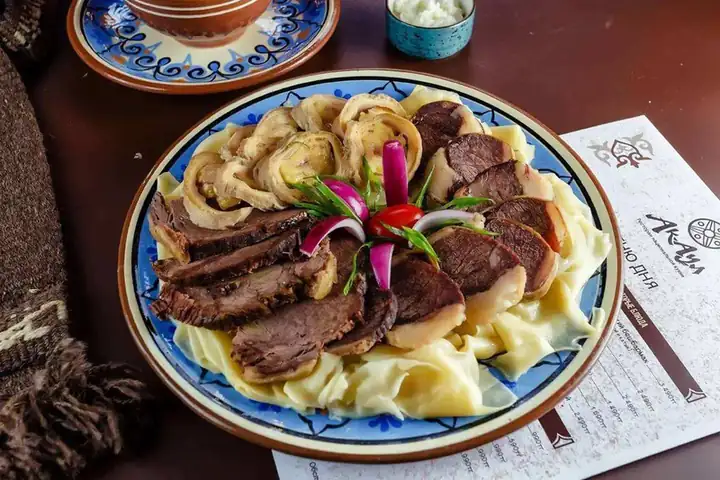
Image notes
Resized for the web; the photo itself has not been edited.
Tap any red Chinese text to hear it in Mandarin.
Why try it
Smoked Horse Meat is a traditional Kazakh meat product associated with the Ili Kazakh Autonomous Prefecture. Its importance is practical as well as culinary: winter slaughter and preserving meat helped households carry food through the cold season, so the dish reflects how seasonal pastoral life shaped the local table.
The flavour is more than “smoky.” Salt, drying and wood smoke concentrate the meat, giving it a deep savoury taste, a distinct smoke aroma and a firm texture that rewards thin slicing and slow chewing. The exact balance changes from household to workshop, so treat 熏马肉 as a regional food tradition, not a single protected recipe or a dish owned by one town.
How it is made and eaten
A traditional outline is straightforward: horse meat is cut into pieces, salted, hung from a wooden rack and exposed to smoke before being dried. Local accounts describe pine branches or fruitwood as the fuel. One report describes roughly two hours of smoking followed by drying, while other descriptions simply smoke the meat until it is dry; do not assume that one timing or seasoning applies everywhere.
The finished meat is commonly cooked before serving, then cooled and sliced. A newspaper feature describes rinsing it, simmering it in water and cutting it into thin slices; the actual cooking time depends on how salty, dry and thick the piece is. In Ili, horse meat may also appear in mǎròu nàrèn (马肉纳仁), a related noodle dish in which cooked horse meat is served over noodles with onion. Ask whether a menu uses smoked meat or freshly boiled horse meat, because the two are not the same preparation.
Finding it in Ili
There is no single restaurant, shop, entrance or ticket attached to 熏马肉. In Yining or another Ili town, search the exact Chinese name 熏马肉 Xūn Mǎròu in Meituan (美团) or Amap/Gaode Maps (高德地图). Open several nearby results yourself, then check the menu wording, recent reviews, current opening hours and whether the dish is available that day. If the results mainly show 熏马肠 (smoked horse sausage) or 马肉纳仁 (horse-meat naryn), confirm the item before ordering; they are related local foods, not interchangeable names.
Winter is the strongest cultural and availability lead, especially around the period before Spring Festival. A 2024 report from Yining described shops boiling and selling horse sausage before the festival and sending vacuum-packed horse meat and sausage elsewhere in China. That is a dated example of seasonal supply, not a guarantee that a particular listing is open or serving 熏马肉 now.
Because this is a regional dish rather than a fixed visitor site, it has no dedicated transport connection or return route. Plan only after choosing a current food listing, and do not treat a map result as proof of today’s supply.
Dietary note
This dish contains horse meat and is not vegetarian. Salt, smoke and seasonings vary by maker. If halal certification, alcohol, added spices or other allergens matter to you, ask the actual seller about the recipe and preparation; colour and appearance cannot guarantee halal status, vegetarian suitability or an allergen-free dish.