

Yining Baked Buns 伊宁烤包子
Yining Baked Buns are thin, unleavened samsa parcels filled most often with lamb, onion and cumin, then stuck to a naan-pit wall until crisp; the Yining–Ili label points to a regional Xinjiang food rather than one fixed shop or recipe.
Tap any red Chinese text to hear it in Mandarin.
Yining Baked Buns are best understood as a Yining/Ili way of naming a Xinjiang pastry usually called 烤包子 or samsa (沙木萨), rather than as a protected recipe belonging to one restaurant. An Ili government food guide places 烤包子 among the region’s Xinjiang specialties, while a Yining government tourism itinerary has treated baked buns as part of a local food stop alongside naan and tandoor-roasted meat. In April 2026, the Xinjiang Catering Association also included 烤包子 in its list of ten classic Xinjiang snacks.
What makes it worth trying
The appeal is a clear contrast: a thin, browned shell and a hot, juicy filling with the savoury sweetness of lamb and onion. The name samsa is used across Central Asia; in Xinjiang, the pastry is closely associated with Uyghur food traditions, but it is not limited to one community or one fixed shape.
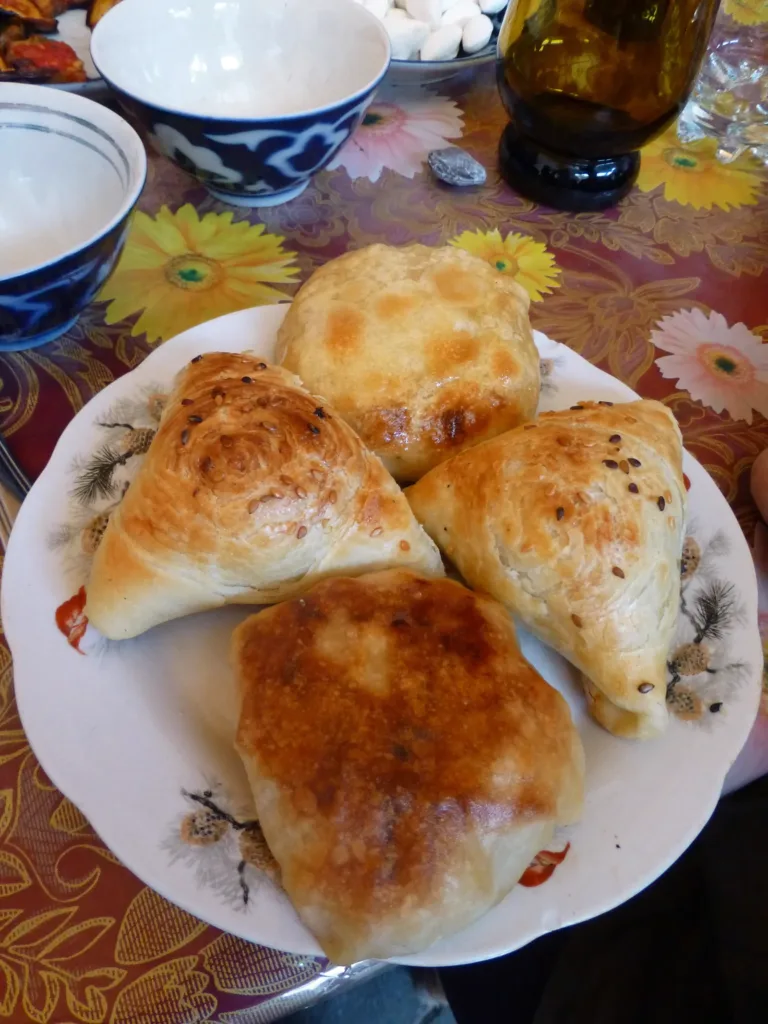
A square is common, but triangles and other shapes are also found. Lamb and onion are the usual pairing; chicken, beef, cheese, potato and pumpkin fillings are documented variations. Treat these as kitchen-to-kitchen options, not as a promise that every Yining seller will have them.
How it is made
The usual dough is unleavened wheat dough rolled thin. The filling is diced lamb, onion and cumin, with salt and pepper; some regional descriptions also include diced lamb-tail fat and a little water. The dough is folded in from four sides, commonly into a square, then pressed onto the inner wall of a heated naan pit (馕坑). Radiant heat cooks the filling while blistering and crisping the pastry.
That method explains why a freshly baked bun is more than a steamed baozi: the outside should crackle, while the fat and onion keep the centre moist. Some bakers brush the top with egg and add sesame, so ask about the day’s version if those ingredients matter to you.
How to look for it in Yining
Keep the Chinese name 伊宁烤包子 Yīníng Kǎobāozi on your phone. In Meituan (美团) or Amap/Gaode Maps (高德地图), search that exact phrase near your current location. Open the individual listing rather than relying on a ranking: check that the current menu actually names 烤包子, read recent reviews and photos, confirm today’s opening hours, and ask whether a fresh batch is still available. A listing can remain visible after a seller changes its menu or sells out.
This is a dish, not a ticketed attraction. It has no separate entrance ticket, passport procedure, border permit, airport, railway station or bus route. A particular vendor’s address and route are seller-specific, so this guide does not recommend a restaurant, branch, address or transport connection. It is not a seasonal scenic attraction either, but the time of day, batch size and availability still vary by kitchen.
Dietary and ordering notes
The classic version contains wheat, lamb, onion and usually cumin; lamb fat, egg wash, sesame, pepper or other seasonings may also be used. Recipes are not guaranteed by appearance. If you need halal, vegetarian or allergen-safe food, ask the seller about the actual meat, fat, egg, sesame and shared preparation surfaces before ordering. Do not infer any of those guarantees from the colour or shape of the bun.
Sources & reading
Image credits & notes (1)
- Samsa photographed in Uzbekistan; an illustrative Central Asian baked-bun reference, not an Yining-specific scene. Photo: Ji-EllePhoto: CC BY-SA 4.0