

Hui Fried Flatbread 油香
Hui Fried Flatbread is featured among the local specialties of Xinjiang.
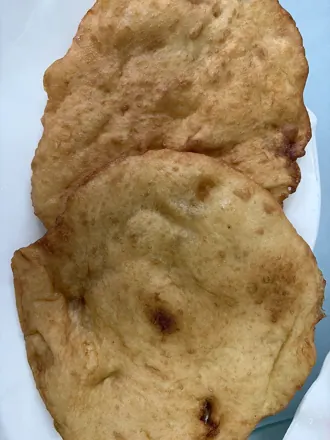

Photo adjustments
Resized and WebP compressed; subject not altered.
Hui Fried Flatbread (油香), also called 油饼 in everyday Chinese, is a Hui flatbread set down for Changji Hui Autonomous Prefecture: flour, salt, alkali and vegetable oil, shaped round and then deep-fried or steamed.
How it is made
The dough is a plain one: flour, salt, alkali (食用碱) and vegetable oil, worked and shaped into a flat round bread. The source gives two ways of finishing it, and they are genuinely different breads – frying in oil, which browns the surface and firms the crust, or steaming, which keeps the bread pale and leaves the crumb soft and springy.
Alkali is the ingredient worth noticing, since it gives the dough its characteristic bite and colour rather than any added sugar. Nothing in the source describes a filling, so treat the shape as a plain round bread unless the shop says otherwise.
What to expect in the mouth
With only a little salt in the dough, the flavour comes from the wheat, the oil and the browned crust rather than from a sweet filling. Fried 油香 is crisp at the edge and tender inside; a steamed one tastes lighter and chewier, closer to a plain bun. Both are best eaten the same day, because fried bread softens as it cools and steamed bread dries out.
Hui household and festival bread
The source places 油香 inside Hui household custom rather than inside restaurant cooking. It is fried for festivals, for weddings and funerals, and for memorials to ancestors, and Hui families call the work of frying them 捞油香. Making a batch is a household and neighbourhood activity, and the bread is both eaten at home and given as a gift.
In the assigned catalogue the name is listed for Xinjiang, under Changji Hui Autonomous Prefecture, an area with a long-established Hui population. Treat that as a place to look for the bread rather than as a claim that every bakery there makes it, or makes it the same way.
Ingredients and dietary questions
The stated ingredients are flour, salt, alkali and vegetable oil, which leaves the default version free of dairy and egg. Two questions are still worth asking: whether an animal fat or nut oil has replaced the vegetable oil, and whether the frying oil is shared with meat or fish. Anyone avoiding gluten has no way around the main ingredient, and household recipes differ in how much alkali they use.
Buying and ordering
The one question that decides what you get is 炸的还是蒸的 – fried or steamed. Say 油香 and then ask, because the same name covers both and a stall may have only one of them ready. Buy where you can watch the frying or the steaming rather than taking a bagged portion from a shelf; festival and market stalls normally sell by piece or by weight, so a single piece is an ordinary order.
How it is eaten
油香 belongs to the table as a bread course: torn or cut and shared alongside tea or a meal rather than treated as a main dish. In a household it arrives with the rest of the food and is offered to guests first, which is the part of the custom the source stresses when it describes the bread being fried both to give away and to keep. It is plain enough to mop up the juices of a shared table.
More dishes to compare
Explore related local specialties and compare their names, preparation notes and ordering guidance.
Nang bread 馕 →
Nang bread (馕) is a Xinjiang flatbread baked against the wall of a tandur oven, which gives it a crisp, stamped surface and a long shelf life. 油香 is a Hui bread, cooked by frying or steaming rather than in an oven, and it is tied to household and festival practice. The comparison is about cooking method and cultural setting rather than about which bread is more typical of the region.
Questions before you order
Is 油香 the same thing as 油饼?
In practice, yes – the source gives 油饼 as the common Chinese name and 油香 as the term used by Hui cooks, and describes one bread made from flour, salt, alkali and vegetable oil. Ask for either name and you are understood, though 油香 is the form tied to festival cooking.
Is it always deep-fried?
No. The source describes the bread as either fried or steamed, and the two versions look and eat differently. Ask 炸的还是蒸的 before buying if the texture matters to you.
Source introduction: Wikipedia contributors: 油香 · CC BY-SA 4.0. English translation and adaptation of the cited introduction, with additional preparation and ordering guidance.
Sources & reading
Named culinary source added during the audit. Source origin and local variants remain distinct; this is not a claim that all preparations have been individually verified.