

Dai-Style Rice Eaten by Hand 傣味手抓饭
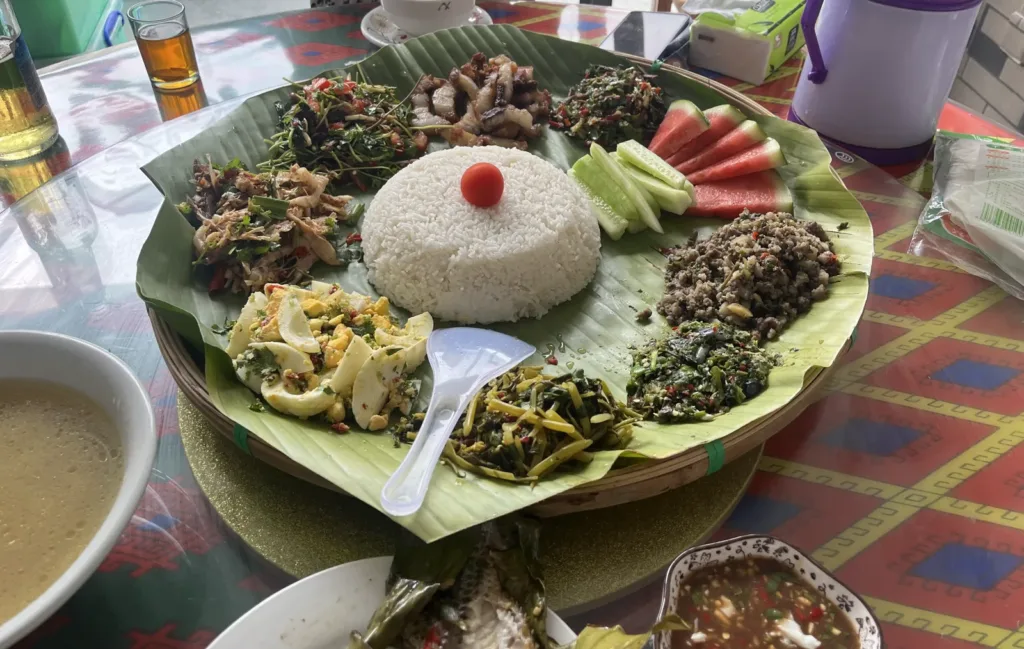
Dai-style rice eaten by hand (傣味手抓饭, Daiwei shouzhua fan) is a shared Xishuangbanna Dai meal built around rice, often purple and white rice, with grilled meats, vegetables, fruit and dipping sauces arranged around it. Its special feature is the format: a colourful spread to share and combine by hand, while the surrounding flavours change with the kitchen.
Tap any red Chinese text to hear it in Mandarin.
What the name means
The Chinese name is more useful than a single English translation. 傣味 Dǎi wèi means a Dai-style flavour profile; 手抓 Shǒuzhuā means taking food by hand; 饭 means rice. In Xishuangbanna, Dai cooking commonly puts rice, sour accents, grilled meat or fish and local herbs on the same table. The dish is therefore best understood as a shared serving style rather than one fixed recipe.
A tray is assembled instead of cooked as one pot. Rice forms the centre, while small dishes are placed around it. A common Xishuangbanna version may include purple and white rice, spicy chicken, dried beef, fried or grilled items, vegetables, fruit and a dipping sauce. Another table may use a different mix. Treat the name as a guide to the format, not a promise of an exact set menu.
What to look for
The layout is part of the experience. A provincial tourism guide describes Dai-style hand-grabbed rice with banana leaves under the food, rice in the middle, fruit and sweets inside the arrangement, and meat and vegetable dishes toward the outside. Xishuangbanna’s broader green-leaf feast tradition is also known for arranging colourful rice and dishes in a peacock-like display. That presentation is a way of making a shared meal look ceremonial; it is not a guarantee that every serving will be shaped as a peacock.
Start with the rice, then try it with one side at a time. Mild rice gives a base for sour pickles, chilli, grilled meat, vegetables or a sweet tropical fruit. A little of each makes the contrast easier to notice than mixing everything at once. The exact balance may be sour, hot, sweet, salty or smoky depending on the tray in front of you.
How to eat it
Wash your hands before eating. Take a small amount of rice and a little of a side dish, combine them at the edge of the tray or in your palm, and eat that bite before making another. The hand-eating tradition is part of the dish’s name and of the shared-table format; it is not a test of speed or bravery. If you prefer cutlery, ask for a spoon or fork when ordering.
This is a good dish to order for a group. Ask 几人份 (jǐ rén fèn, “for how many people?”), 有什么菜 (yǒu shénme cài, “what is included?”), and 辣不辣 (là bu là, “is it spicy?”). If you need the chilli separate, ask before the tray is assembled. Do not assume that a colourful rice platter is vegetarian, peanut-free or safe for a particular allergy: meat, fish, shrimp, peanuts, herbs and shared cooking equipment can vary, so explain your restriction clearly and ask what is in that day’s version.
Practical tips
The best way to approach the meal is with curiosity and ordinary table courtesy. Follow the host or the table’s serving arrangement, use any communal utensils provided, and do not treat the display as a performance that requires photographing people. The dish’s appeal is the combination of rice, changing side dishes and a meal shared at close range—not a guaranteed recipe or a fixed show.
Where to eat it
You can find Dai-Style Rice Eaten by Hand all over Yunnan, so there is no need to seek out one particular restaurant. To find one near you, search for “傣味手抓饭” in Meituan (美团) or Amap (高德地图) and check recent reviews, distance and opening hours.
More dishes to compare
Explore related local specialties and compare their names, preparation notes and ordering guidance.
Shou Zhua Fan 手抓饭 →
Shou Zhua Fan (手抓饭) is the neighbouring Yunnan entry and the same format under a plainer name: rice served on a tray with accompaniments eaten by hand. Comparing the two shows how the Dai label narrows the seasoning tradition while the basic way of serving the meal stays the same.
Image credits & notes (1)
- A Dai hand-grabbed rice platter photographed in Ruili, Dehong Prefecture, Yunnan, shown as a regional example rather than a named Xishuangbanna venue. Photo: Doge24190Photo: CC BY 4.0