

Sapie Cold Dish 撒撇
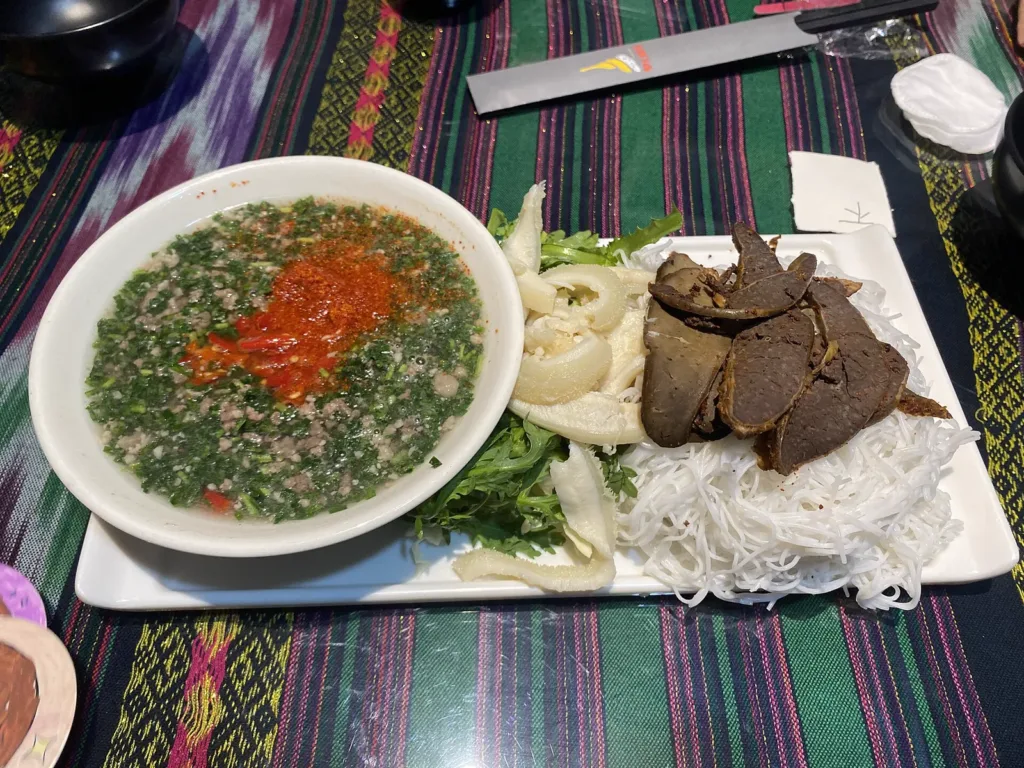
Sapie (撒撇) is a Dai family of mixed dishes built around fresh meat, cooked offal, aromatic herbs and a filtered bitter or sour dressing. In Xishuangbanna, the best-known version is beef Sapie, often served with rice noodles in Menghai County; its unusual bitterness, fresh beef and changing raw-to-cooked preparations are the point, not a fixed recipe.
Tap any red Chinese text to hear it in Mandarin.
What it is
Sapie is not one standardized salad. In Xishuangbanna, local food accounts list beef Sapie (牛撒撇), lemon sa (柠檬撒), fish sa (鱼撒), bitter sa (苦撒) and eggplant sa (茄子撒) as related preparations. The version most visitors will encounter is beef Sapie, especially the bitter style called 苦撒.
A beef bowl commonly combines thinly cut yellow-cattle back or spine meat with cooked tripe and other beef offal. Its defining dressing is a carefully filtered bitter liquid made from cow intestine or bile; herbs and seasonings can include刺五加 leaves, coriander, lemongrass, mint or other local greens, garlic, ginger and chilli. The exact balance changes between households and stalls.
The Chinese name is explained in more than one way in local accounts. One explanation uses “撒” for a cold mixed preparation and “撇” for the bitter intestine; an older account glosses “撇” differently. Rather than treating the word as a precise ingredient label, use it as the name of a Dai style of mixing meat with a distinctive bitter or sour liquid.
Why it stands out
The flavour is deliberately bitter. Fresh meat and cooked offal meet the green, grassy notes of herbs, chilli and sometimes lemon, while the bitter dressing lingers and may finish with a mild sweetness. That contrast is why a bowl can seem challenging at first and then become more interesting after a few mouthfuls. It is a labour-intensive food: local descriptions emphasise the freshness of the meat, the cleaning of the offal and the filtering of the bitter liquid.
“Cold dish” is a useful translation of the mixing style, not a promise that every serving is refrigerated or completely raw. A traditional household account describes boiled bitter liquid mixed with raw beef for a festival or honoured guest. A recent Menghai account describes beef, cooked offal and herbs being mixed before the meat mixture is briefly cooked in the noodle broth. Both versions are part of the food landscape, so ask how the bowl is prepared rather than judging by its colour.
How to eat it
In Menghai, beef Sapie also appears as 撒撇米线, a rice-noodle meal. A bowl may include thin rice noodles, the beef-and-offal mixture, herbs, lemon and broth, with crisp fried cowhide served alongside. Lemon sa is the sharper, sourer alternative; it is a related style, not simply a different English name for the bitter beef version.
Keep 牛撒撇 Niú Sāpiě or 撒撇米线 Sāpiě Mǐxiàn on your phone when ordering. If you avoid raw meat or offal, ask whether the beef is生拌, briefly blanched or cooked in the broth, and whether the stall is serving 苦撒 or 柠檬撒. Sapie contains beef and commonly beef offal, and its appearance does not prove that it is vegetarian, fully cooked or free of allergens.
Where to eat it
You can find Sapie all over Yunnan, so there is no need to seek out one particular restaurant. To find one near you, search for “撒撇” in Meituan (美团) or Amap (高德地图) and check recent reviews, distance and opening hours.
Sources & reading
Image credits & notes (1)
- Dehong Sapie with rice noodles and sliced accompaniments at Dream Dehong Restaurant in Mangshi, Dehong Prefecture, Yunnan; a regional illustration rather than a Xishuangbanna-specific stall. Photo: 瑞丽江的河水 (Theo Ho)Photo: CC BY-SA 4.0