

Explore the region
Tap any red Chinese text to hear it in Mandarin.
Summary: Tanshishan Site Museum presents a prehistoric site on the north bank of the lower Min River, pairing excavation remains with a focused account of Tanshishan culture and Fujian’s early maritime connections.
Why this site museum matters
Tanshishan is a place to see archaeology in its landscape rather than a collection of ancient objects removed from context. The site lies in Ganzhe Subdistrict, Minhou County, about 21 kilometres from central Fuzhou. It was found in 1954, and the named culture belongs to the Neolithic-to-Bronze-Age sequence of the lower Min River and the southeast coast.
The site is especially useful for understanding why Fuzhou’s cultural story is tied to the river and the sea. Tanshishan culture is recognised as the first archaeological culture named in Fujian, and the site was selected in 2021 as one of China’s “Top 100 Archaeological Discoveries of the Century.” That distinction is best read as archaeological significance, not as a claim that every interpretation about prehistoric migration is settled.
What to look for
Begin with the basic exhibition Root of Strait Civilization — Tanshishan Culture. Its route is about 220 metres long and uses excavated artefacts together with sculptures, reconstructed scenes, multimedia, photographs, text, and sound-and-light effects to explain how people lived roughly 5,000 years ago. Read the displays for evidence of subsistence, craft, burial practice, and contact along the lower Min River, rather than treating the reconstructed scenes as surviving buildings.
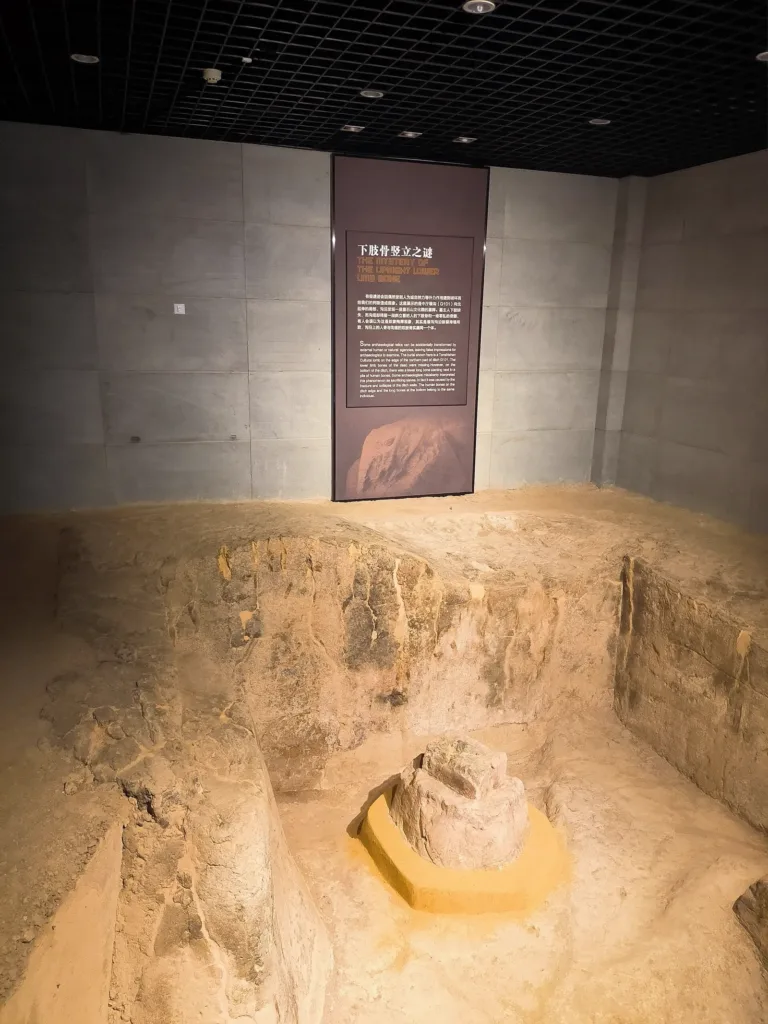
Continue to the archaeological display area. The official visitor description lists burials, ash pits, trenches, and pottery kilns among the remains found through the site’s excavations. A 2025 Fujian cultural-authority answer records ten excavations, with the large 1996–97 campaign helping identify four archaeological cultural phases. The contrast between an excavation floor and the museum’s interpretive reconstructions is the most rewarding part of the visit: one shows what archaeologists found, while the other shows how those fragments are cautiously turned into a picture of daily life.
Allow time for the museum’s maritime framing. Official descriptions connect Tanshishan culture with the lower Min River and coastal areas, while an English China Culture report describes it as the earliest named archaeological culture on China’s southeast coast. This is a compact visit, but it gives Fuzhou a much older and more material setting than a city-centre heritage walk alone can provide.
Practical visit
The official address is No. 330, Tanshi Village, Ganzhe Subdistrict, Minhou County, Fuzhou, Fujian. A Minhou government visitor listing, published on 5 June 2018, states that admission is free and gives opening hours of Tuesday to Sunday, 09:00–16:00, with Monday closed. Because that listing is not a live timetable, confirm the current hours and any reservation or identification requirements before setting out. The Fujian cultural authority lists the museum office number as 0591-22988233.
No metro stop is identified in the official visitor note reviewed. The same Minhou listing says to take Fuzhou bus 33 or 38 and get off at 昙石站 Tánshí Zhàn; it also mentions a minibus from Fuzhou West Coach Station (福州西客站) toward Ganzhe, also using the 昙石 stop. These route details come from a 2018 page, so search the exact Chinese name 昙石山遗址博物馆 Tánshí Shān Yízhǐ Bówùguǎn in Amap (高德地图) on the day of travel and confirm the direction with the driver or station staff. For the return, check the reverse-direction service at the same named stop before entering; the published guide does not provide a current timetable or last departure. If the live bus information does not fit, give a licensed taxi or ride-hailing driver the full Chinese address above rather than relying on an English transliteration.
Find Tanshishan Site Museum
昙石山遗址博物馆 · 闽侯县
The pin marks the area, not the entrance.
Sources & visit information
Sources checked on 2 November 2026. Hours, tickets, reservations and transport can change; confirm with the operator before you go.
Image credits & notes (1)
- An archaeological profile display in the site museum's archaeology hall, with an interpretive panel above the preserved soil section. Photo: FradonStarPhoto: CC BY 4.0