

Explore the region
Tap any red Chinese text to hear it in Mandarin.
Why this place matters
Jian ware is best understood in the landscape that made it. The protected Jian kiln ruins lie around Houjing and Chizhong villages in Shuiji Town, Jianyang District, rather than inside one compact museum compound. The kilns began making ceramics in the late Tang and Five Dynasties, reached their peak in the Song period, and produced the black-glazed tea bowls now known as jian zhan. Jianyang’s place in the ware’s origin and its role in Song tea culture are also part of the national intangible-heritage record. The Daluhoumen ground includes a 135.6-metre No. 3 dragon kiln, built along the hillside; the ruins are a national-level major historical and cultural site.
The visit is therefore about reading a production landscape as well as looking at finished bowls. The kiln grounds are spread across several named areas, including Luhuaping, Niupilun and Yingzhangqian (营长乾). A local account places the main ruins north of Shuiji and well outside Jianyang’s urban display spaces, so the Chinese destination name matters when arranging the last leg.
What to look for
At a kiln ground, look for the long, sloping dragon-kiln form and the relationship between the hillside, firing route and settlement. Do not remove sherds or treat fragments on the ground as souvenirs. The site is protected archaeological heritage, and the sources reviewed do not provide a current public-path map for every kiln ground.
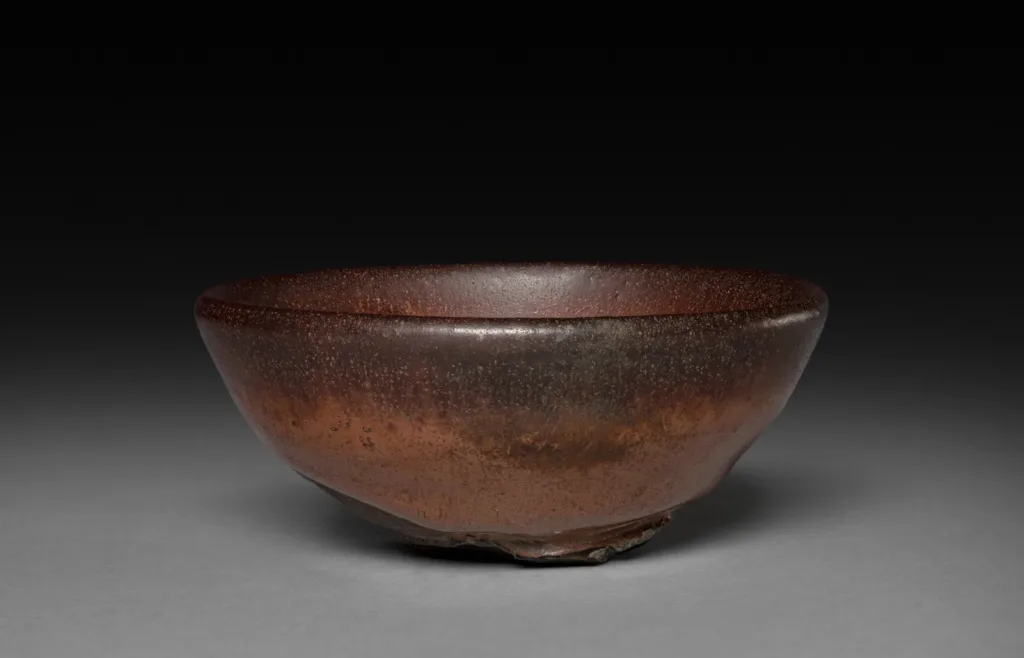
In a museum or exhibition space, compare the glaze rather than judging every bowl as simply “black.” The named effects include 乌金釉 (wujin, a dense black), 兔毫 (tuháo, “hare’s fur”), 油滴 (yóudī, “oil spot”), 鹧鸪斑 (zhègūbān, “partridge feather”), 曜变 (yàobiàn) and other mixed effects. In high-fired glaze, crystals and optical changes create the streaks or spots; the result is not a printed pattern that can be made identical on demand.
Also compare the form and the making sequence. Jian bowls are associated with a broad mouth, a smaller foot and a comparatively heavy, iron-rich body. The traditional process is described as thirteen main stages, from selecting and crushing porcelain stone through washing, ageing and kneading the clay, throwing, trimming, biscuit firing, glazing, loading and firing. The thick glaze tends to gather inside the bowl, while the outside is commonly only partly glazed to prevent sticking in the kiln.
The exhibition layer
The district’s modern display spaces are related to the heritage but are not the same entrance as the rural ruins. The Jianyang Jian Zhan Cultural and Creative Park has been described as including a cultural exhibition hall, master workshops and teaching or experience facilities. The Chunzhan Jian Kiln Culture Museum, reported in a 2025 Fujian cultural feature, displayed more than 400 Jian ware works. Treat these as separate venue checks: a museum name or a creative-park listing should not be used as proof that the Daluhoumen kiln ground is open that day.
Planning the visit
This listing covers a dispersed heritage area and its associated exhibition layer, not one ticketed campus. The current official opening hours, ticket price, reservation channel and foreign-passport admission procedure were not stated in the sources reviewed. Check the specific museum or managed site before leaving Jianyang, and ask which kiln ground is open. If a gate, roofed structure or archaeological surface is marked closed, stay outside it; do not cross fields or climb protected fabric to get a closer view.
Getting there and back
There is no metro service applicable to this rural site, and the sources reviewed did not establish a current direct bus or rail connection to a visitor entrance. For a road transfer, give the driver the Chinese destination “福建省南平市建阳区水吉镇后井村建窑遗址(大路后门窑址)” and confirm the open visitor point before setting off. The ruins extend across more than one village and kiln ground, so “建盏文化展示馆” may send you to a city exhibition venue instead of the archaeological site.
Arrange the return pickup in advance. Do not assume that a taxi will be waiting at a rural kiln ground, and do not rely on a generic map pin as proof of an open entrance. If you are arriving by rail or long-distance coach, verify the current Jianyang-area arrival station and the onward road connection with the operator on the day of travel; no station-to-ruins service was confirmed in the sources used here.
Find Jian Ware Culture Exhibits and Kiln Sites
建盏文化展示与窑址开放点 · 建阳区
The pin marks the area, not the entrance.
Sources & visit information
Sources checked on 1 November 2026. Hours, tickets, reservations and transport can change; confirm with the operator before you go.
Image credits & notes (1)
- A Song-dynasty Jian ware tea bowl from Fujian in the Cleveland Museum of Art collection; a representative object image for the exhibition layer, not a photograph of the Jianyang kiln ruins. Photo: Gary Kirchenbauer; Cleveland Museum of Art open-access recordPhoto: CC0 1.0