

Explore the region
Why this area is worth your time
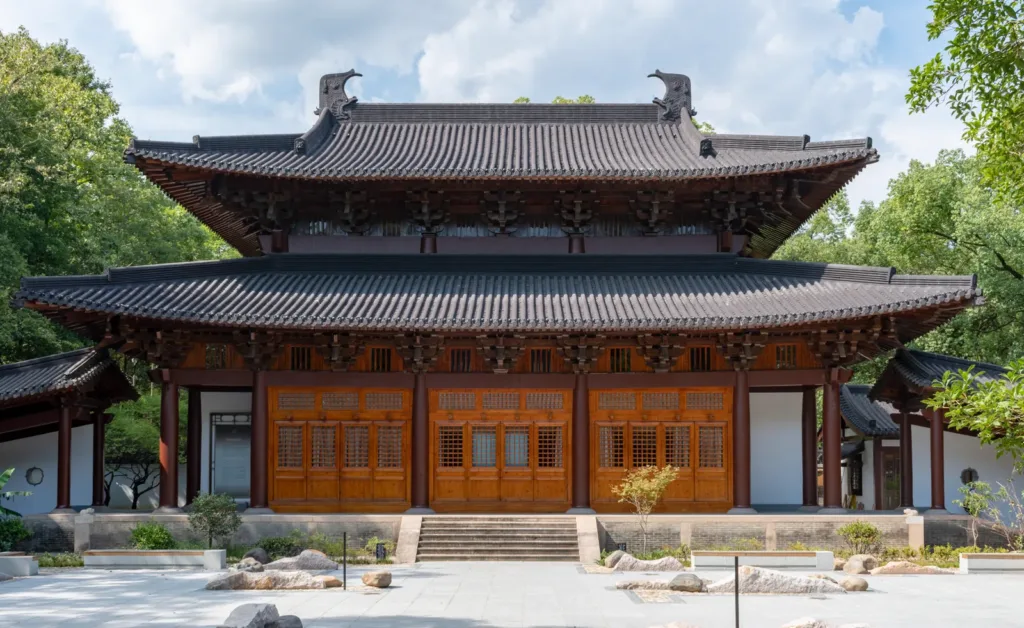
Wuyi Palace brings the mountain, river and religious history of the main scenic area into a compact visit. The scenic authority places it at Qingchuan, the end of the Nine-Bend Stream raft trip, below the southern foot of Dawang Peak. It also records the site’s older names—Huixian Temple, Chongyou Temple and Wannian Palace—and identifies two Longjing wells, Wannian Palace and Sanqing Hall among the surviving features.
The most useful way to visit is to look at the setting rather than treat the palace as an isolated temple. Notice how the buildings sit between the stream and the peak, then read the street and memorial as later cultural layers within the same visitor precinct.
What to look for
Begin with the Wuyi Palace precinct and its relationship to Dawang Peak. The historic references are not just a date label: the site’s names and remaining wells and halls show how a religious landscape was retained inside a much larger scenic system.
Walk the reconstructed Song-style commercial street as a designed visitor setting, not as an untouched residential old town. The official scenic description lists the imitation-Song street and cultural venues in this area. The Liu Yong Memorial stands in the middle of Wuyi Palace’s old street in a pavilion-style imitation-Song building; use it to connect the landscape to Liu Yong, a Northern Song ci poet associated with Wuyishan, rather than to a generic claim about “ancient culture.”
Temporary programming changes. A Nanping government report from 1 October 2026 recorded an NPC poetry-and-tea interaction in the Wuyi Palace streets, but that dated event report is not a promise of a daily show. Visit the street as a place to observe the architecture, river edge and tea-related visitor culture, and check any programme on the day.
Entry, tickets and boundaries
Wuyi Palace is a sub-area inside the main Mount Wuyi Scenic Area, not a separate open-road trailhead. A 2026 Nanping government report describes visitors entering through the scenic area’s South Entrance Visitor Service Centre and then taking sightseeing vehicles to attractions. A provincial government report also says that internal roads in the main scenic area mainly rely on sightseeing vehicles. Give a taxi the Chinese destination “武夷山风景区南入口游客服务中心” and make the internal transfer after entry; there is no verified road-side taxi drop at the palace itself.
Treat scenic admission, the sightseeing vehicle and the Nine-Bend Stream bamboo raft as separate arrangements unless the current operator explicitly packages them together. The 2024 provincial notice separated the scenic admission, sightseeing-vehicle ticket and raft ticket, but its prices are historical and should not be carried forward. An earlier 2026 first-quarter policy used real-name reservation through an official mini-program and ended on 31 March; it is evidence of a booking channel at that time, not a current promise. Confirm the date-specific booking route, price, opening hours and whether a passport is accepted before paying.
The raft trip ends at Qingchuan near Wuyi Palace, so combining the two is a sensible plan when a raft place is available. A raft reservation does not by itself establish scenic entry, sightseeing-vehicle coverage or a return connection, so check each item separately.
Stay on the signed visitor routes. The National Park administration issued a February 2026 notice prohibiting unauthorised entry into the park for through-hiking and similar activities; Wuyi Palace should not be used as a back door into protected or unmanaged areas.
Getting there and back
From Wuyishan North Railway Station, the Wuyishan municipal route sheet lists route 9 between the high-speed rail station and Xingcun Bus Station, with a stop named “武夷山庄(武夷宫)” (Wuyishanzhuang, Wuyi Palace). This is the clearest published public-transport relationship for the area. Confirm the day’s direction and operating times before relying on it.
For an outward connection after visiting, the same official route sheet lists route 16 as a one-way service from Wuyi Palace through Wuyishanzhuang, Lantang and Baodao Hotel to Sumin Hotel. It lists a first departure at 07:50 and a last departure at 18:00 in summer or 17:30 in winter. Schedules can change, so do not wait until the last moment to arrange the return.
No applicable metro connection is established in the verified sources. The practical plan is railway or coach travel to Wuyishan, then route 9, a taxi to the South Entrance Visitor Service Centre, and the scenic area’s own sightseeing vehicle. The exact internal sightseeing-vehicle stop and same-day last service were not specified in the official pages read for this article; follow the operator’s signs and dispatch instructions on arrival.
Combine your visit
A suggested sequence linking the specific features of this visit.
-
Wuyi Palace precinct
Begin with the Daoist setting beneath the peak.
-
Liu Yong Memorial
Connect the landscape with the poet’s local association.
-
Song-style street and streamside
Read the reconstructed street against the Nine-Bend Stream setting.
This order is editorial. Confirm access and any transfers between stops; it does not establish a walking route, same-day connection or common admission ticket.
Find Wuyi Mountain Scenic Area · Wuyi Palace area
武夷山风景名胜区·武夷宫片区 · 南平市
The pin marks the area, not the entrance.
Sources & visit information
Sources checked on 1 November 2026. Hours, tickets, reservations and transport can change; confirm with the operator before you go.
Image credits & notes (1)
- The main hall of Wuyi Palace in the Mount Wuyi Scenic Area, photographed from the front. Photo: xiquinhosilvaPhoto: CC BY 2.0