

Explore the region
Tap any red Chinese text to hear it in Mandarin.
Qingshuiyan (清水岩) stands on Penglai Mountain in Penglai Town, Anxi County, within Quanzhou. Anxi’s county government describes the temple as founded in 1083, rebuilt in 1564 and designated a national 4A scenic area; the Quanzhou government places it among the city’s mountain and sea attractions.
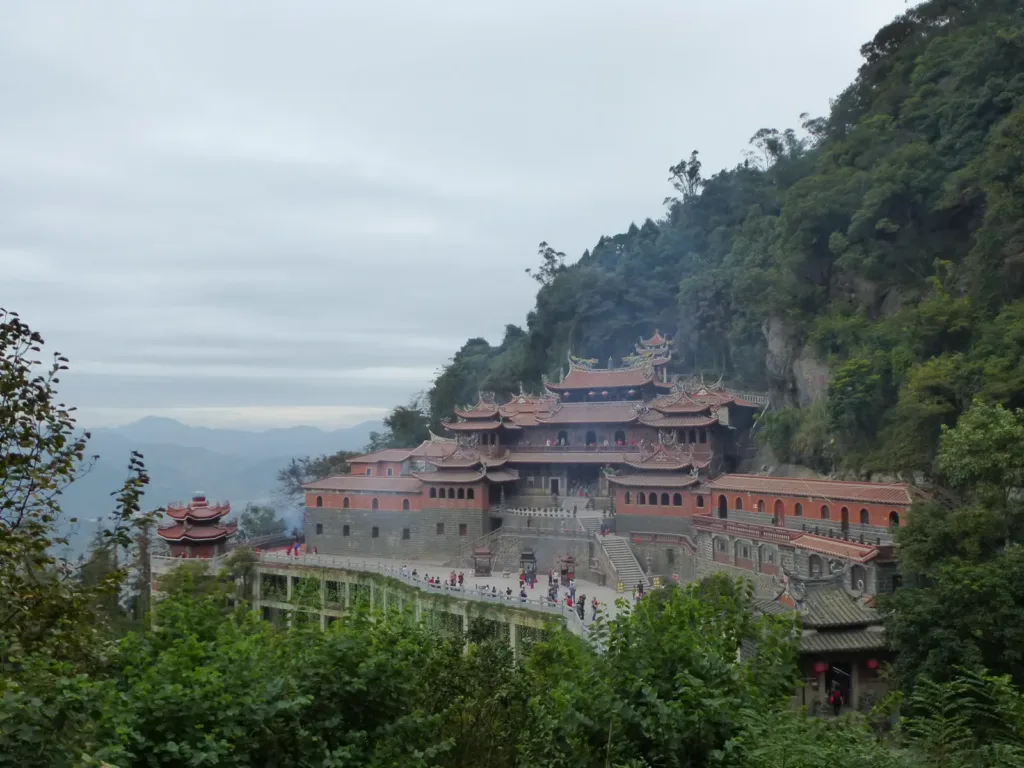
The complex is built into a steep mountainside above a ravine rather than laid out as a flat courtyard. Its principal halls rise through three levels: Haotian Kou below, the Qingshui Zushi Hall in the middle, and Shakyamuni Hall above. Red-brick walls, grey tiles, terraces and forest make the “帝” character plan easiest to understand from the approach and lower terraces. Behind the halls is the Zhenkong reliquary pagoda associated with Qingshui Zushi.
Look for the Yan Tu stone stele, a carved panoramic map of the temple landscape. The old camphor called “Zhizhi Chaobei” (“branches facing north”) is another named feature; the north-facing branches belong to local legend, not a botanical explanation. The grounds also include rock formations, inscriptions and springs, so allow time to notice the relationship between the halls and the mountain rather than treating the temple as one photo stop.
Qingshui Zushi is not only a figure inside the temple. A Fujian government cultural article describes the Master Qingshui belief and customs as a national intangible cultural heritage tradition rooted at Qingshuiyan, with offerings of flowers and tea and a three-day Spring Festival procession among its ritual forms. On such occasions this remains a working pilgrimage site: observe quietly, follow signs, and do not photograph worshippers without permission.
Location and getting there
Qingshuiyan is in Penglai Town, about 16 km from Anxi county seat according to the town government. From Anxi, a transport report published in 2021 describes county bus route 201 from Anxi Hengxing Bus Station (安溪恒兴车站) to Qingshuiyan (清水岩), with the return direction listed from Qingshuiyan back to Hengxing Bus Station. The published route includes Penglai Bus Station (蓬莱车站) and Pengge Village (彭格村) before the final stop. Because the detailed route source is not a current timetable, confirm the day’s service and last return at the station or in the operator’s current channel before setting out.
If you arrive by rail, Anxi Railway Station (安溪站) is a passenger station at Zhuanwen Village, Chengxiang Town, Anxi County. It is not at the temple. Arrange a road transfer from the station to Hengxing Bus Station for route 201, or take a taxi directly to the scenic area; the sources checked here do not establish a direct rail-to-temple service.
For a taxi or ride-hailing car, show the Chinese destination 福建省泉州市安溪县蓬莱镇清水岩景区 Fújiàn Shěng Quánzhōu Shì Ānxī Xiàn Pénglái Zhèn Qīngshuǐ Yán jǐngqū or 清水岩寺 Qīngshuǐ Yán Sì. The official sources identify Penglai Mountain and Penglai Town but do not publish a reliable fixed street address or a precise visitor drop-off gate. Confirm that the driver is taking you to the signed scenic-area entrance or 山门 Shānmén, not merely to Penglai town. If you take a taxi up, arrange the return before entering; by bus, the documented return direction is 清水岩 → 恒兴车站 Qīngshuǐ Yán → Héngxīng chēzhàn.
Before you go
Qingshuiyan is both a scenic area and an active temple. Current standard admission, opening hours, online reservation and passport-based ticket or entry arrangements were not stated in a current venue notice among the sources checked. Older public listings conflict: a 2018 Quanzhou government itinerary printed CNY 20, while a travel guide updated in August 2025 printed CNY 15 and 06:00–17:30. Treat neither as a current tariff or timetable; check the latest local notice before travelling.
Find Qingshuiyan Temple
清水岩 · 安溪县
The pin marks the area, not the entrance.
Sources & visit information
Sources checked on 24 October 2026. Hours, tickets, reservations and transport can change; confirm with the operator before you go.
Image credits & notes (1)
- Qingshuiyan’s red-brick temple complex terraced into the forested mountainside at Anxi Photo: lihui (李翙)Photo: CC BY-SA 3.0