

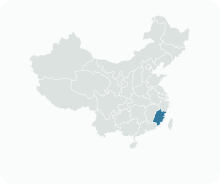
Get to know Anxi County

Photo adjustments
EXIF orientation normalized; resized without changing aspect ratio; converted to WebP. No subject edits.
- Administrative area
- County · 县
- Part of
- Quanzhou
- Chinese name
- 安溪县
- Local areas
- County guide
Area & population
- Area in the source
- 2,994.00 km²
- Population · 2020 census
- 1,003,599
Source: cited geographic source, as of the dates shown.
Setting and landscape
Anxi borders Nan'an (南安) to the east, Hua'an (华安) to the west, Xiamen's Tong'an District (同安区) to the south and Yongchun (永春) to the north. Locals split the county in two. Inner Anxi (内安溪), the higher and steeper townships such as Changkeng (长坑), Jiandou (剑斗), Xianghua (祥华) and Gande (感德), live mainly from tea, natural resources and tourism. Outer Anxi (外安溪) is lower and flatter, and takes in the county seat at Fengcheng (凤城镇) and the towns of Hutou (湖头), Guanqiao (官桥) and Longmen (龙门).
History and tea
The area began in 864 as Xiaoxi (小溪场), an outpost of Nan'an. In 955 its overseer Zhan Dunren (詹敦仁) won approval for a county, named Qingxi (清溪) for its clear streams, and became its first magistrate. After Fang La's (方腊) uprising broke out in another Qingxi, in Zhejiang, Emperor Huizong renamed it Anxi in 1121.
Tieguanyin, also called "red-heart Guanyin", is an oolong whose tea-bush variety was found at Yaoyang (尧阳) in Xiping (西坪) during the Yongzheng reign of the Qing dynasty. The bush is delicate and gives little, hence the local saying that it is "good to drink, hard to grow". The early-morning tea market at the China Tea Capital draws the county's growers.
What to see
Qingshui Yan (清水岩), on Penglai Mountain (蓬莱山) northwest of the county seat, was founded in 1083 and rebuilt in 1564. It enshrines Qingshui Zushi (清水祖师), a cult that began in Anxi and spread to Taiwan and Southeast Asia; Taiwan alone has more than 150 of his temples. The county government says its main hall follows the plan of the character "帝" ("emperor"), and a Ming stone carving of the whole site serves as an early visitor map.
In the county town, the Confucian Temple (文庙), founded in 1001, is a national key protected site; inside are an octagonal caisson ceiling built of lotus-shaped brackets and eight carved stone dragon columns. The City God Temple (城隍庙) dates from 956, the year after the county was created. At Hutou, a national historic and cultural town, the residence of the noted Qing minister Li Guangdi (李光地故居) is also a national key protected site. Qihu Yan (骑虎岩) in Huqiu town (虎邱镇) is named as the birthplace of Foshou (佛手) tea.
Highlights
- Qingshui Yan 清水岩: Mountain temple founded in 1083 to Qingshui Zushi, a national AAAA scenic area.
- Anxi Confucian Temple 安溪文庙: Founded in 1001; a national key protected site with carved dragon columns.
- Li Guangdi's residence 李光地故居: Home of the Qing minister Li Guangdi in Hutou, a national key protected site.
- Tieguanyin 铁观音: Oolong tea variety found at Yaoyang, Xiping, in the Yongzheng reign.
Sources for this guide
安溪县 - 维基百科,自由的百科全书 · Chinese Wikipedia · CC BY-SA 4.0
安溪旅游:古迹朝圣_旅游推荐_走进安溪_安溪县人民政府 · Anxi County People's Government
国家A级景区_旅游推荐_走进安溪_安溪县人民政府 · Anxi County People's Government
Original English written from the listed sources and checked sentence by sentence against quoted extracts by a separate reviewer. Updated 2026-09-23.
Explore Anxi County
Core places to explore, with English and Chinese names.
Places to explore around Anxi County
 AI illustration · AI 示意图(仅供参考,非该地点实拍)
China Tea City and Tieguanyin Tea Country中国茶都及铁观音茶乡
China Tea City is Anxi's wholesale tea market, complemented by separate villages and estates in the county's Tieguanyin tea country.
Read the place guide → A large temple complex terraced up a forested mountainside: several halls with red walls, grey tiled roofs and upswept eaves, stone retaining walls and stairways, and visitors on the walkways and terrace; incense smoke hangs over the roofs with green hills and hazy ridges beyond under an overcast sky.
Qingshuiyan Temple清水岩
Qingshuiyan is a hillside temple complex on Anxi's Penglai Mountain, centred on the worship of Qingshui Zushi.
Read the place guide →Plan your visit
Getting there
Anxi County is about 55 km in a straight line from central Quanzhou. Search for 安溪县 in a map app to find stations and your accommodation.
Where to stay →Build your route
China Tea City and Tieguanyin Tea Country and Qingshuiyan Temple are both listed here. The linked place guides have entrance and visit details.
Continue with Quanzhou →More in Quanzhou
Sources & geographic information
Administrative names and parent areas: Official geographic directory · Reference date 2026-09-06.
Some facts checked against 安溪县 — Wikipedia contributors, CC BY-SA 4.0.
Photo: Qingshuiyan Temple · lihui · CC BY-SA 3.0. Full frame retained; proportionally resized and converted to WebP. No retouching or changes to the photographed subject. Card displays may crop the view.

Map data © OpenStreetMap contributors. Pins mark approximate centres, not entrances or boundaries.