

Explore the region
Tap any red Chinese text to hear it in Mandarin.
中国茶都及铁观音茶乡
Anxi is easiest to understand as a chain. Tea is grown on the county’s hills, shaped into oolong through repeated withering, shaking, firing and rolling, and sold through a market built to connect growers with buyers. Tieguanyin is both a named tea-tree variety and the tea made from it; Anxi county material places the tea’s origin in Xiping’s Yaoyang area, while FAO lists the wider Anxi Tieguanyin Tea Culture System as a designated agricultural heritage system.
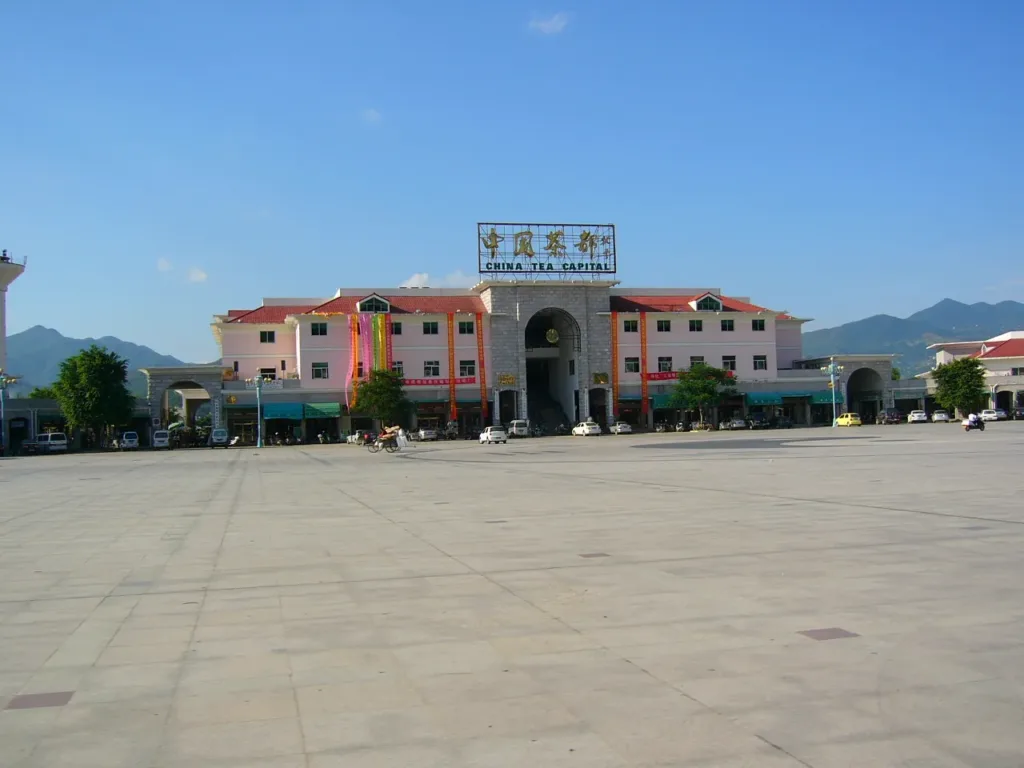
China Tea City gives the urban end of that chain a concrete setting. It is a working wholesale market, not a quiet museum. You can watch the rhythm of tea shops, compare how sellers describe origin and roast, and then travel out to the tea-country stops to see why the landscape matters. Ask before tasting or photographing inside a shop.
What to see
China Tea City(中国茶都;安溪全国茶叶批发市场)
The market was built in 2000 as a trading platform for Anxi tea. Later reporting still describes it as a live distribution centre rather than a heritage reconstruction, with tea from Anxi and other producing regions moving through the county.
The Ministry of Culture and Tourism’s Anxi route describes the market as about 250 mu in area, with roughly 180,000 square metres of buildings. Its first floor has three tea-trading halls; the second has a tea-art performance hall; and the third houses a tea-culture museum with sections on Chinese tea history, oolong tea, tea varieties and a large teapot collection. The useful visit is to notice the difference between commerce and interpretation: the lower floors are for buying and selling, while the upper display spaces explain the product and the tools around it.
Xiping’s Tieguanyin origin area(西坪铁观音发源地)
Xiping is a separate rural stop, not a second building inside China Tea City. The official tea-tourism route names Nanxuan Study, the Tieguanyin Science Museum and a tea-temple area where visitors may encounter the origin story, mother-tree lore and tea-making interpretation. County material identifies Yaoyang in Xiping as the home of the Tieguanyin tea variety and explains why the plant is considered delicate and difficult to grow.
Treat any picking, making or guided visit as an activity that needs a current local confirmation. The sources describe the places and their role in the tea story, but do not establish a current daily timetable or a universal visitor ticket.
Yunling Tea Estate(云岭茶庄园)
Yunling is another separate stop. It was developed from an earlier state-run tea farm and is valued for its tea gardens as well as for tea-picking, tea-making and tasting experiences described by the Ministry of Culture and Tourism. This is the landscape side of the visit: look at how paths, slopes and rows of bushes shape the experience, rather than expecting a single museum building.
Plan the visit
Use “China Tea City and Tieguanyin Tea Country” as a tea itinerary label, not as one walkable attraction with one gate. Start at the market in Anxi’s urban area, then arrange separate road transfers to Xiping and Yunling. The market-side roads identified in a 2026 Anxi government notice are Datong Road, Hebin South Road and Chadu Hebin Road; the notice treats China Tea City as a landmark building group and tea-trade zone, but does not identify a single tourist entrance.
For a taxi or ride-hailing car, show 中国茶都(安溪全国茶叶批发市场) and add 大同路、河滨南路一带,茶都广场方向 Dàtóng Lù, Hébīn Nánlù yídài, Chádū Guǎngchǎng fāngxiàng. On arrival, follow the current public-market signs to the trading halls or exhibition building. Do not give the driver only “铁观音茶乡”: that name covers the wider county and can send you to a different rural stop. There is no current source here for a single ticket office, a universal opening schedule or a fixed admission price, so confirm the particular hall or activity before making a special trip.
Anxi’s 2023 government bus guide lists K3 with stops at 茶都广场 Chádū Guǎngchǎng, 茶都公园 Chádū Gōngyuán and 明珠茶叶城 Míngzhū Cháyèchéng, and 101 at 茶都广场 Chádū Guǎngchǎng on the Anxi urban network. These are useful Chinese stop names, but the guide is dated and routes can change; check the live local notice before boarding. There is no verified metro connection for this county-market visit.
The passenger station to search on a rail ticket is 安溪东站 Ānxī Dōng Zhàn on the Xingquan Railway. Fujian’s railway authority lists it as a passenger-and-freight station, and a 2025 local report says Anxi East had local bus links on 7路、10路、K3路 plus taxi and ride-hailing connections. The local bus guide’s “动车站” end point is the practical Chinese label to compare with the live route; confirm that the current K3 service still reaches the market-side stops before returning. For a road transfer from Quanzhou, a 2025 report describes a coach/point-bus service between 安溪汽车总站 Ānxī Qìchē Zǒngzhàn and 泉州动车站(汽车北站). It is a coach terminal connection, not a train-platform transfer; check the current “泉运出行” or “滴滴出行” listing for times and seats.
For the return, use the same Chinese destination in reverse: 茶都广场/茶都市场北门 Chádū Guǎngchǎng / Chádū Shìchǎng běimén for the market-side bus area, 安溪东站 Ānxī Dōng Zhàn for a booked train, or 安溪汽车总站 Ānxī Qìchē Zǒngzhàn for the coach network. Do not assume a last bus, a tea-making session or an exhibition room will still be operating after a full day in the hills.
Find China Tea City and Tieguanyin Tea Country
中国茶都及铁观音茶乡 · 安溪县
No reliable map pin yet: search by the Chinese name.
Sources & visit information
Sources checked on 24 October 2026. Hours, tickets, reservations and transport can change; confirm with the operator before you go.
Image credits & notes (1)
- China Tea City (China Tea Capital) in Anxi County, viewed from its broad entrance plaza Photo: TakamaxaPhoto: Public domain